Wednesday, February 25, 2015

The Rise and Fall of Paramount Records

Paramount’s founders were owners of a Wisconsin furniture company who knew absolutely nothing about the record business.  Their big idea was to do everything as cheaply as possible.  And somehow, with great luck and a fair wind, they evaded impending bankruptcy to become the most important label in the race-records marketplace.

Cheapo-cheapo production principles had led them to use the least costly and most crappy crumbling shellac they could lay hands on.  So overcoming the extreme challenges of preservation and restoration is a great triumph. And the compilation, design and production of this two-volume archival history, by Jack White’s Third Man Records in partnership with Dean Blackwood & John Fahey’s Revenant Records, is a real labour of love.

Volume 1 covers the decade 1917-27.

Volume 2 covers the company’s final 5 years between '28 and '32.

There are 1600 tracks in total.

Of which this is the first tranche.

(Maybe the next ones should be smaller.)


Volume 1 - part 1   1.71 GigaBytes
https://mega.co.nz/#!TUYRwJzJ!h-WvdwmKZ9gMvn04OGObLKCwfH-SJvm4WsGFCTvHaLg

Tuesday, February 24, 2015

Albert King - King does the King's Thing

"Originally titled King Does the King's Thing, here's Albert King adding his own touch to a batch of Elvis Presley tunes. Because King's style is so irreducible, the concept actually works, as he fills this album with his traditional, high-voltage guitar work and strong vocals. That isn't surprising, since four of the nine tunes on here originally started as R&B hits covered by Presley, including an instrumental version of Smiley Lewis' "One Night." No matter what the original sources may be, though, this is a strong showing in King's catalog." Cub Koda

Friday, February 20, 2015

Lágbájá - Nigeria

Before chancing on a random torrent a few weeks back, I had heard none of this music, and the artist name of Lágbájá was new to me.  But I am now a fan and, out of the selection available to me for listening and study, these are the 26 tracks which hit me the best and the sweetest and the most serious.

Here’s what I have learned:

Our most effective English translation of the Yoruba “lágbájá” would be “anonymous”. Lagos-born Bisade Ologunde adopted it as his name on behalf of the faceless and voiceless, and performs in a mask to underline his identification as: 'The man without a face who speaks for the people without a voice'.

Like his old friend Fela Kuti, he presents political and social comment using a colloquial urban blend of English and Yoruba, adding costumes and production design that make connections to the ancient tradition of Egungun – the ancestral spirits who guide the people towards peace and truth.

The music uses singers and western horns, with guitars and keyboards, over a central percussion ensemble of traditional drums, and mixes traditional Yoruba music with Afro-pop styles of juju, west-coast high-life, and Fela’s afro-beat, all blended together with large dollops of funk and jazz.

Also like Fela, Lágbájá plays saxophone – only much better.
(Thankfully.)

And I greatly respect and appreciate the triumph of Yoruba roots and the rhythm culture of interlocking interdependence over the simplifying tendencies of western pop, and how – even in his most contemporary incarnations of Quincy-Jones-standard modernity – the traditional remains central.   “Konko Below” for example, which I think for some reason might be the most recent track here, is one which flirts easily with a style cliché or two out of rap/R&B convention, yet still it is impossible to deny the Yoruba drums pulsing at its heart.

But it seems as if the current ascendancy of the hip-hop aesthetic, driven by the rise of Naija nu-stars like 9ice or 2 Face Idibia or Terry G, may have re-cast the masked-one now as old-hat.  A musicologically principled distance from the more faddishly en vogue currents, together with his pecuniary frustrations over the encroachments of technology and free-downloading, might help explain why he seems to have released little these days.

With performance success in Ghana, France, Brazil and Britain, a chance for the international market that all African artistes hunger for, and an AllMusic.com biography which has him “based in Manhattan”, he has been subject to critique based on an expatriate absence which he denies, claiming to be always home in Lagos where - also vaguely reminiscent of Fela - he has a club.

His club-concept is named Motherlan’ and aims to follow village-square traditions of being a community gathering-place for a range of artistic and devotional events like dance, and story-telling, and ceremonies in the moonlight.

There is YouTubery under the same name.
You should check it out.

Lazz’s Lágbájá Collection (at a dissatisfying mixture of low and lower kbps, but the brilliance of the music still shines through) 
187.2 MB 
https://mega.co.nz/#!WVAB3a4A!B9o3vg9Kh9Xai6MIPD-Q1IMQEyooh6y5zwQJUGnHkio

Original R&B - Smokin', Drinkin' and Messi' Around


Tuesday, February 17, 2015

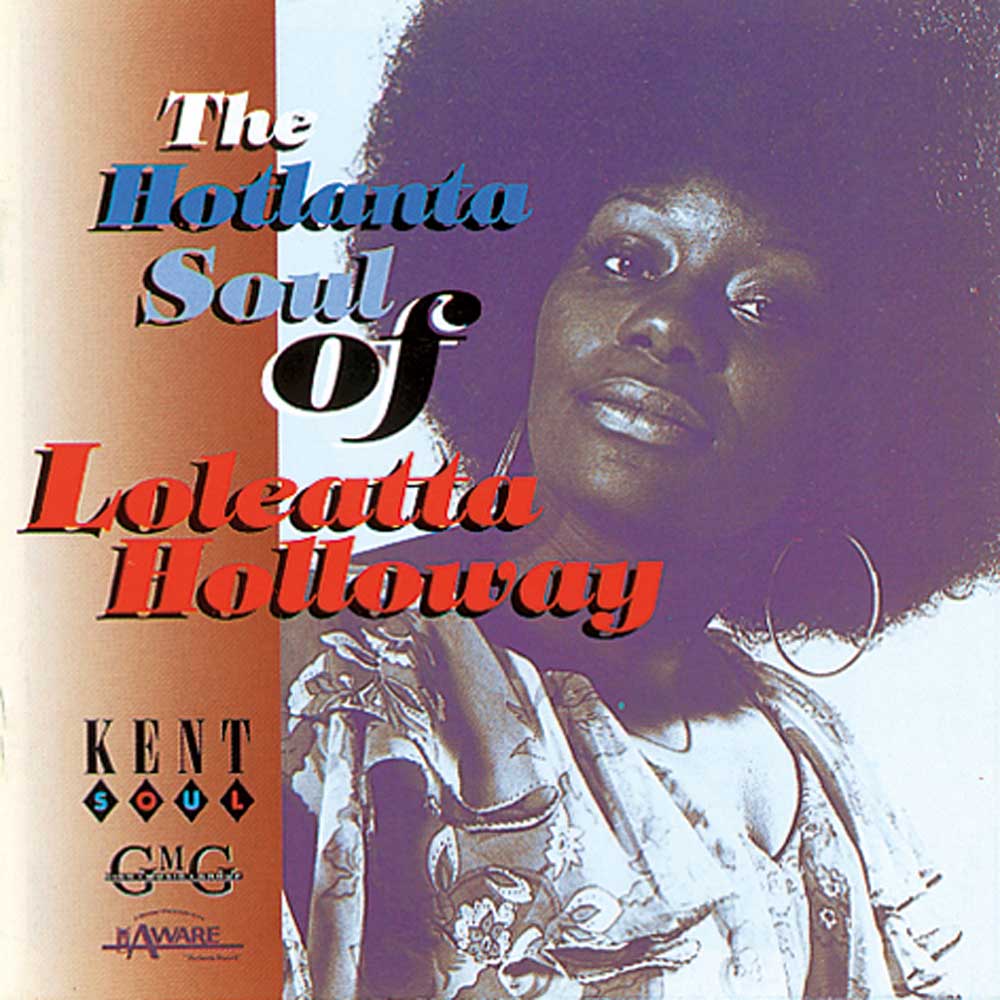
Loleatta Holloway - The Hotatlanta Soul of Loleatta Holloway

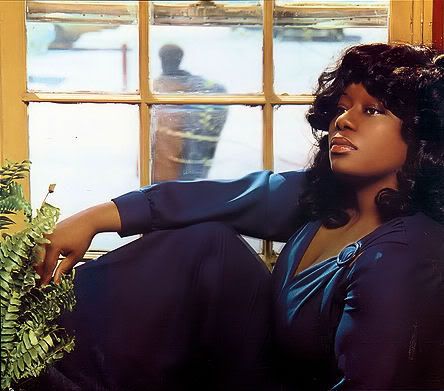
Loleatta Holloway is probably still best known to the public as one of the disco queens of the 1970s.  But that part of her career might soon be forgotten.   Fortunately, Ms. Holloway had the opportunity to document her real vocal artistry under close to ideal circumstances during the early 70s before the dark cloud of disco descended on the world of Soul.   This work, mostly recorded in Atlanta and often under the production of Sam Dees, stands as a timeless testimony to one of the truly great soul divas, a soul diva who almost came along too late. 

Loleatta Holloway was born in Chicago in 1946 and began to sing gospel at an early age.  Her vocal prowess pushed her up in the ranks of gospel music very quickly; she became a member of none other than the Caravans in the 1960s, and then worked the programs successfully as a solo artist.   Her crossover into secular music came with the acceptance of an offer to play the starring role in a Chicago musical - "Don't Bother Me, I Can't Cope."   Her first secular recordings (included here) were produced by her husband and manager, Floyd Smith: Rainbow '71, For Sentimental Reasons, Bring it On Up.

Her first 45 and live performances got noticed right away, and Michael Thevis soon took her to the Hotatlanta Studio where she recorded the remaining tracks on this compilation for Aware records.    Here we have a fortunate combination of mostly high quality songs and production (often Sam Dees) and a great soul diva at the height of her powers.

Sadly, we lost Loleatta Holloway prematurely in 2011.  This is her recorded legacy that will live forever.  


Sunday, February 15, 2015

Orchestra Baobab - Senegal


Orchestra Baobab was the multi-ethnic house-band of the Baobab Club in Dakar right from when the elite room opened in 1970 until the joint went dark in 1979 – by which time they were established as Senegal’s most popular band.

Sounds and styles from the Caribbean had already been embraced throughout west Africa since the ‘50s, and the special accent of Orchestra Baobab came from their adoption of Cuban instrumentation and rhythmic styles parsed through the individual roots and origins of a polyglot membership.

Balla Sidibe and Rudy Gomis, for example, are from the southern forest region of Casamance and harmonise in Portuguese creole, while the northern Wolof griot vocal style of Ndiouga Dieng replicates that of his predecessor Laye M’Boup, killed in a 1975 car crash,  and Medoune Diallo’s is the voice we hear singing in Spanish.  Sax-player Issa Cissoka and drummer Mountage Koite are both from Mande griot families - Cissoko from Mali, and Koite from eastern Senegal – and bassist Charlie N’Diaye is from Casamance in the south.  On lead guitar, Barthelemy Attisso is from Togo, and rhythm guitarist Latfi Ben Geloume is from a Moroccan family exiled to Senegal’s Saint Louis.   Baro N'Diaye, the original saxophonist-leader of the group, seems to have been plain ordinary French-Senegalese – as was singer/percussionist Mapenda Seck.

“Baobab à Paris” is indication of the reach of their appeal into France, where there is a large expatriate community - and yet, shortly after the Baobab Club’s closure and then on through the ‘80s, audience tastes back home in Dakar began turning to the grittier sounds of bands like the Etoile de Dakar (featuring a young Youssou N'Dour) and the popularity of Orchestra Baobab began to wane.

In 1987, the band split up.

“Pirates Choice” was recorded in 1982 and released on cassette.  A vinyl version was later released in France and quickly became a sought-after cult rarity which came to the attention of the World Circuit label, who re-released it in 1989 as a double CD packaged with extra tracks.

The solid success of the re-release right across the label’s niche network meant there was an audience for live performance strong enough to sustain international touring if only the band were still in existence.  African performing artists all desire to achieve success on a world stage, though – so perhaps it was not really very hard at all, especially with the intercession and support of Youssou N’Dour, for World Circuit in 2001 to persuade the band to reform for tours of Europe and the United States and a new CD.

“Specialist In All Styles” was released in 2002 – twenty years after “Pirates Choice”.

The band are still the same guys.  Pretty much.  Thierno Koite, perhaps a relative of the drummer Mountaga Koite, replaced Baro N'Diaye, the original sax-player.  And Assane M’Boup, who may similarly be kin to original singer Laye M’Boup, replaced Mapemda Seck.   Only two personnel changes between them.  Plus, on the new one, we have guest performances from producer Youssou N’Dour, from Ibrahim Ferrer, and from Thio M'Baye on sabar drums.

The singing is beautiful and all of the music is absolutely made for dancing.

Baobab à Paris Vol 1 On Verra Ca (1978) - 320kbps 52.4 MB

https://mega.co.nz/#!7RIGzb5B!1SLPrClFptq_dDd-mC9-qInaDUgE2DzI89QVyrb7Ioo

Baobab à Paris Vol 2 Africa '78 (1978) - 320kbps 52.4 MB
https://mega.co.nz/#!PFZG2BYJ!cgvL31u96DqQddDQB-QP-B3iHKWn-smoadQXiJ3cZdQ

Pirate's Choice- The Legendary 1982 Session Disc 1 (1982) - 320kbps 94.7 MB
https://mega.co.nz/#!XMoU3A7Y!oK4QbcDB_LdgjQuYzrHArogOOYZsVuOeeT0BLs1huM0

Pirate's Choice- The Legendary 1982 Session Disc 2 (1982) - 320kbps  94.0 MB
https://mega.co.nz/#!fEBzxJRA!urO-vZH3lbge5xNcCCdRXTN1EVNQzrGGzujA7grB-1g

Specialist In All Styles (2002) - 192kbps  68.5 MB
https://mega.co.nz/#!acJxXQjS!wi1byg77U_CaMLpqUCUuauZtJ9qV2wtw8j8WQnSTeGg

Thursday, February 12, 2015

Tony Allen - Film Of Life

"For his tenth album, Tony Allen, the co-creator of Afrobeat, has pulled out all the stops. At his side are French producers The Jazzbastards and fellow world-class musicians including Damon Albarn (Gorillaz, The Good the Bad & the Queen, Blur). With Film of Life, Allen has produced an album that has the ring of a true self-portrait, offering an overview of his rich and exemplary career that brings together bebop, Afrobeat jazz and psychedelic pop."

" A sleek, sensuous, wildly diverse album from an old master. Building from the old Afro-Beat sound he helped create, Nigerian-born drummer Tony Allen shifts and arcs into heavy dub and clubby funk, off-kilter pop and artsy, Eno-esque electronica... It's smooth, multi-textured music that feels in turns joyful and dark, playful and forboding, and consistently wickedly creative. Currently pushing 75, Afrobeat elder Tony Allen is still very much in the groove, and this is a fine album, very listenable and enticing. Recommended! (DJ Joe Sixpack, Slipcue Guide To World Music)"

The RPM Blues Story

RPM was a subsidiary of Modern Records, one of the major blues and R&B labels of the '50s. One Day's 2014 compilation The RPM Blues Story focuses on the imprint's best blues sides, with everything recorded in the late '40s and '50s. Lots of big names -- B.B. King, Lowell Fulson, Howlin' Wolf, Lightnin' Slim, Johnny "Guitar" Watson -- are present on this collection, all doing raw, vital work that is matched nicely by the lesser-known names here. It all results in an excellent (and affordable) primer on one of the best R&B/blues labels of its time. AMG

Saturday, February 7, 2015

Washboard Sam 1935 - 1947

Whether Washboard Sam really was a half-brother of Big Bill Broonzy (and his 17 or 18 brothers and sisters) as is often claimed, is relatively unimportant in the face of the role he himself played as blues pioneer.
Born as Robert Brown in Arkansas in 1910, Washboard Sam is one of the great black musicians, singers and lyric composers of the pre-1945 period, without whom the developments in rhythm & blues in Chicago, the blues capital of the post-war years, would scarcely have been imaginable. Sam came to Chicago in 1932, played a little washboard and sang, and soon found himself with an exclusive contract with Bluebird, the label under which the Victor company (now known as the Bluebird Record Company) managed to make a business out of country blues in the 1930s. Washboard Sam and
Big Bill Broonzy made a considerable contribution to this success. They gathered together a whole group of instrumentalists for their recording sessions including pianists such as Roosevelt Sykes, Bob Call (Black Bob), Joshua Altheimer and even at this stage, electric guitarists such as George Barnes. Washboard Sam wrote the music and lyrics of both humorous and melancholic melodies; however those that are most loved have always been the ones with the most swing to them. The wide choice of titles available cover the entire range of his musical ideas and achievements. After the War, sales of records produced by the 'older' blues generation, i e that of Washboard Sam, Big Bill or Tampa Red began to drop and were increasingly replaced by the new, more aggressive recordings by artists such as Muddy Waters, Lightnin' Hopkins or B B King. In 1946, Washboard Sam withdrew from the overheated, unpredictable music scene of Chicago. He became a policeman with a ...'quiet family life' (S B Charters) which he only interrupted for a few recordings in 1953 and 1954, and a European tour in 1964. Washboard Sam died in 1966 following heart failure. (From sleeve notes)

Note : 18 tracks 17 of which appear on CD for the first time - CD cover has error missing out the number 12 and showing a jump from 11 to 13 !!! Sloppy !!!...Full personnel etc shown in scans  

New Orleans Soul - The Original Sound of New Orleans Soul 1960-76

Another interesting comp from the Soul Jazz folks. Much of it is stuff many will have, but even for me there are a number of things I hadn't encountered yet. Worth the effort.

" For more than ten years Soul Jazz Records have been exploring and documenting the sound of New Orleans Funk. Now they turn their attention to the flipside of this musical coin - New Orleans Soul.

These two musical forms share a lineage that begins with the city's enormous rhythm and blues explosion in the post-war 1940s and 1950s. New Orleans Soul incorporated the soulful vocals of the gospel church, the driving beat of rhythm and blues, as well as traces of the second-line parade bands and the latinized rhythms of the city.

Here you will find New Orleans soul in all its glorious variations from the deep, deep soul of singers Aaron Neville, Willie Tee and Robert Parker to the storming northern soul of Maurice Williams and Eldridge Holmes, the funky soul of Eddie Bo, Lionel Robinson and Ernie K-Doe all alongside the Crescent City's finest soul sisters Irma Thomas, Betty Harris, Jean Knight, Inell Young and more!

The main force behind New Orleans Soul is Allen Toussaint, a virtual one-man hit-making machine in the 1960s, writing, arranging and producing hit after hit for an unending list of unbelievably talented local singers such as Eldridge Holmes, Maurice Williams, Betty Harris, Ernie K Doe and Diamond Joe all of whom are featured.

New Orleans is also a city of great musical families. Vocalist Aaron Neville was the brother of Art Neville (who formed The Meters) and later in the 1970s joined with brother Cyril to form The Neville Brothers. Soul vocalist supreme Willie Tee is also known as Wilson Turbinton, who alongside brother Earl, formed the super-heavy funk band The Gaturs and backed the Mardi Gras Indian group The Wild Magnolias.

Also included here are rare, lost and killer soulful tracks from New Orleans artists Eddie Bo (and protégée vocalist Inell Young), Jean Knight, Jimmy Hicks, Francine King and more!"

Friday, February 6, 2015

Muddy Waters - With Little Walter: 1950-1952

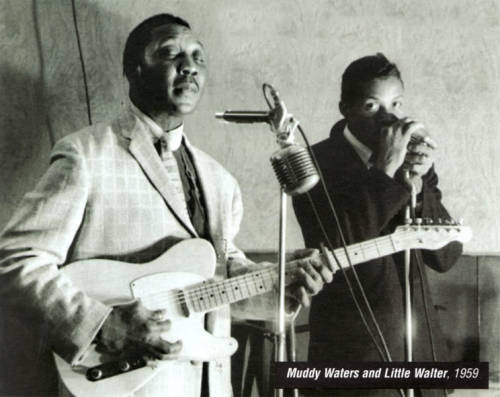
When most people think about the legacy of Muddy Waters, the first songs that come to mind are probably those macho Willie Dixon-produced shouts from the mid-1950s: Hoochie Coochie Man, Mannish Boy, I'm Ready, I Just Want to Make Love to You, Got My Mojo Working, etc.   But as far as I am concerned, the pinnacle of Muddy Waters' recorded output unquestionably lies here, in the records that he made with Little Walter in the early 50s before Willie Dixon entered the picture.  This is Muddy Waters playing his own music his own way in a manner that helped mold the evolution of Chicago and Mississippi blues in the 1950s and beyond.   It just doesn't get any better than this.  If I could only own one blues collection, I would choose this one.   I can't begin to describe here how much satisfaction and inspiration these recordings have given me over so many years.

I took these recordings from two sources:  The first 22 tracks come from the 2-CD set, The Anniversary Collection, released on Chess (MCA) in 2000.  The final 3 tracks come from the Hip-O-Select collection "Hoochie Coochie Man."  Together they present all of Muddy Water's recordings from June, 1950 to the end of1952.   The first session here marks the time when Leonard Chess finally honored Muddy's wish to allow him to record with Little Walter, and the result marked a milestone in recorded blues history.  (Parkway records had already recorded the two together in 1951, but Muddy Waters was essentially confined to guitar accompaniments for contractual reasons.)  Little Walter is co-featured on almost all of these tracks, although many believe that it is actually a teenage Junior Wells who takes care of the mean harp work on the last four tracks.  Jimmy Rogers is also present on many songs in this collection.

There are no weak tracks here (IMO), and the number of masterpieces is mind boggling:  Long Distance Call, Honey Bee, Louisiana Blues, She Moves Me, Still a Fool, Too Young to Know, Standing Around Crying, Iodine in My Coffee to name a handful.   I will stop here at the risk of sounding too fanatical.  When it comes to Muddy Waters, I am indeed a fanatic, and these recordings are IT for me.     


Wednesday, February 4, 2015

Irma Thomas - A Pair of Recovered Jewels

 In the past couple of years we have been treated to not just one but a pair of lost Irma Thomas albums from the early 70's finally seeing the light of day in the CD era. Irma had left New Orleans and, for a couple years, music following 1969's hurricane Camille. By late 1971 she began a comeback, signing to Atlantic Records, seemingly her shot at the big time. For some reason Jerry Wexler never chose to release Thomas' Atlantic/Cotillion recordings - there is some speculation that Aretha's management may have had some hand in that, but I'd also offer the thought that Wexler may well have been using Irma as leverage with Aretha. Wexler would have done anything to prevent losing Aretha the way he lost Ray Charles. These recordings would be have been made in 1971 & 1972.
As soon as she finished her Atlantic contract Irma signed with Jerry 'Swamp Dogg' Williams to his Fungus label in 1973 and made this strong album of Southern Soul with Duane Allman and others from the Muscle Shoals musician circle. I had heard of this record, but had never seen it until it's reissue a couple years ago.

Monday, February 2, 2015

Original Soundtrack Recording Of Catch My Soul

If you have never heard this...well...YOU SHOULD!! I don't exactly recall where I got this marvel, but since I sort of recall extracting it from either comments or a chat box, my best guess would be Twilight Zone blog - whom-so-ever that original uploader may have been -- THANK YOU!!


Sunday, February 1, 2015

Freddie King - Burglar (1974)

Freddie King has always been one of my favourite Blues artists. I love all of his recordings, starting with his Federal/King classics ('Have You Ever Loved A Woman', 'Hideaway' etc) 2 albums for Atlantic/Cotillion, 3 for Leon Russell's Shelter Records and his final album 'Burglar' for RSO in 1974. He died way too early, of acute pancreatitus, on 28th December 1976 at the tender age of 42.
'Burglar' remains my favourite Freddie album as , to me,  it catches his raw and gritty guitar and vocals like no previous recordings. At the time of release, critics had mixed responses...Why ?...It may be that most of the sessions were recordrd in the UK with some fine players including the great Steve Ferrone on drums and/or it was full of Funky grooves  that some purists found unpalatable...Humbug !!!...

I cherish the feel of these recordings and have no reservations recommending 'Burglar' to my fellow Chitlins pals here...
Give it a spin and enjoy Freddie doing his Thing ! The track 'Sugar Sweet' was recorded in Florida and features Eric Clapton's band of the time - Full personnel is included in the scans

Tracks : 01 Pack It Up 02 My Credit Didn't Go Through 03 I Got The Same Old Blues 04 Only Getting Second Best 05 Texas Flyer 06 Pulp Wood 07 She's A Burglar 08 Sugar Sweet 09 I Had A Dream 10 Come On (Let The Good Times Roll)

Saturday, January 31, 2015

Millie Jackson - Live and Uncensored

Mildred "Millie" Jackson (born July 15, 1944) is an American singer-songwriter and comedienne. Three of her albums have been certified gold by the RIAA for over 500,000 copies.

Her vocal performances are often distinguished by long, humorous, and explicit spoken sections in her music, which she started doing on stage to get the attention of the audience. She has also recorded songs in a disco or dance music style and even some country styled songs. She is the mother of Keisha Jackson.

Born in Thomson, Georgia, Jackson is the daughter of a sharecropper. Her mother died when she was a child and subsequently, she and her father moved to Newark, New Jersey. By the time Jackson was in her mid-teens, she had moved to Brooklyn to live with an aunt. She occasionally worked as a model for magazines like JIVE and Sepia.

Jackson's singing career reportedly began on a dare to enter a 1964 Harlem nightclub talent contest, which she won. Although she first recorded for MGM Records in 1970, she soon left and began a long association with New York-based Spring Records. Working with the label's in-house producer, Raeford Gerald, her first single to chart was 1971's deceptively titled "A Child of God (It's Hard to Believe)," which reached number 22 on the R&B charts. In 1972, Jackson had her first R&B Top Ten single with the follow-up, "Ask Me What You Want", which also reached the pop Top 30, then "My Man, A Sweet Man" reached #7 R&B; all three hits were co-written by Jackson. "My Man, A Sweet Man" retains its popularity today for northern soul enthusiasts and is played on the radio in the UK and quoted as an example from this musical genre as is her 1976 recording, "A House for Sale". The following year brought her biggest single success and her third Top Ten hit, "It Hurts So Good," which made #3 on the R&B charts and #24 on the Billboard Hot 100 pop chart. The single was featured on the album of the same name and in the blaxploitation film Cleopatra Jones, also appearing on that film's soundtrack along with the song "Love Doctor".

In 1974, she released the album Caught Up, which introduced her innovative style of raunchy rap. The featured release was her version of Luther Ingram's million-seller, "(If Loving You Is Wrong) I Don't Want to Be Right", for which she received two Grammy nominations. By now, she had switched producers to work only with Brad Shapiro, recording at Muscle Shoals Studio in Alabama with the renowned Muscle Shoals Rhythm Section. She continued to record most of her material for Spring there, including the follow-up album, Still Caught Up.

Over the next ten years, Jackson had a string of successful albums and numerous R&B chart entries, the biggest being her 1977 version of Merle Haggard's country hit "If You're Not Back In Love By Monday". That hit single was followed by many more, including her version of the Boney M. song, the disco single, "Never Change Lovers In The Middle of The Night." This single peaked at #33 on the Black Singles chart in 1979.

Jackson recorded an album in 1979 with Isaac Hayes called "Royal Rappin's" and the same year saw her release a double album, "Live And Uncensored", recorded in concert at Los Angeles venue, The Roxy. Jackson also formed and produced the group Facts of Life. They had a major hit in 1976 with "Sometimes" (#3 R&B, #31 Pop). wiki

Wednesday, January 28, 2015

Soul Gospel Vols. 1 & 2

Kind of an odd compilation pair from Soul Jazz Records. The first volume in particular is oddly constructed and I'm not clear what their vision was, still there are plenty of tasty tracks and a fair number of Gospel tracks that I didn't have anywhere else.


Sunday, January 25, 2015

Ebo Taylor - Love and Death

Much of the story of African popular music since World War II concerns African-rooted musics from the New World coming back to the Mother Land and inspiring Africans to fuse these sounds with their own traditional musics.   The sound of hard funk, as developed by James Brown and Sly Stone in the 1960s, became hugely popular in West Africa.   Afrobeat was essentially created by the great Fela Ransom Kuti, a Highlife band leader from the South West of Nigeria, who spent time in the US in the 1960s absorbing and integrating the Brand New Bag with Highlife.  There exist fascinating recordings from this period that illustrate the sound in embryo.

Afrobeat quickly moved from Nigeria to the neighboring countries of the Benin Republic, Togo, and (especially) Ghana.  Ebo Taylor was one of the first Ghanian artists to popularize and develop Afrobeat in that country, adding to that his own distinctive mix of fusion of Highlife with Funk and Jazz.  He established that sound not only through his own recordings, but through producing many other top Ghanian artists. 

Ebo Taylor is still alive and very much active.  This is his seventh decade of activity!  He was already a working professional musician in the 1950s, and was already leading his own band in the early 60s.  He first came into contact with Fela Kuti in 1962 while residing temporarily with his band in London.   His classic recordings from the 1970s and 1980s were reissued not long ago on a highly recommended package: Life Stories: Highlife & Afrobeat Classics 1973-1980.  

Following this period, Ebo Taylor kept a rather low profile on the music scene for a while, but became active again in the first decade of the new century, culminating in his triumphant Love and Death album, which is posted here.  This is pure Ebo Taylor with a crack band.  Fine music!

Ebo Taylor moved to London a few years ago to pursue his career further there.   When I moved to Nigeria, he was still working and playing the clubs in Accra, Ghana.   I had a chance to see him and meet him there, and the experience was unforgettable.  Enjoy!


Friday, January 23, 2015

Bo Dollis and the Original Wild Magnolias

Not only the greatest Mardi Gras Indian albums ever made, but some of of the most seriously bad-ass funk ever played anywhere. The Turbinton brothers band, known both as the New Orleans Project and the Gaturs, absolutely DESTROY it on both records; first with Snooks Eaglin on guitar and Julius Farmer on bass, then with Guitar June (not the Japanese guy) and Ervin Charles on bass for the second album. Farmer and Charles were two of the funkiest bass players EVER. (George would be the first to agree) Of course leading the show here on some of the most revolutionary music ever played in New Orleans is the great Bo Dollis at the height of his powers. This is how he will always sound in my mind's ear; rest in peace my big chief.

Thursday, January 22, 2015

Bo Dollis & the Wild Magnolias - I'm Back at Carnival Time!

I hadn't noticed before just how square the review sounded.

''Bo Dollis, New Orleans' most popular "Indian" chief, has been heading the Wild Magnolias since 1964. His fiery, flamboyant, charismatic style is ideal for the backdrop of Mardi Gras. He's an exuberant vocalist, equally gifted at rousing chants, energetic up-tempo tunes, or even more traditional gospel-tinged soul. This session featured Dollis and the Wild Magnolias backed by a great set of session musicians and, at times, the Rebirth Brass Band. This links the Indian performing tradition with Crescent City blues, R&B, and vintage jazz sensibilities, resulting in several superb, roaring performances. The best in both Mardi Gras and contemporary/classic New Orleans fare."

Millie Jackson - On The Country Side

I am taking some degree of malicious glee in using THIS album as my first Millie Jackson post. Of course if this is your first exposure, then YOU are one of those having the friendly joke played on you. In others words, this album is nothing like your average release from this Chitlin Circuit Queen.

"The Bitch Is Back

Rock and roll from the ‘50s was credited with mixing white musical styles, such as country and pop, with black music, such as R&B and gospel. However, by the early ‘70s, the genres had separated. Classic soul and country rock were being created with little ethnic intermixing, which reflected what was going on in the larger society. But the truth is country and soul came out of the same Southern places before rock even existed, and the influence the two had on each other has always been clear to discerning listeners.

Consider Millie Jackson. Her deep soul albums of the ‘70s, such as It Hurts So Good, Still Caught Up and Feelin’ Bitchy, contained a country leavening in the way Jackson accentuated the language and phrased her way across a melody, not to mention the fact that she frequently covered country songs on these albums. There was also something about her attitude. You couldn’t call her a redneck, but then again she retitled “Redneck Crazy” as “Black Bitch Crazy” on the one new song on this collection. They are pretty much the same things.

Anyway, it should not seem a surprise that Jackson released a straight country record back in 1980 called Just a Li’l Bit Country. She covered such deliciously emotive material as Don Gibson’s “I Can’t Stop Lovin’ You”, Tammy Wynette’s “Till I Get it Right” and Howard Harlan’s “Pick Me Up on Your Way Down”. She also, for some reason, included a few non-country items, such as Neil Diamond’s “Love on the Rocks”. The album flopped, which Jackson attributes to personnel changes at the record company. That may be true, but the original album was spotty and not all the songs top notch.

Which is probably why there are only five of 10 Just a Li’l Bit Country tracks included on the recent anthology of Jackson’s country music, mostly recorded between 1977 and 1981, featured on The Soul Country Collection. The 17-cut collection contains some real gems, including her 1977 top 10 soul cover of Merle Haggard’s “If You’re Not Back in Love By Monday” and the 1978 top 40 soul hit version of Kenny Rogers’ “Sweet Music Man”. These work because Jackson takes these songs straight on. There is nothing gimmicky about them.

Less successful are the more disco-fied and less sacrosanct covers, like Barbara Mandrell’s “Angel in Your Arms”. She camps it up too much, and the instruments blare over her voice in a lackluster arrangement. Mitchell’s too good to have to be trendy to succeed. Sure, it may be fun to change Kris Kristofferson’s bawdy “Anybody That Don’t Like Hank Williams” into the irreverent “Anybody That Don’t Like Millie Jackson”, but the joke wears thin before the song is over.

Jackson’s a major talent who doesn’t always get her due because she often performs blue. That was and is her trademark, but there is little of that here. Instead, this disc offers a chance for listeners to hear a neglected side of an overlooked artist. Soul lovers may revel in the already available classic albums from the past, but there is much to offer music fans here." By Steve Horowitz 6 November 2014

Tuesday, January 20, 2015

Bo Dollis & the Wild Magnolias - 1313 HooDoo Street

New Orleans looses another giant today - the greatest Mardi Gras Indian singer the world has ever known has passed, but we will never forget him. Thankfully his manager Glen has kept his promise to Bo and made sure that he leaves us a strong recorded legacy - I imagine that at least one or two more will appear in the next couple of years.

Oddly enough, despite the cover, this one is not primarily a Mardi Gras Indian album; at least not to the degree that most other Mags albums are. On this album arranger Wardell Quezergue chose to focus on Bo Dollis as a New Orleans R&B singer.
 The song choices are unlike any other Bo Dollis album and the results?.......check it out, it is one of MY favorites!

Sanctified Soul

Utilizing the sledgehammer principle, we've started this CD with the Soul Clan, the only serious attempt to form a soul super-group in the 1960s. The group members were Messrs Conley, Burke, Covay, Tex and King who perform well on a good southern soul style ballad, That's How It Feels, without shaking the world, but neatly serving as an appropriate antipasto for the delicacies to come.
As individuals, Conley, Burke and Covay get the chance to serve up their own creations later on in the CD and in fact it's the latter, Don Covay, who provides the 1968-recorded I Stole Some Love. It's a great storytelling slowie, complete with rap and a Here Comes The Judge style interjection.
The overall feel of this CD is 'slow and moody' done the way Atlantic specialized in their Southern-influenced 1960s heyday. Particular highlights of this genre are the Soul Brothers Six with Can't Live Without You, James Carr's later 1971 offering I'll Put It To You, Ted Taylor's Feed The Flames, a fine Dan Penn and Spooner Oldham song and Judy Clay's tortured Greatest Love. Hardcore Southern soul fans will be excited by the appearances of Herman Hitson and Ben and Spence and Rudy Mockabee's interpretation of Roy Lee Johnson's Cheer Up (Daddy's Coming Home).
Being Kent and renowned for our catholic tastes we've also featured some appropriate social commentary from Sam Dees and JP Robinson who tackle the drugs problem and the political repression so relevant to their own black constituencies.
Stylistically we've also represented Atlantic's home town, NYC, with cultured offerings from ex-Drifter Rudy Lewis and Lee Jackson's Ad For Love with its strong doo wop influences.
We end on the beautiful and relevant Time To Say Goodbye from Bettye Swann, a Southern girl whose career started in LA, moved to the mid-south with great critical acclaim and cut this and some of her finest recordings in Philadelphia. It's from 1974, a point where over-production was selling soul music short, but the best, like this, was combining the experience and pedigree of a great singer with the newly acquired recording techniques, in an appropriate, learned and respectful manner.
Finally Dave Godin has added some incisive and enlightening sleevenotes to complement the terrific sound reproduction achieved by our own Sound Mastering post production studios, who got to work on some fabulous Atlantic tapes. -Ady Croasdell, Kent Records

Monday, January 19, 2015

Bill Brandon - On the Rainbow Road

...and now back to the Chitlin' Circuit. 

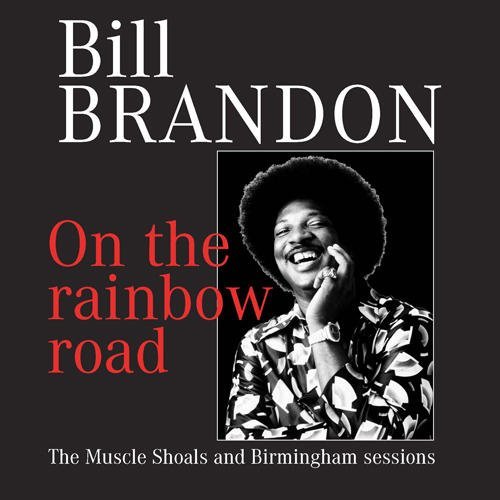
Bill Brandon is one of those great voices from the shadows who recorded a number of fine 45s in the 1960s in Muscle Shoals and Birmingham.  Some of those singles pop up regularly on Southern Soul collections.  But Soulscape did us a big favor not long ago by bringing the majority of his 60s work together in one dynamite compilation: On the Rainbow Road.

Bill Brandon is himself from Alabama.  He began his recording career in Muscle Shoals for the Quinvy label, under the management of the legendary Quin Ivy.  He moved from there to under Sam Dee's umbrella, continuing to record in Alabama.   Sir Shambling provides a nice essay with some additional information on Bill Brandon:   http://www.sirshambling.com/artists_2012/B/bill_brandon/index.php

If you like good Southern Soul, it is hard to imagine not liking the music on this disc.  Bill Brandon is particularly effective at delivering slow ballads in the classic manner.   Add to that generally high quality songs and top production - and you have yourself a winner. 

Sunday, January 18, 2015

Terry G - G.Zuz

This one is for Lazz.   He asked for some modern Hip-Life from West Africa that fuses Hip Hop and Highlife.   I consider this recent offering from Terry G to be prime product of that kind, and it is also a good representation of the grooves that are currently rocking the club scene in Nigeria.   You will hear a strong influence of Reggae (Ragga) here, as well as Highlife and Hip Hop.  I apologize in advance for the sound quality.  The legit CD market in Nigeria has crashed, and CD collections like this one are only sold on the street.  That is where I bought this.   Some tracks come through better than others.

The history of this music in Nigeria really goes back to one individual: 2face Idibia.   By the late 1980s, young Nigerians had turned away from the popular musics of the 60s and 70s (Highlife, Juju, Fuji, Afrobeat), and were grooving in the clubs almost exclusively to foreign Hip Hop and Reggae.   2face launched a distinctly Nigerian approach that incorporates the feel and techniques of Hip Hop with local music sensibilities and Highlife.  The last two decades have witnessed an explosion of this type of music.  While young Nigerians still listen to the latest foreign Hip Hop sounds, their preferred dance music is now made in Nigeria by people like 2face, P-Square, Flavour, D'Banj, Kcee, and Terry G.  

Terry G. comes from Benue State, and cites 2face as his idol and inspiration.   He has a particularly rhythmically charged approach to modern Nigerian music that fuses rap and singing in a seamless way somewhat similar to Ragga in Jamaica.     Nigerian crowds can be very hard to please, however.   Last year, Terry G performed for his fans in Benin City.  Some were not pleased with the the length and depth of the concert.  So they rushed the backstage area and beat Terry G to a pulp.  He had to recuperate in the hospital for some time.

This is not cerebral music.  It is intended 100% for getting your backfield in motion, or as they call it in Nigeria - shake yo bum bum.    Terry G will knock you, Apako!

A Gospel Blues Morning, Volume 2

The first of these was so well received that I couldn't resist going to this well again with quite a few artists not in the previous collection. There is around 90 years between the oldest songs here and the newest.

Loaves & Fishes - 18 Inspirational Songs From Gospel's Golden Age

 Time for for Sunday church brothers and sisters. I find hardly a mention of this excellent compilation out there on the internet so I guess Deacon Kingcake will have to supply a word or two.

For those who enjoy having some Gospel around but aren't interested in a large collection of individual artists' material, these compilations are perfect. Ace has put together a very enjoyable disc here; it is hard to question any of the inclusions, all are first rate.

The majority of these recordings come from the Specialty label, although you'll be hard pressed to read the back information which some 'arty' genius decided to do with orange and yellow printing on an orange field, thus rendering it nearly illegible. (a pet peeve)


Saturday, January 17, 2015

African Brothers Dance Band (International)

Perhaps Preslives can tell us more, but this seems to be a seminal 'Highlife' album. The band formed in the early 60's as teenagers and went through many transformations prior to this, their first LP. They were one of the first African bands to tour the U.S. and Canada in the same year (1970) that they did this album.
read a more extensive history here

Thanks to Daver88 for the link to the groups' site.

Sir Warrior and the Oriental Brothers International - Heavy on the Highlife!

Highlife is the backbone of popular music forms in Nigeria and Ghana, and also had a strong influence elsewhere in Africa.   Highlife originally came to prominence in Ghana in the late 40s and early 50s in large dance bands that were highly influenced by the Afro-Cuban orchestras of the time.  Soon different ethnic groups in West Africa were creating their own types of highlife based on local rhythms, often in smaller bands that featured guitar more prominently. 

In South West Nigeria in the 1960s, early Highlife morphed into the two branches of Juju and Afrobeat.   In the South East of Nigeria, populated by the Igbo people, Highlife developed on a different path with a strong incorporation of local "folklore."   In the 1960s, Chief Osita Stephen Osadebe became the recognized King of Igbo Highlife.  Already in the 1970s, however, the Oriental Brothers International were competing for this crown.  Their highly rhythmic stripped down guitar-based version of Highlife took over the dance floors.  To this day, the music Sir Warrior and the Oriental Brothers remains in high favor among Nigerians from the South East.   It was often the dominant sound at the Igbo owned "bush bars" in Abuja that I frequented almost every weekend over the last four years.  One of these bands was actually fronted by Sir Warrior's son.

The Oriental Brothers International band was formed by four brothers in the early 1970s, the most prominent of the brothers being Christogonus Ezebuiro "Sir Warrior" Obinna and Ferdinard Dansatch (Satch) Emeka Opara.   After achieving great success in the mid-1970s, Sir Warrior and Satch Opara went their separate ways, each one keeping the title Oriental Brothers International as the name of their band.  So it can be a bit confusing sorting out the discography of what looks like 100s of albums.   Sir Warrior died in 1999, as was mourned greatly in Nigeria.

The English Original Music label did a good job of putting together this compilation in the late 1980s.  Heavy on the Highlife! is a selection of tracks recorded in Nigeria in the 1970s and 1980s.   It was one of the first CDs that I ever bought, and it has received heavy (highlife) rotation ever since.   The first three tracks are classic Oriental Brothers from the 1970s.  The first two are still played quite often in Nigeria.   The highly infectious "Ihe Eji Aku Eme" is a 1980s track from the Oriental Brothers band led by Satch Opara.  The last two tracks are from the 1980s unit led by Sir Warrior.   The disc gives a good picture of what this music was and is all about. 


Friday, January 16, 2015

King Sunny Ade' - The Best Of The Classic Years

"King" Sunny Adé (born Sunday Adeniyi, 22 September 1946) is a Nigerian musician, singer-songwriter, multi-instrumentalist, and a pioneer of modern world music. He has been classed as one of the most influential musicians of all time.

Adé was born to a Nigerian royal family in Ondo, thus making him an Omoba of the Yoruba people. His father was a church organist, while his mother was a trader. Adé left grammar school in Ondo under the pretense of going to the University of Lagos. There, in Lagos, his mercurial musical career started.

Sunny Adé's musical sound has evolved from the early days. His career began with Moses Olaiya's Federal Rhythm Dandies, a highlife band. He left to form a new band, The Green Spots, in 1967. Over the years, for various reasons ranging from changes in his music to business concerns, Sunny Adé's band changed its name several times, first to African Beats and then to Golden Mercury.

In the 1970s and 1980s Adé embarked on a tour of America and Europe where he played to mixed (both black and white) audiences. His stage act was characterised by dexterous dancing steps and mastery of the guitar. Trey Anastasio, American guitarist, composer and one of his devout followers, once said, "If you come to see Sunny Adé live, you must be prepared to groove all night."

After more than a decade of resounding success in Africa, Adé was received to great acclaim in Europe and North America in 1982. The global release of Juju Music and its accompanying tour was "almost unanimously embraced by critics (if not consumers) everywhere". Adé was described by The New York Times' as "one of the world's great band leaders", and in Trouser Press as "one of the most captivating and important musical artists anywhere in the world"...wiki