Showing posts with label Volt. Show all posts

Thursday, June 23, 2016

Lou Johnson - With You In Mind & more

 After the Sweet Southern Soul session and album one might think Jerry Wexler would have kept Lou around, but timing is everything and around this time two factors conspired against Lou. First, Wexler had become dazzled by a new talent named Donnie Hathaway, second Johnson had developed an increasingly problematic heroin habit. I would guess that both were in play in Atlantic dropping Johnson.

Johnson struggled with the habit until 1970 when he moved home to his mother's house in NY to get clean. By 1971 Lou was clean and looking for work, when in the lobby of the CBS building he ran into Allen Toussaint whom he knew from a 1966 session in New Orleans. Once he had confirmed that Lou had put his habit behind him, Toussaint invited Lou down to New Orleans for 30 days that resulted in this album.

I'm guessing that most of you know by now that the SeaSaint band of the time would have included The Meters, the horn section would be Gary Brown and company, the backup singers include Eldridge Holmes and Toussaint....you get it. Oddly enough, the excellent Toussaint penned ballad that is used as the album title, isn't on the album!

Anyway, once the album is finished, Marshall Seahorn deigns to release the album on one of his own labels, but instead sells it to Isaac Hayes and Dave Porter at Stax/Volt. Well okay, they had a better distribution network, but be it intentional or not there was a prejudice against non-homegrown products at Stax and the promotion/distribution teams never really got on board behind the album. The album went predictably nowhere and that was essentially the end of Johnson's solo career.

I am going to tack on here a goody from Kent records that our Shares Ninja patsoul kindly left in the shares - it contains all of Lou's earlier work with Burt Bacharach and his first New Orleans tracks with Toussaint from 1966. Together with the earlier post, this pretty much completes the Lou Johnson story.

Saturday, February 1, 2014

Otis Redding - The Complete Stax/Volt Singles

Is it really possible that this is the first Otis Redding post? Wow, hard to believe, but I guess I would assume he's one guy EVERYONE would have a lot of. This 2013 set collects all the Stax/Volt singles; most, if not all, are the original mono versions. No matter what you already have in your collection, you still probably need this...after all, it's OTIS!!

" Otis Ray Redding, Jr. (September 9, 1941 – December 10, 1967) was an American singer, songwriter, record producer, arranger and talent scout. He is considered one of the greatest singers in popular music and a major artist in soul and rhythm and blues. His singing style was powerfully influential among soul artists of 1960s and helped exemplify the Stax Sound.

After appearing at the 1967 Monterey Pop Festival Redding wrote and recorded the iconic "(Sittin' On) The Dock of the Bay" with Steve Cropper. The song became the first posthumous number-one record on both the Billboard Hot 100 and R&B charts after his death in a plane crash. The Dock of the Bay became the first posthumous album to reach number one on the UK Albums Chart.

Born and raised in Georgia, United States, Redding left school at 15 to support his family, working with Little Richard's backing band, the Upsetters, and performing at talent shows for prize money. In 1958, he joined Johnny Jenkins' band, the Pinetoppers, and toured the Southern United States as driver and musician. An unscheduled appearance on a Stax recording session led to a contract and his first single, "These Arms of Mine", in 1962. Stax released Redding's debut album, Pain in My Heart, two years later.

Initially popular mainly with African Americans, Redding later reached the broader American popular music audience. He and his group first played small gigs in the South, then debuted in the western United States at LA's popular Whisky a Go Go. They later performed in Paris, London and other European cities.

Redding's premature death devastated Stax. Already on the verge of bankruptcy, the label soon discovered that Atlantic Records owned the rights to his entire catalog.

Redding received many posthumous accolades, including the Grammy Lifetime Achievement Award and induction into the Rock and Roll Hall of Fame and the Songwriters Hall of Fame. He received the honorific "King of Soul". In addition to "(Sittin' On) The Dock of the Bay," "Respect" and "Try a Little Tenderness" are among his best known songs."

Sunday, January 19, 2014

Rev. Maceo Woods & The Christian Tabernacle Concert Choir - Step To Jesus

Some funky gospel - not to be missed.  Nothing novelty or corny here, ultra soulful, real deal gospel.  This comes from my CD so the tracks are wicked minty and FLAC.  I will follow this up with the other album next Sunday.

Does anybody have any Maceo Woods on Vee Jay???

Wednesday, November 27, 2013

Darrell Banks - I'm The One Who Loves You

 Patsoul's contribution of Banks' Atlantic album gave us the opening chapter of his musical legacy. Here is the next and sadly final chapter of that story.

Banks came to Stax in 1969 and a flurry of recording resulted in the one full LP, a couple singles and some demo's. Once again the amazing folks of Kent/Ace have managed to assemble everything and preserve this too brief talent. Banks was shot and killed in early 1970.

Friday, May 17, 2013

The Best Of Sam And Dave

Sam & Dave were an American soul and rhythm and blues (R&B) duo who performed together from 1961 through to 1981. The tenor (higher) voice was Samuel David Moore (born Samuel David Hicks on October 12, 1935), and the baritone/tenor (lower) voice was Dave Prater (May 9, 1937 – April 9, 1988).

Sam & Dave are members of the Rock and Roll Hall of Fame, the Grammy Hall of Fame, the Vocal Group Hall of Fame, and are Grammy Award and multiple gold record award winning artists. According to the Rock & Roll Hall of Fame, Sam & Dave were the most successful soul duo, and brought the sounds of the black gospel church to pop music with their call-and-response records. Recorded primarily at Stax Records in Memphis, Tennessee, from 1965 through 1968, these included "Soul Man", "Hold On, I'm Comin", "I Thank You", "When Something is Wrong with My Baby", "Wrap It Up", and many other Southern Soul classics. Other than Aretha Franklin, no soul act during Sam & Dave's Stax years (1965–1968) had more consistent R&B chart success, including 10 consecutive top 20 singles and 3 consecutive top 10 LPs.  Their crossover charts appeal (13 straight appearances and 2 top 10 singles) helped to pave the way for the acceptance of soul music by white pop audiences, and their song "Soul Man" was one of the first songs by a black group to top the pop charts using the word "soul", helping define the genre. "Soul Man" was a number one Pop Hit (Cashbox: November 11, 1967) and has been recognized as one of the most influential songs of the past 50 years by the Grammy Hall of Fame, the Rock & Roll Hall of Fame, Rolling Stone magazine, and RIAA Songs of the Century. "Soul Man" was featured as the soundtrack and title for a 1986 film and also a 1997–1998 television series, and Soul Men was a 2008 feature film.


Nicknamed "Double Dynamite", "The Sultans of Sweat", and "The Dynamic Duo" for their gritty, gospel-infused performances, Sam & Dave were one of the greatest live acts of the 1960s. They were an influence on many future musicians, including Bruce Springsteen, Al Green, Tom Petty, Phil Collins, Michael Jackson, Elvis Costello, The Jam, Teddy Pendergrass, Billy Joel and Steve Winwood. The Blues Brothers, who helped create a resurgence of popularity for soul, R&B, and blues in the 1980s, were influenced by Sam & Dave - their biggest hit was a cover of "Soul Man", and their act and stage show had many similarities to the duo.


When Sam & Dave arrived at Stax, they worked with producer & engineer Jim Stewart and songwriters including the MGs' guitarist Steve Cropper, who wrote or co-wrote four of their first eight recordings. The duo then moved to relative newcomer writers and producers Isaac Hayes and David Porter. Hayes and Porter wrote and produced the duo's biggest hits (although they did not receive production credits until the Soul Men LP and singles). According to Moore and Prater, they also greatly influenced the duo's singing style, and had them shift their recording style from the style of their Roulette records to a more live, more energetic gospel, call-and-response feel and beat driven soul style the group is known for today.

Sam & Dave's Stax records also benefited from the musicians and engineering at Stax. The Stax house band, Booker T. & the M.G.'s, and the Stax horn section, the Mar-Keys, had world-class musicians who co-wrote (often without credit) and contributed to recordings—the same musicians who recorded with Otis Redding, Wilson Pickett, Carla Thomas and other soul artists. Sam & Dave's Stax recordings through 1967 were engineered by Stax founder Jim Stewart, who created the Memphis Sound by recording live in a single take. Stewart is credited for instrumental mixes that allowed for instrumental separation and the distinct contribution of each instrument to the overall feel of the song. Hayes and Porter are in the Songwriters Hall of Fame, The Mar-Keys are in the Musicians Hall of Fame, and Booker T. & the MG's, Jim Stewart, Isaac Hayes and Sam & Dave are all in the Rock & Roll Hall of Fame.
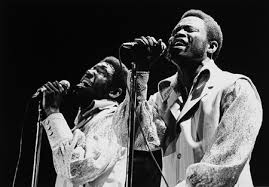
While the first two Stax singles failed to chart, the third, the Hayes/Porter composition (with similarities, including the title, to a gospel standard) "You Don't Know Like I Know" hit #7 R&B in 1966. This was the first of 10 consecutive Top Twenty R&B chart hits over three years, and 14 R&B chart appearances during their career. The year 1969 started well, with the Atlantic release of The Best of Sam & Dave LP in January. It contained all their Stax A sides except "A Place Nobody Can Find" and several B-sides, and peaked at #24 on the R&B LP charts and #89 on the Billboard LP charts. Their first single of the year, "Soul Sister, Brown Sugar", returned Sam and Dave to the R&B top 20, and was a #15 hit in the UK.  The follow-up "Born Again", reached the lower levels of the charts, and was the last single Sam and Dave recorded at Stax.
_______________________________________________________________

During the early '80s, Atlantic released newer compilations from some of the most popular R&B artists from the '60s, including Aretha Franklin and Wilson Pickett. The Best of Sam & Dave perhaps works even better. Although the duo's 1969 greatest hits remains definitive from a pop culture and song choice perspective, this boasts superior sound and zero filler. Like all of their compilations of merit, The Best of Sam & Dave proves the precision of the backing from Booker T. and the MG's and the duo's most illustrious songwriting team, Isaac Hayes and David Porter. The writing team's masterwork, the amazing and kinetic "Soul Man" was in line with the burgeoning black pride of the time. While other well-known tracks like "When Something Is Wrong With My Baby" and "Hold on, I'm Comin'" are here, The Best of Sam & Dave also culls other songs that are just as potent. The humorous "Said I Wasn't Gonna Tell Nobody" and the hard-driving yet quirky "Wrap It Up" all display the singular one-two punch of Moore's narrow and irascible tone pitted against Prater's woebegone baritone. Arguably the best track, the phenomenal "I Thank You" closes the compilation on a high note. Although the duo did switch officially to Atlantic by the early '70s, this compilation stops at the prime Stax material. The Best of Sam & Dave had a brief shelf life and was supplanted by more extensive overviews. As a compilation spotlighting the hits, this does the job. - Jason Elias / AMG

Tuesday, May 14, 2013

Mavis Staples - The Volt Albums

These two albums were dropped in the Shares by our new friend patsoul, thanks to him! I thought they deserved a run up front as these are the only two Stax/Volt records of Mavis as a solo artist. I'm a little concerned as to how long his Mediafire links will last with their new recognition system so I have provided an embedupload link as well.

Here is the first part of her Wiki bio:
"Mavis Staples (born July 10, 1939 in Chicago, Illinois) is an American rhythm and blues and gospel singer, actress and civil rights activist who recorded with The Staple Singers, her family's band.

Mavis Staples began her career with her family group in 1950. Initially singing locally at churches and appearing on a weekly radio show, the Staples scored a hit in 1956 with "Uncloudy Day" for the Vee-Jay label. When Mavis graduated from what is now Paul Robeson High School in 1957, The Staple Singers took their music on the road. Led by family patriarch Roebuck "Pops" Staples on guitar and including the voices of Mavis and her siblings Cleotha, Yvonne, and Purvis, the Staples were called "God's Greatest Hitmakers."

With Mavis' voice and Pops' songs, singing, and guitar playing, the Staples evolved from enormously popular gospel singers (with recordings on United and Riverside as well as Vee-Jay) to become the most spectacular and influential spirituality-based group in America. By the mid-1960s The Staple Singers, inspired by Pops' close friendship with Martin Luther King, Jr., became the spiritual and musical voices of the civil rights movement. They covered contemporary pop hits with positive messages, including Bob Dylan's "A Hard Rain's a-Gonna Fall" and a version of Stephen Stills' "For What It's Worth."

During a December 20, 2008 appearance on National Public Radio's news show "Wait Wait...Don't Tell Me," when Staples was asked about her past personal relationship with Dylan, she admitted they "were good friends, yes indeed" and that he had asked her father for her hand in marriage.

The Staples sang "message" songs like "Long Walk to D.C." and "When Will We Be Paid?," bringing their moving and articulate music to a huge number of young people. The group signed to Stax Records in 1968, joining their gospel harmonies and deep faith with musical accompaniment from members of Booker T. and the MGs. The Staple Singers hit the Top 40 eight times between 1971 and 1975, including two No. 1 singles, "I'll Take You There" and "Let's Do It Again," and a No. 2 single "Who Took the Merry Out of Christmas?"

Staples made her first solo foray while at Epic Records with The Staple Singers releasing a lone single "Crying in the Chapel" to little fanfare in the late 1960s. The single was finally re-released on the 1994 Sony Music collection Lost Soul. Her first solo album would not come until a 1969 self-titled release for the Stax label...(and) another Stax release, Only for the Lonely, in 1970."

Friday, June 29, 2012

The Complete Stax/Volt Singles 1959 - 1968

Honestly... what can I say here?!?  This collection is all you could ever want if you are a fan of the Stax sound.  This is in 320 mp3 with no booklet.  You will have to buy it if you want the real deal.  Everything has been tagged fully and correctly.  Chances are this post will be temporary, so grab it while you can!!!

At nine discs and 244 tracks, The Complete Stax-Volt Singles: 1959-1968 is far too exhaustive for casual fans, but that's not who the set is designed for -- it's made for the collector. Featuring every A-side the label released during those nine years, as well as several B-sides, the set is a definitive portrait of gritty, deep Southern soul. Many of the genre's major names -- Otis Redding, Sam & Dave, Carla Thomas, Booker T. & the MG's, William Bell, Rufus Thomas, the Bar-Kays, Albert King -- plus many terrific one-shot wonders are showcased in terrific sound and augmented with an in-depth booklet. For any serious soul or rock collector, it's an essential set, since Stax-Volt was not only a musically revolutionary label, its roster was deep with talent, which means much of the music on this collection is first-rate. But if you only want the hits, you'll be better off with a smaller collection, since too much of this set will sound too similar, and sorting through the nine discs will be a monumental task if you only want to hear Otis, Rufus, Carla, and Sam & Dave.  - by Stephen Thomas Erlewhine