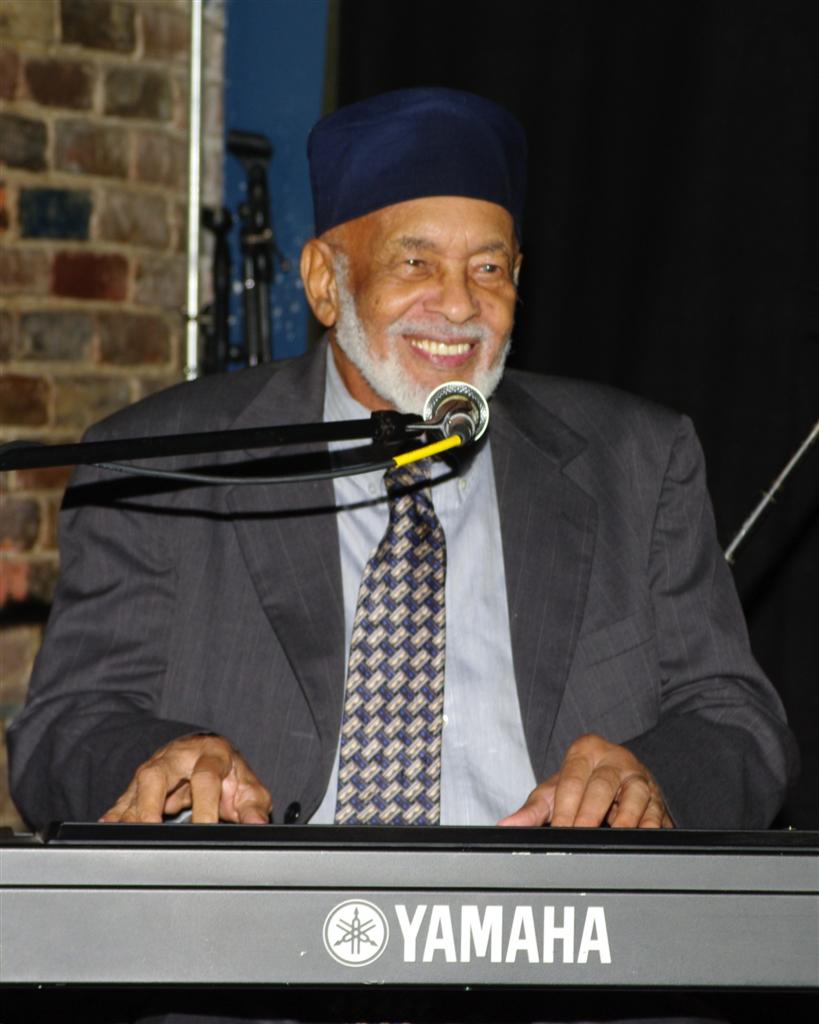
"Joseph "Smokey" Johnson (born November 14, 1936, New Orleans, died October 6, 2015, New Orleans)
is an American drummer. He is one of the musicians, session players, and songwriters who have served as the backbone for New Orleans' output of jazz, funk, blues, soul, and R&B music.
Johnson served as the drummer for Fats Domino in the 1950s and 1960s.
In 1961, Johnson and Wardell Quezergue worked together on the session for Earl King's proto-funk classic, "Trick Bag", produced by Dave Bartholomew.
Soon thereafter, Johnson went with Quezergue and childhood friend Joe Jones, and several other New Orleans artists (including Johnny Adams, Earl King and Esquerita) to audition for Motown in Detroit, where they recorded numerous demo sessions. (Jones had conned everyone into believing the were going to record, rather than audition, see story) Earl King once remarked that at least part of the reason why they got in the door was Motown's fascination with Smokey Johnson, who could do more on a trap set by himself than any two of the label's session drummers. Although Motown ended up not signing any of the New Orleans artists, Johnson offered to remain on staff while the other New Orleans artists were dispatched.

Johnson remained in Detroit for several months before deciding to return home; but his influence on the Motown sound was profound, as the other drummers studied his techniques, incorporating them into countless hit sessions.
In 1963 and 1964, Dave Bartholomew enlisted Johnson for his last two Imperial big band albums, giving Johnson the spotlight on the tune, "Portrait Of A Drummer", from New Orleans House Party.
 In 1964, about a year after Nola Records was formed in New Orleans,
Quezergue a partner in the label as well as principal producer/arranger,
invited Johnson to be the drummer for label's house band. After a few
months, Johnson and Quezergue wound up writing and recording what has
become a New Orleans Mardi Gras standard called "It Ain't My Fault".
Deftly arranged, "It Ain't My Fault" is a fascinating early example of
both Johnson and Quezergue incorporating Second Line syncopation into
pop music. The arranger's device of starting off with just the drummer's
relaxed but intricate percussive work (plus somebody hitting what
sounds like a glass bottle) quickly pulls the listener into the song,
even before the simple musical hook, played by just the guitar and
piano. George Davis runs the guitar riffs on the first side with that
recognizable style made famous several years later on Robert Parker's
"Barefootin'".
In 1964, about a year after Nola Records was formed in New Orleans,
Quezergue a partner in the label as well as principal producer/arranger,
invited Johnson to be the drummer for label's house band. After a few
months, Johnson and Quezergue wound up writing and recording what has
become a New Orleans Mardi Gras standard called "It Ain't My Fault".
Deftly arranged, "It Ain't My Fault" is a fascinating early example of
both Johnson and Quezergue incorporating Second Line syncopation into
pop music. The arranger's device of starting off with just the drummer's
relaxed but intricate percussive work (plus somebody hitting what
sounds like a glass bottle) quickly pulls the listener into the song,
even before the simple musical hook, played by just the guitar and
piano. George Davis runs the guitar riffs on the first side with that
recognizable style made famous several years later on Robert Parker's
"Barefootin'".While the lighthearted, hard to resist "It Ain't My Fault" was enjoyed locally in New Orleans, it did not have a national impact at the time, it set the stage for many more uniquely funked up grooves to follow, and over time has become a Mardi Gras favorite and a part of the brass band repertoire.
Johnson stopped playing drums after suffering a stroke in 1993.
Johnson was forced to leave his home in the wake of Hurricane Katrina in September 2005. Johnson is now a resident of Musicians' Village, a Habitat for Humanity project in the Upper Ninth Ward of New Orleans." wiki
Smokey passed away yesterday, may he Rest In Peace.