
Showing posts with label Otis Clay. Show all posts
Showing posts with label Otis Clay. Show all posts
Thursday, January 25, 2018
Otis Clay & Johnny Rawls - Soul Brothers

Saturday, October 15, 2016
Johnny Rawls (w/ Otis Clay) - Remembering O.V.

"Over recent years Johnny Rawls has established himself as one of the last true soul/blues singers standing from the southern states’ chitlin’ circuit. A significant part of his own education was as the leader of the late O.V. Wright’s touring band and Johnny has recorded one tune associated with O.V. on each of his last three CDs. Johnny has now produced a full album of O.V. material, clearly a labour of love for him and a superb album of classic soul and r n’ b.
As he has done over several albums, Johnny has again recorded with The Rays. Co-producer and bassist Bob Trenchard has a great soul band at his disposal: Dan Ferguson on keys, Johnny McGee on guitar, Richy Puga on drums and a horn section of Andy Roman on sax, Mike Middleton on trumpet and Robert Claiborne on trombone. The Iveys (Arlen, Jessica and Jillian) add backing vocals. Johnny has left his axe at home for this recording but sings on all tracks, joined by the peerless Otis Clay on three cuts. The album was recorded in Texas and mixed by Jim Gaines in Tennessee.
The CD opens with Otis Clay leading on the funky “Into Something (I Can’t Shake Loose)” and it’s a great opener as Johnny and Otis take turns on the vocals and the horns punctuate the foot-tapping beat established by the rhythm section. Changing pace Johnny sings “Precious, Precious” particularly well with excellent harmony vocals from The Iveys.
“Nickel And A Nail” is a very well-known song on which Otis Clay shares the vocals, both vocalists doing a great job. Less well known is “Poor Boy”, another song on which Don Robey had a writing credit. It is covered in a gentle style, the organ and plucked guitar providing the main backing and the horns sitting this one out. Earl Randle’s “I’ve Been Searching” is also very well done, the horns shouting out their riffs with gusto. “Don’t Let My Baby Ride” is a mid-paced, horn-driven tune with attractive backing vocals.
The three tracks which have appeared before on Johnny’s albums are reprised here in remixed versions. Deadric Malone’s “Eight Men, Four Women” appeared on the 2012 “Soul Survivor”, a stately ballad in which love is on trial before a jury, the backing vocalists playing a significant role behind Johnny’s impassioned vocal. “Blind, Crippled And Crazy” was on 2011’s “Soul Survivor” and has been covered many times. It may well be the best known song here but this version is as good as any, Johnny easily demonstrating his mastery of this style of singing, just a hint of grit in his generally smooth soul voice. “Ace Of Spades” was the title of Johnny’s 2009 BMA winning album and it’s a wonderful example of his soul/blues style, the horns being particularly effective.
Closing the album is the only original tune on the set, co-written by Johnny Rawls and Bob Trenchard as a tribute to O.V. Despite all the excellent and well-known songs on this tribute album “Blaze Of Glory” may be the highlight. The horns set the pace before Johnny opens the song with a recollection of his early touring days, including his presence at O.V.’s death: “even the great ones can’t cheat death”. Johnny publicly pledges that he will keep playing O.V.’s music as long as he performs. Otis Clay then reprises the verse but adapts the lines to his own experiences as a rising Memphis singer. With a rousing chorus shared by the two singers and The Iveys, this is a shot of high class Memphis soul." Blues Blast Magazine
Sunday, January 31, 2016
Otis Clay - The Gospel Truth

Saturday, January 30, 2016
Otis Clay - Testify

Some overlap with an earlier posting but not much!


Otis Clay - Trying to Live My Life

Thursday, January 28, 2016
Otis Clay - Live i Boston 1992

This would be from the tour in support of the 1992 album "I'll Be Good To You".
Friday, January 22, 2016
Otis Clay - The Only Way Is Up + bonus


Friday, January 15, 2016
Otis Clay - The Atlantic Years
:format(jpeg):mode_rgb():quality(96)/discogs-images/A-206199-1299677514.jpeg.jpg)
I wanted to join in the Otis Clay love fest. Otis was one of my very favorite artists, and a constant source of inspiration for me. God rest his soul. I hope that he saves a seat for me in Glory.
After Otis Clay's amazing burst of creativity at One-derful! Records, the results of which KC already posted here, Otis was signed to Atlantic's Cotillion label where he stayed from 1968 until his move to Hi records in 1971. Unfortunately, Atlantic didn't take Otis seriously enough at the time and recorded very little, but did allow him to release five dynamite 45s for the label during these years.
As far as I am aware, Atlantic never compiled these singles into the Cotillion Otis Clay LP that should have been. This oversight continued into the CD age, where a number of these tracks appeared only on various compilations. So here is the great Otis Clay Atlantic album that never was. I have compiled his five 45s in chronological order and added an additional track, Your Helping Hand, that was unreleased at the time.
There is some top drawer Otis here. Enjoy!
Otis Clay - Respect Yourself

" AllMusic Review by Steve Leggett
Mississippi native Otis Clay hasn't changed much with the times, as this live set recorded at the Lucerne Blues Festival in Switzerland in 2003 quickly makes clear. From the start of his secular singing career in Chicago on the One-derful and Cotillion labels in the 1960s, through his high watermark on Hi Records in Memphis in the 1970s (where he was the hardest vocal hitter Hi ever recorded), Clay has stuck fast to his gospel-fueled roots, and his gruff, impassioned singing continues to be the very definition of deep soul. Backed by Tyrone Davis' old group, the Platinum Band, a nine-piece, horn-driven Chicago outfit, and given vocal support by veteran singers Theresa Davis and Diane Madison, Clay testifies hard and fast and fiery here, the way he always has. With deep, funky grooves filled out with punchy horns, and led by Clay's gruff and searing vocals, songs like the hard-driving "Nickel and a Nail," the teasing and playful "I Can Take You to Heaven Tonight," and the quick, crisp "Love & Happiness" (made famous by former Hi labelmate Al Green) burn the way the contemporary neo-soul movement can only dream about burning. This isn't retro soul, this is soul still alive and kicking, only a whisper away from a gospel revival meeting, and Clay finally takes listeners there, too, with "Amen/This Little Light of Mine" and a scorching, funky version of George Clinton's "I Just Wanna Testify." "It's a soul song, simply said," is how Clay introduces the set closer, "Respect Yourself," and anyone who thinks soul died in the 1970s will have a hard time explaining that to Otis Clay."
Monday, January 11, 2016
Otis Clay - Truth Is (2013)

Sunday, January 10, 2016
Otis Clay - Watch Me Now

Saturday, January 9, 2016
Otis Clay - Got To Find A Way, The Beginning

"The music industry liked to peg Chicago vocal master Otis Clay as a soul singer. Or an R&B king. Or a gospel titan. Or a high-energy showman. He was all of that, and more, Clay's roots in Mississippi and musical blossoming in Chicago making him an uncommonly eclectic musician who drew upon more stylistic influences than even his more ardent fans may have realized.
 The artist, who churned out hits in the late 1960s with "That's How It Is (When You're in Love)," in the early '70s with "Trying to Live My Life Without You" (later covered by Bob Seger) and in the '80s with "When the Gates Swing Open," said he soaked up the music of Duke Ellington and Thomas A. Dorsey, Sam Cooke and Muddy Waters, and a great deal more.
Clay died Friday at age 73, said his longtime arranger and producer, Thomas "Tom Tom" Washington. Further details of Clay's death were not yet known, Washington said.
"Writing this with a very heavy heart and tears in my eyes as I recently heard the very sad news that the great Otis Clay suddenly passed on," Chicago blues musician Dave Specter wrote on Facebook. Specter collaborated with Clay on "Message in Blue," Specter's critically applauded 2014 album. "Otis conveyed power with soul music and with blues like very few people I've ever heard live," Specter said Saturday. "It was as good as it gets. "His live shows — it was so stirring, and so moving. And he was a great showman. Not when you think of a showman being an over-the-top entertainer on steroids. Nothing like that. It was so real."
 Indeed, in concert Clay proved a galvanic force, his gravelly, rumbling low notes and fervent, imploring high ones showing a potent mixture of the sacred and the secular, the accessible and the sophisticated.
"My life always has been a combination of things musically," Clay told the Tribune in 2013, as he was celebrating the release of his album "Truth Is." "Every Saturday night I listened to the Grand Ole Opry," added Clay, who was born Feb. 11, 1942, in Waxhaw, Miss. "During the day, later on, you listened to (radio) coming out of Memphis. During the noonday, at 12 o'clock, we listened to (blues pioneer) Sonny Boy Williamson, coming out of Helena, Ark. (And) I'm listening to Vaughn Monroe and Rosemary Clooney and listening to Hank Williams and Roy Acuff." So the far-flung idioms those artists represented were set deeply in Clay's musical persona, even before he came to Chicago as a teenager, in the mid-1950s, to live with his uncle and aunt. In Chicago he absorbed further musical influences but in the flesh.
"I guess I've always loved Chicago," Clay said in the Tribune interview. "And people say, 'Well, you're from Mississippi.' And I say, 'Chicago is only a suburb of Mississippi.' It was the place to go. It was exciting, of course. "You got to be in a place where a lot of legends (lived), whether they were blues or gospel, they were in Chicago. I guess I was about 6 or 7 years old when I saw my first live show. I was living in Clarksdale, Miss., at that time, and that was Muddy Waters. "And now I'm in the same city that Muddy Waters is living in and playing local clubs and what have you, though I wasn't going to 'em yet. Sam Cooke was here, the Soul Stirrers, the Caravans and all these (other gospel) people. It was a lot of excitement."
By age 15, Clay was singing Chicago gospel with the Golden Jubilaires, and three years later, in 1960, touring America with Charles Bridges' Famous Blue Jay Singers. That experience only expanded Clay's artistic range, because "our audience was basically, most of the time, white," meaning the singers were expected to perform repertoire well outside gospel tradition. On Sundays, though, "most of the time we would be singing in black churches. … 1960: What was the greatest craze at the time? The twist. So we added that to our repertoire. We added 'That Old Gang of Mine,' 'Mother Machree.' We were variety singers, so therefore I had that exposure, so it wasn't so hard for me to do it."
 Though Clay began releasing soul records on Chicago's One-derful label in the 1960s, he never lost touch with his gospel roots, recording and performing that repertoire through the decades. When disco was ascendant in the 1970s, Clay found a growing and devoted audience for his earthy music on the other side of the world, in Japan. This came as a surprise to him. "I had no idea," he said in the Tribune interview. "I thought when we got ready to go to a foreign country, we were going to go Europe. I didn't think I was going to go to Japan, because I'm thinking Pearl Harbor, WWII. … (I thought:) What am I going to sing? I thought it was one of the craziest ideas. "And then I go to Japan. I find that they are so up on the music. That, too, was a lesson well learned. … They know the songs, they know the meaning of the songs."
Clay had been scheduled to perform Saturday night on Chicago's West Side, said arranger-producer Washington. Specter spoke to Clay on Wednesday: "When you get a FaceTime call from Otis Clay, it's a big deal," said Specter, honored by the call and noting that the singer looked to be in fine spirits.
"He was just a combination of his voice, his passion, his intensity," Specter said. Performing with Clay was "the most inspiring feeling I ever got," he said. "I remember the first rehearsal at Delmark (Records) for 'Message in Blue' – his voice made me cry. And it was just a rehearsal. "I've worked with a lot of great singers. But I don't think I've worked with anybody who had that feeling."
Funeral plans have not been announced." Howard Reich, Chicago Tribune
Otis Clay - Live (Japan (1978) and Clarksdale (1991)

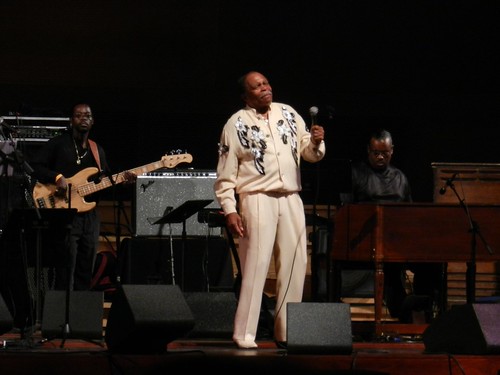

Fate would have it that, for one reason or another, Otis Clay and Chicago Fire went their separate ways before Otis went to the studios for Rounder. To their credit, Rounder assembled crack bands for Otis' two discs for that label. But it didn't really work. The bands didn't know how to give Otis the flexibility that he needed to work his magic. As a result, Otis ended up in a sort of musical straightjacket, trying hard to complement what the band was doing, as opposed to the other way around. What could have been classic albums in the Otis Clay discography with Chicago Fire turned out to be among his weakest.
At any rate, if you can tolerate the lo fi sound, here is Otis in all his glory with Chicago Fire in 1991.
By the way, Otis' new album, Truth Is, is his best release in a while. Support the Soul Man and buy it!
Otis Clay - Soul Man Live in Japan LP rip
 The first time I posted this it was the truncated CD Version, but now thanks to Unky Cliff I am able to offer the full original double LP with 22 extra minutes of goodness!
One thing for damn sure - Otis Clay is best enjoyed live. He is one hell of a dynamic performer. Bullseye/Rounder saved so many of these guys from total obscurity, thank god for Scott Billington and the rest of them for doing this in time to catch a Johnny Adams, an Otis Clay or James Booker before it was too late. For me the 'Moment" here is Clay's tribute to old friend O.V. Wright with his cover of "A Nickle and a Nail".
 "All of Otis Clay's albums are worth hearing, but
this one--a 1983 concert recorded in Tokyo--is not only his masterpiece
but one of the best live soul albums since the mid '60s heyday of the
Stax/Volt Revue. Backed by an incredible band (mostly the guys who
played on Al Green's hits), Clay roars through a set that includes a
couple of Green tunes that he thoroughly makes his own. He also quotes
Sam Cooke to fine effect on the gospel-ish "Precious Precious," and
nearly convinces the audience that he's the second coming of Otis
Redding. This is an essential album for any soul music collection."
"All of Otis Clay's albums are worth hearing, but
this one--a 1983 concert recorded in Tokyo--is not only his masterpiece
but one of the best live soul albums since the mid '60s heyday of the
Stax/Volt Revue. Backed by an incredible band (mostly the guys who
played on Al Green's hits), Clay roars through a set that includes a
couple of Green tunes that he thoroughly makes his own. He also quotes
Sam Cooke to fine effect on the gospel-ish "Precious Precious," and
nearly convinces the audience that he's the second coming of Otis
Redding. This is an essential album for any soul music collection."Recorded live at Yubin Chokin Hall, Tokyo, Japan on October 22, 1983. Includes liner notes by Robert Pruter.
Personnel: Otis Clay (vocals); Mabon "Teenie" Hodges (guitar); Henri "Hank" Ford (tenor saxophone, background vocals); Paul Howard (trumpet, background vocals); Bill McFarland (trombone, background vocals); Charles Hodges (organ); Dedrick Blanchard (keyboards); Leroy Hodges (bass); Howard Grimes (drums).
Living Blues (1/92-2/92, p.51) - "...Clay still reigns as the Windy City's top soul man, as the reissued "Live In Japan" soulfully demonstrates..."
"Thankfully, Otis Clay is an artist who refused to change with the times. When the R&B audience embraced disco and, later, urban contemporary, the hard-edged belter wisely stuck with the type of raw, unapologetic-ally Southern-sounding soul that put him on the map. Though he calls Chicago home, Clay's approach has always shouted "Memphis!" in no uncertain terms. A 41-year-old Clay was clearly very much in his prime when this magnificent live date was recorded in 1983. Sparing no passion on such treasures as "Holding on to a Dying Love" and Al Green's "Here I Am (Come and Take Me)," Clay illustrates why his small yet devoted following holds him in such high regard. One of the most pleasant surprises is the ballad "Love Don't Love Nobody." While the Spinners' excellent hit version boasted a sleek Philly soul production, Clay takes the gem straight to Memphis. " AMG
Otis Clay - The Best Of Otis Clay The Hi Records Years

Otis Clay was born 11th February 1942 in Waxhaw, Mississippi in rural Bolivar County, Mississippi to a musical family, who moved in 1953 to Muncie, Indiana. After singing with local gospel group, the Voices of Hope, he returned to Mississippi to sing with the Christian Travelers, before settling in Chicago in 1957. There, he joined a series of gospel vocal groups including the Golden Jubilaires, the Famous Blue Jay Singers, the Holy Wonders, and the Pilgrim Harmonizers, before making his first solo secular recordings in 1962. They were unissued, and Clay joined the Gospel Songbirds, who recorded in Nashville in 1964 and who also included Maurice Dollison who sang R&B under the name Cash McCall, and then the Sensational Nightingales.
 In 1965 Clay signed with One-derful! Records in Chicago, to make secular recordings. After releasing a series of gospel-tinged soul records, his first hit came in 1967 with "That's How It Is (When You're In Love)", which reached # 34 on the R&B chart, followed by "A Lasting Love" (# 48 R&B). In 1968 the record company folded and his contract was bought by Atlantic Records, who launched their subsidiary Cotillion label with Clay's version of the Sir Douglas Quintet hit, "She's About A Mover", produced at the FAME Studios in Muscle Shoals. The record became Clay's biggest pop hit, reaching # 97 on the Hot 100 (# 47 R&B). However, follow-ups on Cotillion, including "Hard Working Woman" produced by Syl Johnson, and "Is It Over?" produced by Willie Mitchell in Memphis, were less successful.
Clay moved to Mitchell's Hi Records in 1971, and made many of his best known soul blues records for the label. His biggest hit came with "Trying To Live My Life Without You," a # 24 R&B hit in late 1972, which he followed up with "If I Could Reach Out". "Trying To Live My Life Without You" was later covered by Bob Seger, whose version made # 5 on the pop chart in 1981. After several more
 |
| Otis Clay w/ the Hi Records Rhythm section |
He has remained a popular live act in Europe and Japan, as well as the US, and has recorded two live albums, Soul Man: Live in Japan and Respect Yourself, recorded live at the Lucerne Blues Festival in Switzerland. In the 1990s he also recorded two soul albums for Bullseye Blues: I'll Treat You Right and the Willie Mitchell-produced This Time Around. In 2007, he recorded the gospel album Walk a Mile in My Shoes.
In a way, Clay has become a standard bearer for the grittier blues soul hybrid and the Chicago soul tradition when the city is more readily recognised as the nerve centre of so many great blues records and home to a number of the great and legendary straight ahead blues performers. He has been a nominee for a Grammy for Best Traditional R&B Vocal Performance. As a resident of Chicago's West Side, he is actively involved in community-based economic and cultural initiatives, including the development of The Harold Washington Cultural Center.
Wednesday, April 3, 2013
Otis Clay - Respect Yourself (Live At The Lucerne Blues Festival)

This one comes from the good folks at Blind Pig Records in San Francisco who released it in 2005.
Tuesday, August 28, 2012
The FAME Studios Story 1961 - 1973: Home Of The Muscle Schoals Sound

This 3 disc comp is nothing short of excellent. The story of FAME is told through the music - from the pop side all the way to the gut bucket r&b side.
A wide range of artists worked with this legendary outfit, but one thing ties them all together... success!!
I'm sure you guys already have alot of these tracks but they made a huge effort to include some rarities; undoubtedly for the collector types.
Enjoy!!!
Certain studios and labels occupy almost mythical stature in American musical history and FAME Studios, home of the Muscle Shoals sound, is among the elite. During the '60s and into the early '70s, the rotating crew at FAME Studios cranked out single after single, building a legacy that rivals such '60s stalwarts as Motown, Stax/Volt, and Chess, yet despite being the point of origin for such timeless 45s as Wilson Pickett's "Land of 1000 Dances," Arthur Alexander's "You Better Move On," Joe Tex's "Hold What You've Got," Etta James' "Tell Mama," Clarence Carter's "Patches," James & Bobby Purify's "I'm Your Puppet," and Aretha Franklin's "I Never Loved a Man (The Way I Love You)," the label and studio aren't as well known as their peers. Ace's peerless three-disc box The FAME Studios Story: 1961-1973 should go a long way in firming up the label and studio's reputation in the eyes of the mass public. Anchored on those big hits, the compilation tells the story of FAME in exhaustive yet exciting detail, digging up a wealth of rarities (ranging from an unedited acoustic version of "You Left the Water Running" by Otis Redding and a version of "Another Man's Woman, Another Woman's Man" whose singer is unknown to a bunch of singles that rarely pop up on reissues), but this is hardly something for crate-diggers. This is a big, bold set filled with surprises for even seasoned record collectors and much of that has to do with context. Expertly compiled by Alec Palao, Tony Rounce, and Dean Rudland, The FAME Studios Story doesn't shy away from the moments when the Muscle Shoals sound seeped into the mainstream: very early in the set, teen idol Tommy Roe pops up with "Everybody" and toward the end the Osmonds come in with their Jackson 5 knockoff "One Bad Apple" and the revelation is how the FAME musicians gave these teenybopper stars some real swing and funk. That turns out to be the key to the FAME sound -- while Stax/Volt always had grit on the soles of their shoes, FAME was a little lighter, able to ease into slicker crossover material, something that served them well whenever they cranked out some bubblegum or backed Bobbie Gentry or, especially, when they cut effervescent pop-soul/Northern soul singles by Spooner & the Spoons ("Wish You Didn't Have to Go") and David & the Giants ("Ten Miles High"). Which isn't to say FAME didn't get down and dirty (of course they did -- witness Wicked Wilson Pickett's "Hey Jude," complete with guitar from Duane Allman), but they were versatile, adapting to the needs of either the performer or the song. And that very versatility may be part of the reason why FAME isn't as immediately recognizable a name as Motown or Stax -- the Muscle Shoals crew could cop both of those sounds, after all -- but it's also the reason why this set is such a wildly entertaining listen, in addition to being a historically necessary document housed in a very handsome hardcover book.
- Stephen Thomas Erlewine/AMG


