
Showing posts with label Peacock Records. Show all posts
Showing posts with label Peacock Records. Show all posts
Sunday, January 28, 2018
Bless The People Everywhere - Gospel Funk of Peacock & Songbird

Sunday, December 18, 2016
Texas Gospel: Be What You Are, Vol. 2: 1953-1954

Volume Two continues with those classic Quartet recordings with minimal instrumental backing, usually a guitar and the occasional bass drum. The artists featured include: The Christland Singers, The Southern Wonders, The Southern Tones, The Mid-South Singers, The Heaven Bound Four, and The Sunset Travelers (who would soon feature O.V. Wright). These tracks give little hint of the Robey revolution that was on the horizon.
Acrobat has done a fine job of remastering without imposing modern sound standards that would have ruined the set. Highly recommended. Robert Wingfield, Allmusicguide
Saturday, December 10, 2016
Texas Gospel, Volume One, Come On Over Here

Volume One's focus is on classic Quartet recordings with minimal instrumental backing, usually a guitar and the occasional bass drum. The artists featured are The Christland Singers, The Southern Wonders, The Gospel Tone Singers, The Swanee Spiritual Singers, The Golden Harp Singers, The Stars of Hope, and The Gospel Travelers.The disc ends with a pair of burning tracks from The Wilson & Watson Singers: a slightly larger ensemble featuring piano and organ accompaniment.
Acrobat did a fine job of remastering without imposing modern sound standards that would have ruined the set. Highly recommended. Robert Wingfield, All Music Guide
Sunday, November 6, 2016
The Sprit of Memphis Quartet - Happy In the Service of the Lord

A rerun by request:
Gospel music was largely neglected during the surge of CD reissues in the 90s and early 21st Century. Only the Specialty and Nashboro labels had significant reissues. The Spirit of Memphis Quartet was unquestionably one of the greatest, most popular, and most influential quartets of the Golden Age of Gospel in the 40s and 50s. But the CD generation had little opportunity to hear it.
Gospel music was largely neglected during the surge of CD reissues in the 90s and early 21st Century. Only the Specialty and Nashboro labels had significant reissues. The Spirit of Memphis Quartet was unquestionably one of the greatest, most popular, and most influential quartets of the Golden Age of Gospel in the 40s and 50s. But the CD generation had little opportunity to hear it.
Recently, in the Sunset of the CD Age, the
indefatigable Opal Lee Nations managed to put into print for first time in many
decades a good chunk of the recorded legacy of the Golden Age of gospel. He uses European labels that
exploit the liberal copyright laws of the EU. The two most prolific labels have been Acrobat and JSP. While JSP is still going,
Acrobat folded rather quickly after a string of great releases.
Happy in the Service of the Lord was the single most important release
on Acrobat, a 2-disc  collection that brings us the most important recordings
of the Spirit of Memphis Quartet, those made for King and Peacock during
1949-1952. During this time,
The Spirit of Memphis may have wrecked more churches than any other
outfit. The lineup featured three great lead singers: Willmer “Little Axe” Broadnax (tenor),
Jet Bledsoe (tenor/baritone), and the inimitable thundering baritone of Silas
Steele. A number of other classic recordings of the Spirit of
Memphis from the mid-later 1950s, many of which with Joe Hinton on lead
vocals, were included in Acrobat’s 9-Volume “Texas Gospel” reissue of the
Peacock label. We can get
into that series later on for this blog if there will be demand for it.
collection that brings us the most important recordings
of the Spirit of Memphis Quartet, those made for King and Peacock during
1949-1952. During this time,
The Spirit of Memphis may have wrecked more churches than any other
outfit. The lineup featured three great lead singers: Willmer “Little Axe” Broadnax (tenor),
Jet Bledsoe (tenor/baritone), and the inimitable thundering baritone of Silas
Steele. A number of other classic recordings of the Spirit of
Memphis from the mid-later 1950s, many of which with Joe Hinton on lead
vocals, were included in Acrobat’s 9-Volume “Texas Gospel” reissue of the
Peacock label. We can get
into that series later on for this blog if there will be demand for it.
 collection that brings us the most important recordings
of the Spirit of Memphis Quartet, those made for King and Peacock during
1949-1952. During this time,
The Spirit of Memphis may have wrecked more churches than any other
outfit. The lineup featured three great lead singers: Willmer “Little Axe” Broadnax (tenor),
Jet Bledsoe (tenor/baritone), and the inimitable thundering baritone of Silas
Steele. A number of other classic recordings of the Spirit of
Memphis from the mid-later 1950s, many of which with Joe Hinton on lead
vocals, were included in Acrobat’s 9-Volume “Texas Gospel” reissue of the
Peacock label. We can get
into that series later on for this blog if there will be demand for it.
collection that brings us the most important recordings
of the Spirit of Memphis Quartet, those made for King and Peacock during
1949-1952. During this time,
The Spirit of Memphis may have wrecked more churches than any other
outfit. The lineup featured three great lead singers: Willmer “Little Axe” Broadnax (tenor),
Jet Bledsoe (tenor/baritone), and the inimitable thundering baritone of Silas
Steele. A number of other classic recordings of the Spirit of
Memphis from the mid-later 1950s, many of which with Joe Hinton on lead
vocals, were included in Acrobat’s 9-Volume “Texas Gospel” reissue of the
Peacock label. We can get
into that series later on for this blog if there will be demand for it.
The Spirit of Memphis stands for quite a rich and diverse gospel
tradition. The Quartet has
roots dating back to the 1920s and continues to perform today as one of the finest remaining gospel
quartets. If they come to
your town, don’t miss them.
There are also excellent CDs available from the newer aggregations. But here you have the very artistic
peak of the Spirit of Memphis, and one of the peaks of recorded gospel
music.
Saturday, November 5, 2016
Boogie Uproar - Gems From The Peacock Vaults

 Re-run by request:
"The formation of Peacock Records in late 1949 dates back to an event nearly three years earlier when a young guitarist called Clarence 'Gatemouth' Brown saw his chance to grab the spotlight - and took it with both hands! 'Gate' had never been backward in coming forward. When legendary bluesman T-Bone Walker fell ill in mid-performance, he leapt up, picked up the guitar left on the stage and started playing his own 'Gatemouth Boogie'. 15 minutes later a star was born. The owner of the club, Don Robey, ensured the young upstart put his autograph on a management contact. Robey would eventually found Peacock Records to release his music, and that's where the label's history starts."
Sunday, February 14, 2016
The Sensational Nightingales - On Peacock with Julius Cheeks: 1950s

A repost by request:
The Sensational Nightingales have been one of the top gospel quartets for more than 60 years. There are many CDs and LPs available. But you won’t find this one. This collection assembles all of the Peacock 45s from their golden years from 1952-1959, during the time that Julius Cheeks and the Gales earned their reputation as the “Baddest Quartet on the Road.” A handful of these tracks were reissued on MCA’s budget CD/LP entitled the Best of the Sensational Nightingales. But here you have THE essential 75-minute Sensational Nightingales CD that was never released
The Sensational Nightingales have been one of the top gospel quartets for more than 60 years. There are many CDs and LPs available. But you won’t find this one. This collection assembles all of the Peacock 45s from their golden years from 1952-1959, during the time that Julius Cheeks and the Gales earned their reputation as the “Baddest Quartet on the Road.” A handful of these tracks were reissued on MCA’s budget CD/LP entitled the Best of the Sensational Nightingales. But here you have THE essential 75-minute Sensational Nightingales CD that was never released
The Sensational Nightingales were based in Philadelphia. They recruited the legendary singer Julius “June” Cheeks from his hometown in Spartanburg, South Carolina in 1950. By the time that the Peacock recordings began in 1952, the tenor Ernest James had joined the Nightingales from the Dixie Hummingbirds as second lead. In many  ways, Julius Cheeks was the archetypical hard gospel singer, and a huge influence on many other singers, including Wilson Pickett, David Ruffin, and Otis Clay. Cheeks sang so hard that his voice gave out after a decade, forcing him into early retirement. He worked himself and audiences into a complete frenzy. The additional powerful tenor of Ernest James delivered a 1-2 punch that few other quartets could endure. Nobody wanted to follow the Sensational Nightingales on the Program.
ways, Julius Cheeks was the archetypical hard gospel singer, and a huge influence on many other singers, including Wilson Pickett, David Ruffin, and Otis Clay. Cheeks sang so hard that his voice gave out after a decade, forcing him into early retirement. He worked himself and audiences into a complete frenzy. The additional powerful tenor of Ernest James delivered a 1-2 punch that few other quartets could endure. Nobody wanted to follow the Sensational Nightingales on the Program.
After leaving the Nightingales in 1960, Cheeks continued to work and make records with the Four Knights, but began to experience the increasing vocal problems that ended his career. Here you have the true recorded legacy of Julius Cheeks in his prime.
The Sensational Nightingales is still one of the most powerful remaining quartets today.
I've added 3 other collections to the original post. KC
Sunday, October 11, 2015
Over In Glory: Favorites From Classic Gospel Groups

This morning's lovely program was brought to you by Elder Clifford.
"Subtitled "Favorites From Classic Gospel Groups," and this compiles more great gospel treasures by some of the greatest gospel groups of all time and pulled from the multi-label vaults of MCA Records. Highlights include the Mighty Clouds of Joy's "Pray For Me," the Caravans' "One Of These Old Days," the Dixie Hummingbirds' "Christian's Automobile," the Soul Stirrers' "Jesus Be a Fence Around Me," the Ward Singers' "Didn't It Rain," and the Jackson Southernaires' "Too Late." Selections from the Five Blind Boys ("Save a Seat for Me"), the Williams Brothers ("Jesus Will Never Say No"), the Mighty Clouds of Joy ("Heavy Load"), the Staple Singers ("Pray On My Child"), the Gospel Keynotes ("He'll Make It Right") and the Davis Sisters ("Blessed Quietness") finish out this fine gospel group overview."
"Over in Glory: Favorites From Classic Gospel Groups [MCA, 1998]
All climax, all the time. In a music whose individual proponents make it their business to channel the universal, why not stick to their ecstasies and leave the mundane to their secular counterparts? Not that these impassioned tracks are above detail--one apogee among many is the Jackson Southernaires' painfully protracted tale of a son who reaches his dying mama just hours too late. But whether the glorious singers are getting happy or laying their burdens down, they're all in extremis, opening windows not into their mortal souls but into an idealized gospel experience--the spiritual release nonbelievers prize in a music that will never be their own. Connoisseurs may cry cartoon, but for most of us that's a plus, as are the articulated call-and-response built into the group format and the crassness of Peacock's Don Robey, not a guy who hesitated to besmirch the Lord with rhythm sections. Guitars either." A Robert Christgau
Sunday, July 7, 2013
Inez Andrews and The Andrewettes - The Need Of Prayer

 I happened upon this gem in a Gospel bin, selling for only $5. It has been my experience that most used Gospel LP's and 45's are in such terrible shape, they simply aren't worth the time. People who first purchased these records tended to play them a lot and handled them with less care than would a collector. When I pulled this one from it's sleeve it was in decent, cleanable shape with only a little surface damage. The rip has about 20 seconds of scratch at the start of each side (which I have minimized as much as I dare) and thereafter is remarkably clean. Not only that, it has absolutely no overlap with the 20 tracks of Inez Andrews previously offered here!
As with all the Peacock albums that I have seen, this is a compilation of singles but to me the band sounds pretty consistently the same. As is usual with Gospel LP's, there are no musician credits; for that matter even the Andrewettes don't get named.
Enjoy your Sunday
Sunday, June 23, 2013
The Gospelaires of Dayton, Ohio - Bones in the Valley and Can I Get a Witness
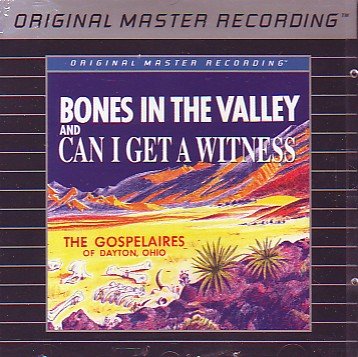
I'm going to re-run this marvelous post from Preslives that appeared around a year ago; I imagine the are a number of you that missed this rareity.
The Gospelaires of Dayton, Ohio were one of the most dynamic quartets that took the 1950s sound of Julius Cheeks and the Sensational Nightingales forward into the 1960s. As Gospel supplied the elements that fueled the evolution of R&B into Soul in the 1950s and 1960s, Gospel also wasted no time in borrowing back what it could from R&B to modernize the spiritual sound. This cross-pollination was so intense that, by the mid-1970s, much of R&B and gospel became virtually indistinguishable except for the lyrics. Like other quartets that came to prominence in the 1960s like the Violinaires and the Mighty Clouds of Joy, the Gospelaires made use of a full R&B-type band accompaniment and vocal innovations of secular groups like the Five Royals to carry on the rich hard gospel tradition.
The Gospelaires of Dayton, Ohio were one of the most dynamic quartets that took the 1950s sound of Julius Cheeks and the Sensational Nightingales forward into the 1960s. As Gospel supplied the elements that fueled the evolution of R&B into Soul in the 1950s and 1960s, Gospel also wasted no time in borrowing back what it could from R&B to modernize the spiritual sound. This cross-pollination was so intense that, by the mid-1970s, much of R&B and gospel became virtually indistinguishable except for the lyrics. Like other quartets that came to prominence in the 1960s like the Violinaires and the Mighty Clouds of Joy, the Gospelaires made use of a full R&B-type band accompaniment and vocal innovations of secular groups like the Five Royals to carry on the rich hard gospel tradition.
 The Gospelaires were formed in the mid-1950s in Dayton,
Ohio, and steadily built a strong reputation that led to a contract for Peacock
records in 1957. The two
records on this compilation come from their mid-1960s prime, when the group was
fronted by the one-two punch of Bob Washington and Paul “Easy” Arnold. The Gospelaires trademark was the use of repeated
hypnotic riffs, over which Washington and Arnold would steadily turn up the heat
with the aim of driving the Congregation into a frenzy There exist some good video tapes of this unit doing
exactly that. You might find
a few on Youtube.
The Gospelaires were formed in the mid-1950s in Dayton,
Ohio, and steadily built a strong reputation that led to a contract for Peacock
records in 1957. The two
records on this compilation come from their mid-1960s prime, when the group was
fronted by the one-two punch of Bob Washington and Paul “Easy” Arnold. The Gospelaires trademark was the use of repeated
hypnotic riffs, over which Washington and Arnold would steadily turn up the heat
with the aim of driving the Congregation into a frenzy There exist some good video tapes of this unit doing
exactly that. You might find
a few on Youtube.
This CD that combines The LPs Can I Get a Witness and Bones in the Valley is another of the precious few short-lived Peacock Spiritual Series releases from late 1980s, after which time the reissue of the Peacock gospel catalog was abandoned indefinitely by MCA.
May this music help infuse your Soul with the
spirit on this Sunday morning!

Monday, April 8, 2013
The Sunset Travelers - With O.V. Wright

How else can I follow KC’s last incredible O.V. Wright post except with more
of the same? I have gathered
here what should be something close to all of O.V. Wright’s first recordings
from the late 50s and early 60s, when he was singing gospel with the Sunset
Travelers and hadn’t yet crossed over into secular music. Before O.V. Wright became a Soul
legend, he had already become a sensation on the gospel programs (But I don't know of any photos of the Sunset Travelers with O.V. Thus, photo to the left)
The Sunset Travelers started in Memphis in 1950. They recruited the teenage O.V. Wright
in the late 1950s and first recorded with O.V. for Peacock in 1959. The first 12 tracks here correspond to
the Peacock LP, “On Jesus Program.”
Although a few of the tracks do not feature O.V. Wright on lead vocals,
I left them in for completeness.
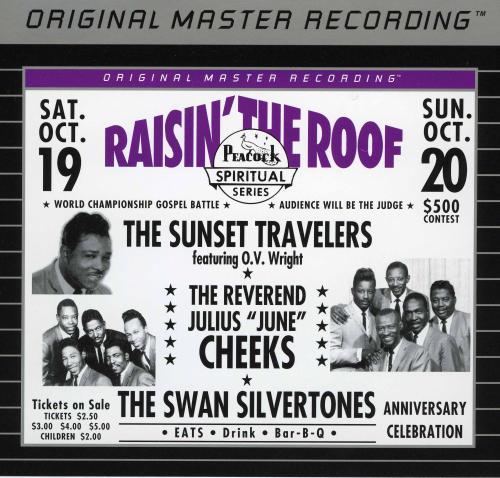
"On Jesus Program" was actually issued on CD in the US in the late 1980s on the compilation "Raisin' the Roof," pictured on the right. When MCA launched the Peacock Spiritual Series at the dawn of the CD era, that raised a lot of hopes for a spectacular reissue series of the Peacock label. But after this release and a few other CDs (which I may post later), MCA trashed gospel reissues altogether and never again released anything from the vast Peacock catalog in the US.
I have tacked on to “On Jesus Program” ten more Sunset
Travelers tracks featuring the incomparable O.V. Wright on lead vocals. Track number 13, “Sit Down and
Rest a While.” deserves comment.
This is the very first recording featuring O.V. Wright when had just joined the group. The Sunset
Travelers themselves made it as a demo. When I first heard it, I didn’t even think that it was
O.V. The sonorities are right, but
certain elements of his mature style are not there yet. However, Grover Blake, a member and manager of this Sunset Travelers group, has verified that it is is indeed O.V. Wright. Lazurus and You Are Blessed come from
the very first 45 the Travelers with O.V. Wright made for Peacock in 1959. Here, the unique presence of O.V. is already unmistakable.
So there you have it – the first installment of the O.V.
Wright story. Whatever you do on
this blog, do not miss the second installment (Backbeat and Goldwax recordings) posted by KC below. The third installment (the Hi
Recordings) might show up here sooner or later. But those recordings are easily purchased commercially.
Sunday, April 7, 2013
Big Mama Thornton - Hound Dog & Ball N' Chain
 It is time continue with more of the great women of this music. Willie Mae "Big Mama" Thornton (December 11, 1926 – July 25, 1984)
Thornton was born in Ariton, Alabama, near Montgomery. Her father was a Baptist minister and her mother a gospel singer. She and her six siblings began to sing at very early ages in the church. Following her mother's death in 1941, Thornton left the family home at age 14. She spent the next seven years touring the south with Sammy Green's Georgia-based Hot Harlem Revue, gaining experience as a singer, harmonica player and sometime drummer. In 1948, she settled in Houston, Texas, where she further honed her skills in the local clubs.

Thornton began her recording career in 1951, signing a contract with Don Robey's Peacock Records. While working with fellow Peacock artist, Johnny Otis, she recorded "Hound Dog," a song written by young songwriters Jerry Leiber and Mike Stoller. (they were teenagers with whom Otis had a sort of mentoring relationship.) The record was produced by Otis, and went to number one on the R&B charts. She never repeated that success but continued to record for Peacock until 1957 performing in the Chitlin Circuit R&B package tours with Little Richard, Junior Parker, Bobby Bland and Esther Phillips.
 In 1954, Thornton was one of the eyewitnesses to the accidental suicide death of singer, pianist Johnny Ace. Thornton's account was that Ace was sitting with girlfriend Olivia on his lap, waving his pistol around, pointing it at Willie Mae. "Don't snap that on me," she told him. Johnny grinned and put the gun to Olivia's head. "Stop that, Johnny, you'll git someone killed," Willie Mae shouted at him. "Nothin' to worry about," Johnny replied, coolly, "ain't but one bullet here and I know exactly where it is." He turned the gun on himself, put it to his temple and pulled the trigger.
 Other stories from the Peacock/Duke era reveal that Thornton was a huge, intimidating woman with a foul temper. She was known to beat men to a pulp in bar-room brawls and usually collected her gig pay and royalties through sheer physical intimidation (and the rumored pistol in her purse), but she was known to resort to direct violence to extort her payments when necessary.
Big Mama is most often described as a hard drinking 'bull dyke' who loved to party but was prone to violent temper explosions. She allegedly once chased Little Richard for most of an evening with murder on her mind when he took his teasing over her sexual preferences too far. Thornton once even faced down the notoriously tough Don Robey when he pulled his famous pistol on her, telling him that if he failed to kill her on the first shot, they would be surgically removing the pistol from his ass. Robey put the pistol away and pulled out the checkbook.
 In a later event she reportedly beat one white record executive relentlessly about the head with her purse whilst onlookers begged her to stop until someone from accounting finally arrived with a check to diffuse the incident. I imagine she didn't have to ask for her check twice after that.
Thornton's career followed the arc of many of the R & B stars, declining through the late 50's and early 60's with the advent of soul and rock and roll, but she was amongst those who were 'rediscovered' in the mid to late 60's in the packaged American Folk tours in Europe. A new recording contract with Arhoolie followed which resulted in Ball N' Chain and the other recordings in the second part of the post.
Throughout the 70's Big Mama continued to perform at festivals with the likes of Muddy Waters, Lightning Hopkins and B.B. King but her health steadily declined from hard living. Her last appearence was at the 1980 Newport festival. She died in 1984 in Los Angeles at only 57 years old.
Sunday, February 3, 2013
Inez Andrews - Thank You Lord / Toiling

 Let's start off our Sunday service with a small addendum to Pres' earlier Inez Andrews post...a pair of gems that show her off in her prime. 'Toiling' is as impassioned a performance as I have ever heard from her. I just picked this up Friday night, an impulse buy that I am well pleased with.
Sunday, November 11, 2012
The Best of The Mighty Clouds of Joy - (Peacock years)

"Contemporary gospel's preeminent group, the Mighty Clouds of Joy carried the torch for the traditional quartet vocal style throughout an era dominated by solo acts and choirs; pioneering a distinctively funky sound which over time gained grudging acceptance even among purists, they pushed spiritual music in new and unexpected directions, even scoring a major disco hit. the Mighty Clouds of Joy were formed in Los Angeles during the mid-'50s by schoolmates Joe Ligon and Johnny Martin; while still in their teens, the original group -- which also included brothers Ermant and Elmo Franklin, Leon Polk and Richard Wallace -- made their recorded debut in 1960 with "Steal Away to Jesus," cut for the Peacock label. Their debut LP Family Circle arrived a year later. In the years that followed, the Mighty Clouds earned a reputation among gospel's greatest showmen; one of the first groups to incorporate choreographed moves into their act, their nimble footwork and bright, color-coordinated outfits earned them the sobriquet "The Temptations of Gospel." More importantly, they were the first group to add bass, drums and keyboards to the standard quartet accompaniment of solo guitar, resulting in a sound which horrified traditionalists but appealed to younger listeners -- so much so, in fact, that the Mighty Clouds became the first gospel act ever to appear on television's Soul Train, where they performed their disco smash "Mighty High." Their crossover success continued with opening slots for secular pop stars including Marvin Gaye, the Rolling Stones and Paul Simon, whom the group backed during a month-long stint at Madison Square Garden. While lineup changes plagued the Mighty Clouds throughout their career, they remained active through the 1990s; in addition to co-founders Ligon and Wallace, their latter-day incarnation also included Michael McCowin, Wilbert Williams, Johnny Valentine and Ron Staples."