A dreary gray day here in the city that care forgot. The sky has joined the music lovers of New Orleans in shedding tears for the loss of a great man. Even those who have felt wronged by him at some time would never wish him the fate of passing away alone in a hotel, so far from his beloved New Orleans. The apparent glamour of the life of a musician has a dark side that is too easily forgotten. I'm a little surprised by the depth of sadness and loss I am feeling today as I sit to write this while listening to Motion. Through my friend Zigaboo I had been introduced to the imperfect side of Allen, but over time I've let it go. It is a sign of your own mortality when your heroes are dying at such an alarming rate.
"It could be the closest I've ever come to greatness.
I was at
an outdoor daytime concert at the Old U.S. Mint in New Orleans. Just
before the music began, a slim, elegant figure emerged. He leaned
against a wall near where I was standing and proceeded to listen to the
music by a band that enjoyed playing the songs of the great Louisiana
swamp rocker Bobby Charles.
It was Allen Toussaint.
Toussaint, who died Monday at 77, was a seminal force in New Orleans rhythm and blues.
Yet there he was, by himself, no entourage or posse or special
treatment, dapper as always in a suit despite the New Orleans heat,
mingling with the masses and enjoying the tunes.
Toussaint, a disciple of New Orleans piano legend Professor Longhair,
was a protean musician, a singer, a splendid piano player in a city
that has produced so many of them, and, most important, a prolific
songwriter and producer. He wrote so many of the songs that define the
extremely fertile era of 50s and 60s New Orleans R&B – think Mother-in-Law and Lipstick Traces and Working in the Coal Mine and I Like It Like That and Ruler of My Heart. He collaborated with Elvis Costello, Paul McCartney and Patti LaBelle. He arranged horns for The Band. His songs were covered by the Rolling Stones (Fortune Teller) and Glen Campbell (Southern Nights). He was named to the Rock and Roll Hall of Fame and he received a National Humanities Medal from President Obama.
He is a national treasure.
Yet
for all his achievements, for all that prodigious talent, Allen
Toussaint never became a household name – except in the right
households. And, of course, in New Orleans, where he was royalty." Rem Reider, USA Today
"From the German-based Bear Family Records reissue label comes over two-dozen selections by a young Allen Toussaint (piano) during his earliest outings as a solo artist -- albeit under the slightly truncated nom de plume of "A. Tousan" or simply "Tousan." Although he'd been gigging and sitting in on a variety of Crescent City R&B sessions, it was RCA Records' Danny Kessler who took the initiative to book studio time for Toussaint. That very first endeavor -- held on January 29, 1958 -- featured Toussaint supported by other Nola locals Alvin "Red" Tyler (baritone sax), Nat Perrilliat (tenor sax), or Lee Allen (tenor sax), either Justin Adams (guitar) or Roy Montrell (guitar), Frank Fields (bass), and Charles "Hungry" Williams (drums). While the exact lineup may not be certain, what is undeniable is the masterful energy of these seminal sides. Toussaint revealed to a reviewer that he "had no involvement in the titles of the songs. When I played them, I referred to them as 'Song Number One,' 'Song Number Two' and so on. It wasn't until the record came out that I was informed Kessler had chosen to name each piece after a different racehorse." Once "Whirlaway" b/w the raucous sacred-inspired "Happy Times" scored favorable results, Kessler hit Toussaint up for enough material to compile what would become the full-length Wild Sound of New Orleans (1958) LP. Arguably the best-known of the instrumental lot is the perky "Java" -- which Al Hirt (trumpet) was able to take to the top of the pop singles survey, not to mention carve out a nice career for himself in the process. Other entries worthy of multiple spins include the mile-a-minute "Tim Tam," "Bono," and the musical Mardi Gras that is "Nashua" -- which owes much to Professor Longhair and points the way for Toussaint's future musical aspirations. Similarly, "Wham Tousan" and "Pelican Parade" are evidence of Toussaint's already fully formed keyboard style. The second half of the Complete "Tousan" Sessions (1992) is dedicated to tracks destined for the Seville imprint and credited to "Al Tousan and His Piano." Of the 15 tunes documented during the December 7 and 8, 1959 session only a handful were ever released. Namely, the 45s "Chico" b/w "Sweetie Pie," "Naomi" b/w "Back Home Again in Indiana" -- a rare cover tune for Toussaint, "A Blue Mood" b/w "Moo Moo" (aka "Cow Cow Boogie"), and "Real Churchy" b/w "Twenty Years Later." Interestingly, the latter is nothing more than a recycled and abbreviated edit of the aforementioned "Sweetie Pie." The remainder make their debut and in true Bear Family style are thoroughly annotated in the 20-page liner notes booklet."
Hard to wrap your mind around - I just saw him play a couple weeks ago and ran into him a couple days later on Royal St. as I was coming out of the grocery. He looked the picture of health. This is my personal favorite album. I was surprised to discover I hadn't posted it before.
No matter what issues anyone may have had with him it is very sad to know that he died alone in a hotel room so far away from home.
The album predates the Sea-Saint era, it was
recorded in Los Angeles but with a cast of New Orleans players including
Mac Rebennack, John Boudreaux, Clyde Kerr and Earl Turbinton. Released
on the English Kent label the album wasn't given wide distribution in
the states and quickly disappeared from print. The record featured
Toussaint versions of Working in a Coal Mine and Everything I Do Gonna
Be Funky both of which were previously released by Lee Dorsey.
Allen Toussaint - From a Whisper to a Scream
Kent 1970
1) From a Whisper to a Scream
2) Chokin' Kind
3) Sweet Touch of Love
4) What is Success
6) Everything I Do Gonna be Funky
7) Either
8) Louie
9) Cast Your Fate to the Wind
10) Number Nine
11) Pickles
A reminder that this is primarily th work of Dr Hep Cat, I helped, but the bulk of the material came from him - there will even be a suplimental as he has come up with even more but this was already uploaded and you can't delete Embedupload items.
"Pioneers in gospel like Sister Rosetta Tharpe and the Ward Singers had
taken gospel music beyond the confines of the church and in the '50s
New York disc jocky and gospel singer Thurman Ruth began to present
his Gospel Caravans at the Apollo. Thurman remembered the Swanees as
"the greatest singing group that I had at the Apollo. They were
terrific. I had them with another big-name group and the big name was
closing. But the Swanee
Quintet was so tough that I had to let them close the show."
By the '60s the sales of the Swanee Quintet's singles were dipping
and though Nashboro released albums like 1960's 'What About Me',
1962's 'The Anniversary Album', 1963's 'Meetin' Tonight' and 1964's
'Soul Stirring Gospel' the golden age for the group seemed to be over.
But then "Mister Dynamite", James Brown, took an interest in the
Swanee's dwindling career.
Brown had once worked as a shoe shine boy outside the WGAC radio
station in Augusta (where the Swanees had their afternoon radio
programme). The shoe shine boy grew up listening to the Swanee Quintet and
in his teenage years secularised the sound of Ruben Willingham and the
Swanees to start James Brown & The Famous Flowers. The R&B
star took the Swanee
Quintet under his wing and gave them a spot in his touring review
and even produced a single, "Try Me Father", with them. As it turned
out, even with the James Brown Band behind them the single, on
Crescent Records, a gospelisation of Brown's 1958 hit "Try Me", was
not a success. Shortly after that session Ruben Willingham left the
Quintet to enter the ministry and perform as a solo singer, although
on his first recordings in 1969 he used the Swanees as a backing
group. Johnny Jones was briefly tempted into an unsuccessful
mainstream R&B career, but he too rejoined the Swanees from time
to time.
The group brought in replacement lead singers Percy Griffin and
Clarence Murray and, though not at the same pace as of old, continued
to tour and, occasionally, record. The Swanee Quintet recorded albums like
'Eternal Life' (AIR, 1992), 'Just One Rose Will Do' (AIR, 1995), 'So
Glad' (AIR, 1998) and 'The New Walk' (Gospel Jubilee, 2000). In 2002
James "Big Red" Anderson was inducted into the Gospel Hall Of Fame
while the following year J R Riles, with the help of fellow Augustans
recognised the historical significance of the veteran gospellers by
honouring the group by naming a street Swanee Quintet Boulevard."
"The second volume of Bear Family's four-part electric blues series Plug It In! Turn It Up! features the years 1954-1967 but that's slightly misleading, as much of the latter years are bunched up on the third disc, which rounds up 29 significant instrumentals. The rest of the collection concentrates on continuing the story the first volume began, as West Coast, Delta, and Chicago blues all began to swing harder and play louder, working their way onto rock & roll jukeboxes as they did so. Some of these singles do play like rock & roll -- that's particularly true of Bo Diddley's heavy-footed rumble and Hank Ballard's easy shuffle on "Look at Little Sister" -- but this is primarily devoted to electrified blues that jolts and jumps like a bare wire. There are plenty of big names and classics here, songs that would later be standards in any number of house bands across the country: "Kansas City," "I'm Ready," "My Babe," "I'm a Man," "I Wish You Wouldn't," "I Can't Quit You Baby," "Got My Mojo Working," "I'm a King Bee," "Texas Flood," "Kansas City," "Baby What You Want Me to Do," "The Sky Is Crying," "Wham!," "Frosty." It's a crash course in history that plays like a party, even on that third disc of high-octane instrumentals."
I had mentioned that Dr Hep Cat and I were working on this and we have managed to create a 4 part collection of over 100 songs! Today I will offer parts 1 & 2, covering a period from 1953 to 1967. The history below comes from the excellent blog Cross Rythms by Tony Cummings. If you click on the name here or on the 'see more below it will take you there.
"The Swanee Quintet
are gospel music survivors - an old style vocal group who over the
decades have travelled the Gospel Highway playing everything from
humble storefront churches to Carnegie Hall and Madison Square Garden.
They are also a group who were called gospel's "countriest" act by
gospel authority Anthony Heilbut (meaning the Swanee's sound was raw
and rural rather than veering towards the white sounds of Nashville)
yet a group sophisticated enough to record and tour with Soul Brother
No 1, James Brown. While hosting a TV special opening the remodelled
Apollo Theatre, actor/comedian Bill Cosby said that one of his
favourite memories "was watching the Swanee Quintet excite the Apollo
audience with their special brand of gospel music."
The origins of the group go back to 1939 when a trio - consisting of
Charlie Barnwell, Rufus Washington and William "Pee Wee" Crawford -
toured Georgia and South Carolina. Based in Augusta, Georgia, they
added two other members, James "Big Red" Anderson and Ruben W
Willingham, and by 1945 the group were operating as the Swanee Quintet with
Willingham on lead vocals, Crawford dropping his vocal duties to
concentrate on playing his un-mistakeable guitar and the other members
harmonising. The group's name was as downhome as their music, gospel authority
Chris Smith observing, "The Swanee Quintet [was] closer than most
people have got to the correct spelling since Stephen Foster altered
the Suwannee River to fit his tune."
For several years the Swanees were featured on a daily radio programme
in Augusta. Eventually in 1951 the group came to the attention of
Nashville entrepreneur Ernie Young who had formed Nashboro Records, a
label with a close link to Ernie's Record mart retail, mail order and
distribution house. From the outset, Ernie Young had hit upon a
reliable niche market for gospel music amongst Southern blacks and
with regular exposure on the influential Nashville radio station WLAC
he had a ready sales outlet in Ernie's Record Mart. The first 78s
released on Nashboro by the Silvertone Jubilee Singers, Zachery's
Heavenly Gospelaires and the Skylarks were moderate but as the '50s
rolled on regular play on WLAC of Nashboro's growing roster of
downhome gospel purveyors like the Consolers, Edna Gallmon Cooke,
Professor Harold Boggs and The Swanee Quintet the hits began to come.
It was the Quintet's 1953 single "Sit Down Servant" they broke big on
the gospel market. Wrote Chris Smith, "The song had all the
ingredients that were to be typical of their style over the years:
Crawford's bluesy guitar riffs, the mighty background chords of
Anderson, Barnwell and Washington (these three formed the Swanee's
backing vocal team for over 30 years) and above all the fierce
preaching and singing of Ruben Willingham, moving with an easy grace
from speech to song to something in between." More successful Swanee Quintet singles like "Cry Sometime" (1954),
"It's Hard To Get Along" and "I'm Alright Now" (1955) and "Race To
Run" and "Jesus Won't Fail" (1956) followed. Chris Smith described Rev
Ruben Willingham as the "testifier par excellence" and certainly his
rasping exhortations to keep faith in Christ were as exciting as
anything in gospel. If Willingham's singing needed anything to make it
perfect, it was a foil, someone to supply contrast. "Big Red" would
sing falsettos in the background, but in 1956 the group went to the
next level when the Quintet became a sextet when Little Johnny Jones
joined. The addition of Jones' sweet high tenor to the group's vocal
armoury was a revelation. More singles like "Come See About Me" (1957)
and "Sleep On Mother" and "Over In Zion" (1958) and "My Father's Land"
(1959) were good but it was their "New Walk" single recorded in August
1959, with its stately but impassioned beginning suddenly transforming
into an uptempo, church wrecking romp, that is considered a classic.
Chris Smith wrote about the Quintet, "As the years passed there was
little change to the Swanee's sound; they and Nashboro kept up with
musical fashion adding various combinations of bass, piano, organ and
drums at times, but luckily these were usually well and unobtrusively
played and they don't distract, either from the vocalists or from
Crawford's guitar work."....see more
Mitty Lene Collier (born 21 June 1941) Mitty Collier was born in Birmingham, Alabama, the seventh child of Rufus and Gertrude Collier, and attended Western-Olin High School, Alabama A & M College and Miles College where she majored in English. She began singing in church as a teenager, and toured with gospel groups, the Hayes Ensemble and the Lloyd Reese Singers, before starting to sing rhythm and blues in local clubs to help subsidize her college education. In 1959, while visiting Chicago, she entered DJ Al Benson's talent show at the Regal Theater, winning for six straight weeks and gaining her a slot on a bill with B. B. King and Etta James as a prize. This brought her to the attention of Ralph Bass of Chess Records, who offered her a recording contract.
She recorded for the Chess label from 1961 to 1968, releasing 15 singles and one album, mostly produced by Billy Davis. Her first record was "Gotta Get Away From It All", which was not a hit. Her first real success came in 1963 with "I'm Your Part Time Love", an answer record to Little Johnny Taylor's "Part Time Love". It reached # 20 on the Billboard R&B chart, and was followed up with "I Had A Talk With My Man", a secularized version of James Cleveland's gospel song "I Had A Talk With God Last Night". The orchestrated ballad reached # 41 on the Billboard Hot 100 and # 3 on the Cash Box R&B chart, and became her best known song, later being covered by Dusty Springfield and Shirley Brown among others. Her next record, "No Faith, No Love", was also a reworking of a James Cleveland song, and reached # 29 on the Billboard R&B chart and # 91 on the pop chart. She released an album, Shades Of A Genius, in 1965. Her last hit, in 1966, was "Sharing You" (# 10 on the R&B chart, # 97 pop). She left Chess in 1968 after recording a single, a new version of "Gotta Get Away From It All" recorded at FAME Studios in Muscle Shoals with producer Rick Hall. She recorded five further singles and an album with William Bell's Peachtree label in Atlanta, Georgia. However, in 1971 she developed polyps on her vocal cords, losing her singing voice, and gave up her secular music career.
She then began to devote her life to her Christian beliefs. After recovering her voice she recorded several albums of gospel music, of which the first, The Warning in 1972, featured "I Had A Talk With God Last Night". Later albums included Hold The Light (1977) and I Am Love (1987). She also established a Bible Study Telephone Prayer Line and a community outreach program, "Feed-A-Neighbor" (FAN), for which she received the key to the city of Birmingham in 1987. She became a preacher, and was ordained in 1989, later being appointed pastor of the More Like Christ (MLC) Christian Fellowship Ministries in Chicago. She has also worked at the University of Chicago, as well as writing plays and continuing to sing gospel music. She has received a number of other humanitarian and other awards, including the National Council of Negro Women (NCNW) Woman of Wonder Award 2000. wikipedia
In the Bluesless desert of the late 1980's, this album was a saving oasis for me. A Rhythm & Blues classic by one of my favourite female vocalists - Etta is up there along with Bessie Billie and Aretha.
Here is what Etta said about 'Seven Year Itch'...:
"That's the title I gave my first album on Island, 'cause it'd been seven years since I recorded for a major company...We cut a horn-heavy Stax/Volt-sounding soul record, with fat charts by Jim Horn and a selection of songs that included choice Otis Redding ('I Got The Will')- I'll never get tired of singing Otis- and a ballad I really loved, 'Damn Your Eyes'. The record didn't burn up the charts, but it was solid, nominated for a Grammy, and sold well enough where Chris Blackwell wanted another one."
(From 'Rage To Survive - The Etta James Story' by Etta James & David Ritz - A great read by the way !)
It's an album I still play regularly and thoroughly recommend.
Musicians include : Barry Beckett, Willie Weeks, Roger Hawkins, Art Neville, Steve Cropper, Jim Horn and others...Enjoy
I think it is time for a re-working of this post. There is a considerable amount of added material.
Ahh, the sad story of Steven Q. Reeder, "but for chance there go I". One of the creative influences behind what makes Little Richard a star but when Richard uses Esquerita's style at The Dew Drop Inn and blows Bumps Blackwell's mind, he may have doomed his buddy to obscurity and an ugly death. Little Richard's New Orleans sessions are so huge and so national that when the guy who actually invented the whole schtick finally gets recorded he is dismissed by an understandably ignorant public as an imitator. No matter that he is a far superior pianist (I give Richard the clear singing edge), the world seemingly has room for only one. This post has been reworked to include all but a tiny handful of stray tracks - this is All The Voola.
Born in Greenville, S.C., in 1935, Steven Quincy Reeder began calling himself "Eskew" after his initials – S.Q. Later, of course, the name became Esquerita, then went back to Eskew. (Little Richard claimed his predecessor liked to point out how his nickname sounded like "excreta.") An early performing career with a gospel group known as the Heavenly Echoes soon led, in a roundabout fashion, to the singer's outrageous nightclub act.
" With his flamboyant makeup, sculpted pompadour, assaultive piano playing and glass-busting trills, Little Richard is invariably described as a rock 'n' roll nonpareil. But Richard himself has often acknowledged that his persona has a lot to do with one of the true unsung heroes of rock – a forgotten wildman who answered to the stage name Esquerita.
Appropriately enough, they met in a Greyhound bus station in Macon, Ga., late one night, when the only people around were the prowlers "trying to catch something – you know, have sex," as Richard Penniman explained in his biography 'The Life and Times of Little Richard.' Eskew Reeder, as the man was then known, had the biggest hands Richard had ever seen. He performed, apparently, with an evangelist named Sister Rosa and an undersized singer appropriately called Shorty. When Richard asked this brother from another planet if he would teach him how to pound the piano, Reeder happily obliged.
People are largely unaware that when those iconic Specialty recordings were made in New Orleans, Richard was not a piano player. (Fats Domino is amongst those thought possible to have played on the sessions.) His piano teachers were Reeder and "..a guy named James (Booker)." There was some period when Reeder toured with Richard as his piano player. It has never been clear to me when that was, or how it was they both ended up in New Orleans at the same time, and why Reeder stayed behind.
Though Little Richard would later claim he gave Esquerita the idea for his gigantic bouffant, (other parts of the story would seem to belie this) that's the only mention of Richard's mentor in the biography. To this day, little is known of Esquerita, whose sole album, released in 1959, was mistakenly seen as little more than a Little Richard copycat job.
"Professor" Eskew Reeder was discovered playing a Greenville barroom called the Owl Club by Paul Peek, guitarist for Gene Vincent's rockabilly backing band, the Blue Caps. Peek introduced the free spirit with the rhinestone wraparound shades to talent scouts at Capitol Records, who had signed Gene Vincent as the label's answer to Elvis. Here was the label's answer to Little Richard.
Later, Reeder would scuffle his way through the '60s, reportedly gigging with the future Dr. John and a young Jimi Hendrix – and cutting a few sessions with a grateful Little Richard. He recorded some songs for Motown, never released. He began changing his stage name – Voola, the Magnificent Malochi – to no avail.
By the '70s, he was playing seedy gigs in back-alley gay bars in New York, billed as Fabulash. A decade after that, he was reduced to begging for change as a squeegee man. Esquerita died of complications from AIDS in New York in 1986, at age 52.
Sadly, his one Capitol album, despite a fantastic, iconic cover image of the singer with his wig piled high and a collection of raucous bawlers inside, came across as one too many Little Richards for the world to handle. Ironically, it was only when an unproven Richard had stretched out his Esquerita muscle on a previously lackluster session in New Orleans that he found his own voice as early rock 'n' roll's most thrilling loony tune.
The first part of this bonanza will take you to Blue Dragon who recently posted the first chapter of this musical story (click the blog name). The subsequent material, mostly recorded here in New Orleans, is in the normal place.
We have a new blog regular, Dr. Hep Cat, to thank for this week's Gospel post. We were FB chatting about other music when he asked me the question "are you hip to Johnny Jones?". I was forced to respond "apparently not!" (a response delivered with a bit of a wince, I admit). DHC came back "he was one of the lead vocals for The Swanee Quintet." ...Well okay, I've heard of them and have some tracks on compilations... not enough that I know a thing about the members tho. Well DHC responded by sending me a pair of jaw dropping lp rips and I was hooked! That pair of records represented 2/3 of his solo output and over the next couple days I managed to come up with the other lp (contained in the compilation pictured here) and even a couple of secular tracks (there were 4 recorded all told, DHC had a third, but one is still missing)! What you will get in this package is everything we have assembled to date which has to be very close to being complete.
Johnny was not a hard gospel 'shouter', but instead a smooth gospel crooner more in the mold of Sam Cooke. In fact, when Sam left the Soul Stirrers to pursue his secular career, it was Jones who was his first replacement. After 6 months or so, Johnny decided that the Stirrer's were not for him and he left, clearing the way for Johnnie Taylor.
An offshoot of this project you will hear today is that DHC and I both realized that there wasn't much in the way of a satisfying collection of The Swanee Quintet out there either and we began working on remedying THAT situation too! It will be a week or two before we reveal the results of our quest on that front, but let me offer that we succeeded beyond our wildest dreams!
AllMusic Review by Stephen Thomas Erlewine
"Bear Family's Electric Blues history Plug It In! Turn It Up! may not seem quite as ambitious as some of their projects, but that's only because it arrives in four volumes of three CDs, not a hulking 12-disc, 12X12 box complete with a hardcover book. Taken on its own terms, it is a pretty impressive chronicle of electrified blues from its infancy to its prime. Here in the first volume, the spotlight shines on its birth, opening up with a cut from Andy Kirk & His Twelve Clouds of Joy, a 1939 side called "Floyd's Guitar Blues" featuring a solo by Floyd Smith, and running to 1954, when the jumping, hard-charged sound started to break into the big time. Wisely, Bear Family is happy to repeat artists -- there is no way to limit yourself to just one T-Bone Walker or Muddy Waters song, after all -- and they bend the rules ever so slightly, letting in sides by R&B singers like Fats Domino and Ray Charles, artists who aren't always strictly classified as electric blues but certainly fit this wide definition. Roughly speaking, the first disc here is devoted to the swinging, jumping sounds of the '40s and '50s, with the second finding the rawer, nastier sounds starting to sneak in (Jackie Brenston's 'Rocket '88'," Howlin' Wolf's "How Many More Years," Elmore James' "Dust My Broom," and Little Walter's "Juke" pop up here), and the third concluding with the rise of overdriven Chicago blues and boogie, with Jimmy Reed rubbing shoulders with Wynonie Harris. Perhaps there are some seminal sides from these 15 minutes -- almost certainly there are -- but this first volume of Plug It In! Turn It Up! tells its story expertly and, best of all, it sounds like a party as it does so."
note if you double click either track list, they will expand for easier reading
"James Henry "Jimmy" Dawkins (October 24, 1936 – April 10, 2013) was an American Chicago blues and electric blues guitarist and singer. He was generally considered a part of the "West Side Sound" of Chicago blues. He was born in Tchula, Mississippi in 1936. He moved to Chicago in 1955. He worked in a box factory, and started to play local blues clubs, gaining a reputation as a session musician.
In 1969, thanks to the efforts of his friend Magic Sam, he released his first album Fast Fingers on Delmark Records, winning the "Grand Prix du Disque" from the Hot Club de France. In 1971, Delmark released his second album All For Business with singer, Andrew Odom, and the guitarist, Otis Rush. Dawkins also toured in the late 1970s backed up by James Solberg (of Luther Allison and The Nighthawks fame) on guitar and Jon Preizler (The Lamont Cranston Band, The Drifters), a Seattle based Hammond B-3 player known for his soulful jazz influenced style. Other musicians that toured with Jimmy Dawkins in the late 1970s were Jimi Schutte (drummer), Sylvester Boines (bass), Rich Kirch and Billy Flynn (guitars). With this combination of musicians Dawkins also toured Europe.
Dawkins began to tour in Europe and Japan and recorded more albums in the United States and Europe. Dawkins also contributed a column to the blues magazine Living Blues. In the 1980s he released few recordings, but began his own record label, Leric Records, and was more interested in promoting other artists, including Taildragger, Queen Sylvia Embry, Little Johnny Christian and Nora Jean Wallace.
Dawkins died of undisclosed causes on April 10, 2013, aged 76." wiki
If you check the Blue Eye blog (just click) you will find a remarkable collection of Boyd's earlier material - here is the next chapter.
"Edward Riley "Eddie" Boyd (November 25, 1914 – July 13, 1994) was an American blues pianist. He was born on Stovall's Plantation near Clarksdale, Mississippi. Boyd moved to the Beale Street district of Memphis, Tennessee in 1936 where he played piano and guitar with his group, the Dixie Rhythm Boys. Boyd followed the great migration northward to the factories of Chicago in 1941.
He wrote and recorded the songs "Five Long Years" (1952), "24 Hours" (1953), and the "Third Degree" (co-written by Willie Dixon, also 1953). Boyd toured Europe with Buddy Guy's band in 1965 as part of the American Folk Blues Festival. He later toured and recorded with Fleetwood Mac and John Mayall & the Bluesbreakers.
Tired of the racial discrimination he experienced in the United States, he first moved to Belgium where he recorded with the Dutch band Cuby and the Blizzards. He settled in Helsinki, Finland in 1970, where he recorded ten blues records, the first being Praise to Helsinki (1970). He married his wife, Leila, in 1977.
Boyd died in 1994 in Helsinki, Finland, just a few months before Eric Clapton released the chart-topping blues album, From the Cradle that included Boyd's "Five Long Years" and "Third Degree"."
This morning's lovely program was brought to you by Elder Clifford.
"Subtitled "Favorites From Classic Gospel Groups," and this compiles more great gospel treasures by some of the greatest gospel groups of all time and pulled from the multi-label vaults of MCA Records. Highlights include the Mighty Clouds of Joy's "Pray For Me," the Caravans' "One Of These Old Days," the Dixie Hummingbirds' "Christian's Automobile," the Soul Stirrers' "Jesus Be a Fence Around Me," the Ward Singers' "Didn't It Rain," and the Jackson Southernaires' "Too Late." Selections from the Five Blind Boys ("Save a Seat for Me"), the Williams Brothers ("Jesus Will Never Say No"), the Mighty Clouds of Joy ("Heavy Load"), the Staple Singers ("Pray On My Child"), the Gospel Keynotes ("He'll Make It Right") and the Davis Sisters ("Blessed Quietness") finish out this fine gospel group overview."
"Over in Glory: Favorites From Classic Gospel Groups [MCA, 1998]
All climax, all the time. In a music whose individual proponents make it
their business to channel the universal, why not stick to their
ecstasies and leave the mundane to their secular counterparts? Not that
these impassioned tracks are above detail--one apogee among many is the
Jackson Southernaires' painfully protracted tale of a son who reaches
his dying mama just hours too late. But whether the glorious singers are
getting happy or laying their burdens down, they're all in extremis,
opening windows not into their mortal souls but into an idealized gospel
experience--the spiritual release nonbelievers prize in a music that
will never be their own. Connoisseurs may cry cartoon, but for most of
us that's a plus, as are the articulated call-and-response built into
the group format and the crassness of Peacock's Don Robey, not a guy who
hesitated to besmirch the Lord with rhythm sections. Guitars either."
A Robert Christgau
"The four Campbell brothers--Chuck on pedal steel, Phillip on electric guitar and bass, Carlton (Phillip's son) on drums, and Darick on lap eight-string steel--play electric gospel music for the House of God, Keith Dominion church. Emphasizing the steel guitar, the group stick to a repertoire that avoids rock and blues, but nonetheless betrays the influences of those forms in their arrangements, which also draw from country, jazz, and other forms. Although their selection of material is spiritual, the guitar work of Chuck Campbell in particular is imaginative and at times even experimental, using a tuning he devised himself and the E-bow to produce eerie sustain. With Kate Jackson on vocals and Charles Flenory contributing electric guitar to some cuts, they recorded an album for Arhoolie's Sacred Steel series, Pass Me Not, in 1996 and 1997. Both Sacred Steel on Tour! and Sacred Steel for the Holidays saw release in 2001. Can You Feel It? from 2005 appeared on a new label for the group, Rope a Dope." AMG
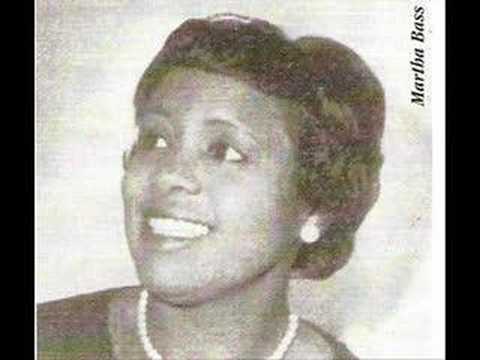
Martha Bass today is not nearly as well known as her daughter, Fontella Bass, or her son, David Peaston. This is partly due to the fact that she had curiously few opportunities to record. Fortunately, we have this masterpiece, I'm So Grateful, that preserves her legacy as one of the great gospel divas of her time.
Martha Bass was born in Saint Louis in 1921, and was trained as a gospel singer by the legendary Willie Mae Ford Smith (aka Mother Smith). She became one of the Clara Ward Singers briefly, but hardly had the opportunity to record until Chess Records took her into the studio in the 1960s. This LP was certainly the crowning achievement of her partnership with Chess.
There are 11 tracks on the LP, but separate recordings were made for the mono and stereo versions. So the CD release on Righteous Records ripped here contains both the stereo and mono versions.
If you like good gospel music, I am sure that you will enjoy Martha Bass.
"Robert Lee McCollum (November 30, 1909 – November 5, 1967) Born in Helena, Arkansas, he left home at an early age to become a busking musician, and after a period wandering through southern Mississippi, settled for a time in Memphis, Tennessee, where he played with local orchestras and musicians, such as the Memphis Jug Band. A particular influence during this period was Houston Stackhouse, from whom he learned to play slide guitar, and with whom he appeared on the radio in Jackson, Mississippi.
After further travels through Mississippi, he found it advisable to take his mother's name, and as Robert Lee McCoy moved to St. Louis, Missouri, in the mid-1930s. Local musicians with whom he played included Henry Townsend, Big Joe Williams, and Sonny Boy Williamson. This led to two recording dates in 1937, the four musicians recording together at the Victor Records studio in Aurora, Illinois, as well as recordings under his own name, including "Prowling Night-Hawk" (recorded 5 May 1937), from which he was to take his later pseudonym. These sessions led to Chicago blues careers for the other musicians, though not, however, for McCoy, who continued his rambling life, playing and recording (for Victor/Bluebird and Decca) solo and with various musicians, under various names. Kansas City Red was his drummer from the early 1940s to around 1946. He recorded Kansas City Red’s song "The Moon is Rising".
McCoy became a familiar voice on local radio stations; then Robert Lee McCoy disappeared.Within a few years, he resurfaced as the electric slide guitarist Robert Nighthawk, and began recording for Aristocrat and Chess Records, the latter of which was also Muddy Waters' label; in 1949 and 1950, the two men's styles were close enough that they were in competition for promotional activity; as Waters was the more marketable commodity, being more reliable and a more confident stage communicator, he received the attention. Though Nighthawk continued to perform and to record, taking up with United and States 1951 and 1952, he failed to achieve great commercial success.
In 1963, Nighthawk was rediscovered busking in Chicago and this led to further recording sessions and club dates, and to his return to Arkansas, where he appeared on the King Biscuit Time radio programme on KFFA. Nighthawk continued giving live performances on Chicago's Maxwell Street until 1964. He had a stroke followed by a heart attack, and died of heart failure at his home in Helena. He is buried in Magnolia Cemetery in Helena." wiki
"Joseph
"Smokey" Johnson (born November 14, 1936, New Orleans, died October 6, 2015, New Orleans)
is an
American drummer. He is one of the musicians, session players, and
songwriters who have served as the backbone for New Orleans' output of
jazz, funk, blues, soul, and R&B music.
Johnson served as the drummer for Fats Domino in the 1950s and 1960s.
In 1961, Johnson and Wardell Quezergue worked together on the session
for Earl King's proto-funk classic, "Trick Bag", produced by Dave
Bartholomew.
Soon thereafter, Johnson went with Quezergue and childhood friend Joe
Jones, and several other New Orleans artists (including Johnny Adams, Earl King and Esquerita) to audition for Motown in Detroit, where they recorded
numerous demo sessions. (Jones had conned everyone into believing the were going to record, rather than audition, see story) Earl King once remarked that at least part of
the reason why they got in the door was Motown's fascination with Smokey
Johnson, who could do more on a trap set by himself than any two of the
label's session drummers. Although Motown ended up not signing any of
the New Orleans artists, Johnson offered to remain on staff while the
other New Orleans artists were dispatched.
Johnson remained in Detroit for several months before deciding to
return home; but his influence on the Motown sound was profound, as the
other drummers studied his techniques, incorporating them into countless
hit sessions.
In 1963 and 1964, Dave Bartholomew enlisted Johnson for his last two
Imperial big band albums, giving Johnson the spotlight on the tune,
"Portrait Of A Drummer", from New Orleans House Party.
In 1964, about a year after Nola Records was formed in New Orleans,
Quezergue a partner in the label as well as principal producer/arranger,
invited Johnson to be the drummer for label's house band. After a few
months, Johnson and Quezergue wound up writing and recording what has
become a New Orleans Mardi Gras standard called "It Ain't My Fault".
Deftly arranged, "It Ain't My Fault" is a fascinating early example of
both Johnson and Quezergue incorporating Second Line syncopation into
pop music. The arranger's device of starting off with just the drummer's
relaxed but intricate percussive work (plus somebody hitting what
sounds like a glass bottle) quickly pulls the listener into the song,
even before the simple musical hook, played by just the guitar and
piano. George Davis runs the guitar riffs on the first side with that
recognizable style made famous several years later on Robert Parker's
"Barefootin'".
While the lighthearted, hard to resist "It Ain't My Fault" was
enjoyed locally in New Orleans, it did not have a national impact at the
time, it set the stage for many more uniquely funked up grooves to
follow, and over time has become a Mardi Gras favorite and a part of the
brass band repertoire.
Johnson stopped playing drums after suffering a stroke in 1993.
Johnson was forced to leave his home in the wake of Hurricane Katrina in
September 2005. Johnson is now a resident of Musicians' Village, a
Habitat for Humanity project in the Upper Ninth Ward of New Orleans." wiki
Smokey passed away yesterday, may he Rest In Peace.
If you want to explore the earlier recordings of Larry Davis there is an excellent post and collection at Blue Eye. (click here)
Artist Biography by Bill Dahl
Anyone who associates "Texas Flood" only with Stevie Ray Vaughan has never auditioned Larry Davis' version. Davis debuted on vinyl in 1958 with the song, his superlative Duke Records original remaining definitive to this day despite Vaughan's impassioned revival many years down the road.
Davis grew up in Little Rock, AR, giving up the drums to play bass. Forging an intermittent partnership with guitarist Fenton Robinson during the mid-'50s, the pair signed with Don Robey's Duke label on the recommendation of Bobby Bland. Three Davis 45s resulted, including "Texas Flood" and "Angels in Houston," before Robey cut Davis loose. From there, Davis was forced to make the most of limited opportunities in the studio. He lived in St. Louis for a spell and took up the guitar under Albert King's tutelage while playing bass in King's band.
A handful of singles for Virgo and Kent and a serious 1972 motorcycle accident that temporarily paralyzed Davis' left side preceded an impressive 1982 album for Rooster Blues, Funny Stuff, produced by Gateway City mainstay Oliver Sain. But follow-up options remained hard to come by: few blues fans could find a copy of the guitarist's 1987 Pulsar LP I Ain't Beggin' Nobody.
Finally, in 1992, Ron Levy's Bulleye Blues logo issued a first-class Davis set, Sooner or Later, that skillfully showcased his rich, booming vocals and concise, Albert King-influenced guitar. Unfortunately, it came later rather than sooner: Davis died of cancer in the spring of 1994.
Wilson Anthony "Boozoo" Chavis (born October 23, 1930 in Lake Charles, LA and died May 5, 2001 in Austin, Texas) was a zydeco musician.
"Boozoo Chavis (born: Wilson Anthony Chavis) was one of the pioneers of zydeco, the Cajun and blues hybrid originating in southwest Louisiana. Although his self-composed 1954 single, "Paper in My Shoes," was the first zydeco hit, Chavis was distrustful of the music industry and refused to perform publicly or record again until 1984. In an interview featured in the 1990 book, The New Folk Music, Chavis explained, "I got gypped out of my record. I get frustrated, sometimes. I love to play, but, when I get to thinking about 1955… They stole my record. They said that it only sold 150,000 copies. But, my cousin, who used to live in Boston, checked it out. It sold over a million copies. I was supposed to have a gold record." After leaving the music business, Chavis devoted his attention to raising champion racehorses in Shreveport and Lafayette, Louisiana and Texas. Chavis waited until 1984 before returning to music. Signing a five-year contract with the Maison de Soul label, he recorded four albums — Louisiana Zydeco Music, Boozoo Zydeco!, Zydeco Homebrew and Zydeco Trail Ride. Chavis' 1997 album, Hey, Do Right, was produced by Terry Adams, keyboardist for NRBQ, who paid tribute to Chavis in their 1989 song, "Boozoo, That's Who."
Chavis' performances, with his band, the Majic Sounds, included much-heralded appearance at the Newport Folk Festival and the New Orleans Jazz and Heritage Festival. The New York Times wrote, "(Chavis is) chaos on two feet. A little bullet of a man, he runs around onstage, shouting and yelling….(his) music can achieve a trancelike intensity". In a review of Chavis' performance at the Southwest Louisiana Zydeco Music Festival, Paul Scott wrote, "There are a lot of Boozoo prototypes coming out. They may be smoother than Boozoo but they try to get his hard accordion; that rough, raw, style; and his sore throat type of singing. And with that single-note and triple-note accordion, he's doing a lot to bring a return to basic zydeco'.
The son of tenant farmers, Chavis acquired his nickname as a youngster. Chavis was raised by his mother who cleaned houses and sold barbecue at horse races until raising enough money to buy a three acre tract of land where she and Chavis moved in 1944. Acquiring an accordion from his father and teaching himself to play, Chavis was soon playing at local barn dances and in the dance club, opened by his mother, where he often sat in with Morris Chenier and his sons, Clifton and Cleveland. In 1994, Chavis appeared in Robert Mugge's video documentary, The Kingdom of Zydeco. He was inducted into the Zydeco Hall of Fame four years later. And continuing to release music into the new millennium, Chavis issued Johnnie Billy Goat in fall 2000. On May 5, 2001 Chavis died after suffering from complications related to a heart attack he had a month earlier." last FM
In the shadow of the furor over 'Hoo Doo Man Blues' this album gets overlooked and at times outright disrespected. I'm pretty sure it was my fist Junior/Buddy vinyl so you will have to excuse my personal prejudice. I'll always love it.
The album is admittedly a schizophrenic mix of live and studio material and bands...I still wouldn't skip it. It's was a frequent late night choice. When others would play Lee Michaels' 'Stormy Monday' at me, this version was my response.
A repost of the whole thing! This was one of this blog's first Gospel posts more than 3 years ago.
"The majority of this music has never been reissued on CD, or in any other form (most tracks were originally released on regional independent labels). Most post-WWII compilations of African-American gospel music naturally concentrate on the astounding quartet and solo vocalist sounds made during the music’s Golden Age. Fire In My Bones attempts to address and collect more neglected sounds from that era (and on to the present day). Dozens of traditions are represented. Some go back hundreds of years while others seem to have been arrived at as soon as the tape began to roll. Field recordings and studio tracks are all mashed together, with solo performances next to congregational recordings, hellfire sermons next to afterlife laments. Leon Pinson, Elder & Sister Brinson & the Brinson Brothers, Grant & Ella, Straight Street Holiness Group, Theotis Taylor, Brother & Sister W B Grate—these artists will now be just a little less obscure.
Fire In My Bones provides a small peek at the incredible diversity and power of post-war black gospel. Much of this music is raw, distorted and might sound a bit strange. But it is not presented as a novelty freak show or as “outsider music.” This is gospel-which we must always remember translates as “the good news”-as it has been sung and performed in tiny churches and large programs, from rural Georgia to urban Los Angeles. It is clearly among the most vibrant, playful, beautiful and emotionally charged music in the world." Thomkins Square
I don't know 'bout anyone else, but I'm finding Jabo to be an absolutely delightful disovery! On this album he effortlessly slides between killer Zydeco, Deep Southern Soul, and even some 'adult urban' Chitlin Circuit blues. The man has got some serious chops!
I defy you to sit your ass still during 'Hard Times'; dis here zydeco rocks the way Beau Jocque used to do! 'Happy Anniversary' is pure Southern Soul on a level that's pretty damn rare these days. 'Bang Me' is a magic mix of rude Boo Zoo zydeco with a dash of Hip Hop that somehow succeeds brilliantly.
This brother is seriously the real deal, a star already in full bloom. Every damn song is another revelation and the variety is impressive. The two female guest vocalists are Smokin', the musicians are playing real instruments and THEY are Smokin'...these 10 tracks are without a doubt ALL KILLA', NO FILLA'!!


 Toussaint, a disciple of New Orleans piano legend Professor Longhair,
was a protean musician, a singer, a splendid piano player in a city
that has produced so many of them, and, most important, a prolific
songwriter and producer. He wrote so many of the songs that define the
extremely fertile era of 50s and 60s New Orleans R&B – think Mother-in-Law and Lipstick Traces and Working in the Coal Mine and I Like It Like That and Ruler of My Heart. He collaborated with Elvis Costello, Paul McCartney and Patti LaBelle. He arranged horns for The Band. His songs were covered by the Rolling Stones (Fortune Teller) and Glen Campbell (Southern Nights). He was named to the Rock and Roll Hall of Fame and he received a National Humanities Medal from President Obama.
Toussaint, a disciple of New Orleans piano legend Professor Longhair,
was a protean musician, a singer, a splendid piano player in a city
that has produced so many of them, and, most important, a prolific
songwriter and producer. He wrote so many of the songs that define the
extremely fertile era of 50s and 60s New Orleans R&B – think Mother-in-Law and Lipstick Traces and Working in the Coal Mine and I Like It Like That and Ruler of My Heart. He collaborated with Elvis Costello, Paul McCartney and Patti LaBelle. He arranged horns for The Band. His songs were covered by the Rolling Stones (Fortune Teller) and Glen Campbell (Southern Nights). He was named to the Rock and Roll Hall of Fame and he received a National Humanities Medal from President Obama.


:format(jpeg):mode_rgb():quality(96)/discogs-images/R-3740844-1367780565-8678.jpeg.jpg)