Friday, October 31, 2014

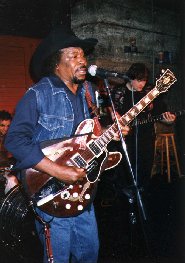
Screamin' Jay Hawkins - Voodoo Jive

 Jalacy Hawkins (July 18, 1929 – February 12, 2000), Born and raised in Cleveland, Ohio, Hawkins studied classical piano as a child and learned guitar in his twenties. His initial goal was to become an opera singer (Hawkins has cited Paul Robeson as his musical idol in interviews), but when his initial ambitions failed he began his career as a conventional blues singer and pianist.

Hawkins was an avid and formidable boxer. In 1949, he was the middleweight boxing champion of Alaska.

In 1951, Hawkins joined guitarist Tiny Grimes's band, and was subsequently featured on some of Grimes's recordings. When Hawkins became a solo performer, he often performed in a stylish wardrobe of leopard skins, red leather and wild hats.

His most successful recording, "I Put a Spell on You" (1956), was selected as one of The Rock and Roll Hall of Fame's 500 Songs that Shaped Rock and Roll. According to the AllMusic Guide to the Blues, "Hawkins originally envisioned the tune as a refined ballad." The entire band was intoxicated during a recording session where "Hawkins screamed, grunted, and gurgled his way through the tune with utter drunken abandon." The resulting performance was no ballad but instead a "raw, guttural track" that became his greatest commercial success and reportedly surpassed a million copies in sales, although it failed to make the Billboard pop or R&B charts.

The performance was mesmerizing, although Hawkins himself blacked out and was unable to remember the session. Afterward he had to relearn the song from the recorded version. Meanwhile the record label released a second version of the single, removing most of the grunts that had embellished the original performance; this was in response to complaints about the recording's overt sexuality. Nonetheless it was banned from radio in some areas.

Soon after the release of "I Put a Spell on You", radio disc jockey Alan Freed offered Hawkins $300 to emerge from a coffin onstage. Hawkins accepted and soon created an outlandish stage persona in which performances began with the coffin and included "gold and leopard skin costumes and notable voodoo stage props, such as his smoking skull on a stick – named Henry – and rubber snakes." These props were suggestive of voodoo, but also presented with comic overtones that invited comparison to "a black Vincent Price."

Hawkins' later releases included "Constipation Blues" (which included a spoken introduction by Hawkins in which he states he wrote the song because no one had written a blues song before about "real pain"), "Orange Colored Sky", and "Feast of the Mau Mau". Nothing he released, however, had the monumental success of "I Put a Spell on You". In fact, "Constipation Blues" has been described as "gross".In Paris in 1999 and at the Taste of Chicago festival, he actually performed the song with a toilet onstage.

He continued to tour and record through the 1960s and 1970s, particularly in Europe, where he was very popular. He appeared in performance (as himself) in the Alan Freed bio-pic American Hot Wax in 1978. Subsequently, filmmaker Jim Jarmusch featured "I Put a Spell on You" on the soundtrack – and deep in the plot – of his film Stranger Than Paradise (1983) and then Hawkins himself as a hotel night clerk in his Mystery Train and in roles in Álex de la Iglesia's Perdita Durango and Bill Duke's adaptation of Chester Himes' A Rage in Harlem.

In 1983, Hawkins relocated to the New York area. In 1984 and 1985, Hawkins collaborated with garage rockers The Fuzztones, resulting in "Screamin' Jay Hawkins and The Fuzztones Live" album recorded at Irving Plaza in December 1984. They perform in the 1986 movie Joey.

In July 1991, Hawkins released his album Black Music for White People. The record features covers of two Tom Waits compositions: "Heart Attack and Vine" (which, later that year, was used in a European Levi's advertisement without Waits' permission, resulting in a lawsuit), and "Ice Cream Man" (which, contrary to popular belief, is a Waits original, and not a cover of the John Brim classic). Hawkins also covered the Waits song, "Whistlin' Past the Graveyard", for his album Somethin' Funny Goin' On. In 1993, his version of "Heart Attack and Vine" became his only UK hit, reaching #42 on the UK singles chart.

Hawkins died on February 12, 2000 after surgery to treat an aneurysm. He left behind many children by many women; an estimated 55 at the time of his death, and upon investigation, that number "soon became perhaps 75 offspring"

Monday, October 27, 2014

Todd Rhodes

Todd Rhodes (August 31, 1900 – June 4, 1965) was an American pianist and arranger and was an early influence in jazz and later on in R&B.

He was born Todd Washington Rhodes, in Hopkinsville, Kentucky. Rhodes attended both the Springfield School of Music and the Erie Conservatory, studying as pianist and songwriter.

In the early 1920s he played with Benny Carter, Coleman Hawkins, Fats Waller, Rex Stewart, Doc Cheatham, and Don Redman in McKinney's Cotton Pickers, a jazz group. Rhodes lived and played in Detroit in the 1930s. In the late 1940s he started his own group, Todd Rhodes and His Toddlers, and started doing more R&B arrangements. With his Toddlers, he recorded "Your Daddy's Doggin' Around" and "Your Mouth Got a Hole In It." Rhodes also worked with Hank Ballard, The Chocolate Dandies and Wynonie Harris. He featured African American female lead singers, such as Connie Allen, who recorded "Rocket 69" in 1951. After she left the band in early 1952, her position was taken by LaVern Baker.

His instrumental "Blues For The Red Boy" became a top 5 R&B hit late in 1948, and was later famously used by Alan Freed as the theme song for his "Moondog" radio show. Freed apparently insisted on referring to the song as "Blues For The Moondog" instead of its actual title.

Rhodes died in June 1965 in Detroit, at the age of 64.

Eddie King & Mae Bee Mae - The Blues Has Got Me

Eddie King was a solid West Side Chicago blues singer and guitarist who left us in 2012.  He worked as a sideman for many prominent artists, most notably as Koko Taylor's lead guitarist for a number of years.   Following a few scattered 45s in the 60s and 70s, Eddie King only released two albums under his own leadership, this one (The Blues Has Got Me) in 1987 and Another Cow's Dead in 1997,
Both of Eddie King's albums are highly worthwhile, and Another Cow's Dead has probably received the most attention of the two.  But is is this album, The Blues Has Got Me, that has a very special place in my heart and listening rotation.   What puts this album over the top for me are the vocal contributions of Eddie King's sister, Mae Bee Mae.

I have no idea why Mae Bee Mae has not recorded very much.  If fact, I don't know any other recorded document of her.  I also do not know if she is still alive or active.   There is a lot of information about Eddie King and Mae Bee Mae up until this album was recorded in the superb detailed liner notes for this album by Robert Pruter that Black Magic has generously supplied in full online.  Check it out:  Liner Notes.

Mae Bee Mae's vocals on certain tracks like (especially) He'll Drain On You and Able Mae Bee have stuck in my head and soul since the first time I heard them.  I still play them often.  Maybe you will too.    

Sunday, October 26, 2014

Mahalia Jackson - Bless This House

I am really excited to be sharing this classic Mahalia album this morning.  This is one of her earlier releases and is closer in result to her Apollo sides.  Of course, we all know what that means!!

Miss Jackson is belting it out on blues and jazz inflected tunes.  Like all of her best Columbia albums, she is backed by the Falls - Jones Ensemble who give her that real church vibe.  This record is not to be missed... not just by fans but by anybody with a stake in soulful music.

This vinyl wasn't in the greatest shape but it cleaned up nicely.  There's no mistaking that you're listening to a record.  That said, the fidelity really trumps any analog noise and that big, soaring voice shadows all.  Ripped at 24/44.1 wav and dithered to 16/44.1 FLAC... enjoy!!!

Bless This House was released in 1956 and features Mahalia Jackson and the Falls-Jones Ensemble. This LP is a favorite of the gospel purists who feel alienated by Jackson's collaborations with pop artists like Percy Faith and Harpo Marx. The songs on Bless This House feature great supporting performances by pianist Mildred Falls and organist Ralph Jones. Highlights include a jazzy, swinging "Let the Church Roll On," a dark, bluesy "Trouble With the Word," and energetic versions of "Down By the Riverside" and "It Don't Cost Very Much." Bless This House includes some of Jackson's most serious offerings and reflects the influence of blues singers Bessie Smith and Ma Rainey on her vocal style. A great introduction to Jackson's joyous, religious music and a good beginning for new listeners. - J.T. Griffith / AMG

Columbia Records, 1956
CL 899

Mahalia Jackson - vocals;  Mildred Falls - piano;  Ralph Jones - organ

A1 Let The Church Roll On
A2 God Knows The Reason Why
A3 Standing Here Wondering Which Way To Go
A4 By His Word
A5 Trouble With The World
A6 Bless This House
B1 It Don't Cost Very Much
B2 Summertime And Sometimes I Feel Like A Motherless Child
B3 Just A Little While To Stay Here
B4 Precious Lord
B5 Down By The Riverside
B6 The Lord's Prayer

Saturday, October 25, 2014

John Lee Hooker ~ Vee-Jay Sides

John Lee Hooker On Campus

Vee Jay's 1964 album John Lee Hooker on Campus is titled to sound like a live recording but it isn't. As part of the Collectables Vee Jay reissue campaign, these 12 tracks originally tried to capitalize on Hooker's emergence on the coffeehouse/college tours he was involved in at the time. This is an electric album that contains excellent material from Hooker, even though the occasional background singers get in the way, attempting to modernize his gritty blues with a smoother soul sound. All of the Vee Jay reissues of John Lee Hooker material are worth having and are budget priced as a bonus. - Al Campbell / AMG

Vee Jay Records 1964
VJLP 1066

John Lee Hooker - vocals, guitar

A1 I'm Leavin'
A2 Love Is A Burning Thing
A3 Birmingham Blues
A4 I Want To Shout
A5 Don't Look Back
A6 I Want To Hug You
B1 Poor Me
B2 I Want To Ramble
B3 Half A Stranger
B4 My Grinding Mill
B5 Bottle Up And Go
B6 One Way Ticket


The Big Soul of John Lee Hooker

There may not be much running time to this LP -- not even 30 minutes -- but John Lee Hooker gives us value for every second there is, and in a totally unexpected setting. Jumping into the R&B and soul explosions of the early '60s -- or at least dipping his toe into them -- he's backed here by the Vandellas, no less, on all but one of the 11 songs here. And coupled with an uncredited band that includes organ accompaniment, among other attributes that one doesn't usually associate with Hooker, he pulls it off. Indeed, he manages to straddle blues and soul far better than, say, Muddy Waters did during this same period; he's still a little too intense for the more pop side of the field, but he's also stretching the appeal of the blues with every nuance on this record, and there are a few cuts here, such as "Send Me Your Pillow" that would have fit on any of Hooker's far more traditional-sounding blues releases; and others, such as "She Shot Me Down" (a rewrite of "Boom Boom"), that are so close to his well-known standard repertory that they slip right into his output without explanation. And the whole album is short enough so that even if he would have gone wrong -- which he didn't -- there was only so far he could have gone wrong. As it is, this is near-essential listening as some of Hooker's most interesting work of the '60s. - Bruce Eder / AMG

Vee Jay Records 1963
VJLP 1058

John Lee Hooker - vocals, guitar

A1 Frisco
A2 Take A Look At Yourself
A3 Send Me Your Pillow
A4 She Shot Me Down
A5 I Love Her
A6 Old Time Shimmy
B1 You Know I Love You
B2 Big Soul
B3 Good Rocking Mama
B4 Onions
B5 No One Told Me

Tuesday, October 21, 2014

Soulin' - Volumes 1-4

An excellent 4 volume collection that I managed to scrape out of the comments at Twilight Zone a few months back - oddly enough, I can't seem to find much mention of these 4 discs anywhere!

All 4 volumes are well selected and constructed to make a fine listening experience. The collection was issued by a company called Moonshine and the only evidence of them that I've found seems to indicate that they are all out of print and selling for ridiculous prices when they show up at all. Thanks to Gyros at Twilight Zone for making them available.


Friday, October 17, 2014

Luther Kent - Luther

When you live down here you kind of end up taking Luther Kent for granted - he's been around forever, always been really good, always has a terrific band and somehow we just take him as a local fixture. The facts of the matter are that Big Luther is a treasure and ALWAYS delivers in spades when you see him live. He has always had a large band which may well be part of the reason that the outside world is largely unaware of him - it is just way too expensive to take that show on the road. All that taken; this is one Singin' mo-fo who has long deserved wider recognition.

Over the years Luther's gigantic vocal growl (Luther is at least 6'6" and 250 lbs) has taken on more and more of the honey from his deep love of Bobby Bland and Johnny Adams...in other words he keeps getting better! Often the band has half of the badasses in town for any given performance - this record is no exception, the band is super tight and obviously New Orleans.

So my friends - welcome to New Orleans, here is local treasure you have likely missed.
(btw a few of these tracks represent the last sessions arranged by the great Wardell Quezergue, sadly which tunes is unclear.)

Monday, October 13, 2014

The Duke of Soul: Volumes 1-7

I have been out of action lately at this blog due to a combination of internet connection problems and constant traveling.  So I wanted to come back with a bang, with a motherload, with something that really needs to be at this blog but is not here yet.   I have to admit that I do not own these CDs.  I never saw one of them in my many years of CD hunting, and would have grabbed any of them in a minute if they had ever crossed my path.    I was astonished to stumble upon them at a blog last year.  Since that blog no longer exists, I guess that putting them up here is OK.

We usually hear of two main centers for classic Southern Soul of the 1960s: Memphis and Muscle Shoals.   But Houston was a third notable center that revolved around Don Robey's various labels: Duke, Backbeat, Peacock, Shure Shot.   The proof is here. Classic Memphis and Muscle Shoals Soul has been the subject of vault research and comprehensive, handsome reissue packages, often with generous helpings of previously unreleased gems,  Not so for Don Robey's labels.   Many of the great 45s never even made it to LPs, let alone legit CDs.  What we have here is a labor of love of music lovers, a bootleg series made mostly from needle drops on vintage 45s.  It is something of a holy grail of Southern Soul.      

Don Robey had quality releases all over the map in African American music: blues, gospel, vintage R&B, even jazz, as well as Southern Soul.   This generous compilation gives us 9 hours of the latter, with a special focus on the undeservedly obscure and forgotten.  The big names available elsewhere (Bobby Bland, O.V. Wright, Junior Parker) are represented with only a few tracks each.   Prepare to be moved deeply by the likes of the Lamp Sisters, Jimmy Outler (the only secular track of his that I own), Clarence Green, John Roberts, Carl Carleton, Jeanette Williams, the Soul Twins, Lee Lamont, Paulette Parker, etc.   Joe Hinton, Ernie K-Doe, Buddy Ace, and Al "TNT" Braggs are also represented generously here.  The first singles of Kim Tolliver and (Little) Frankie Lee are  here.

This series adds up a major and consistently satisfying statement of classic Soul Music.   Don Robey may have been, by most accounts, a very mean and dishonest person, but it is hard to question his phenomenal ear for music or entrepreneurial spirit.  I hope that this music brings you some of the same thrills that it gives me every time that I enjoy it..  
It appears that there may also be a Volume 8.  If anyone here has it, a share would be much appreciated.  Is there a Volume 9?  Volume 10?

Sunday, October 12, 2014

Candi Staton - Life Happens

Lord knows we have all listened to classic soul and said "They don't make records like that anymore." By now most of us also know that these 'rebirth' projects have varying degrees of success, but you need not worry about this one at all == all killer, no filler! YES VIRGINIA They DO still make records like this!!

Candi went back to Rick Hall's Fame studios where she recaptured the lightening in a bottle first minted some 40+ years ago. Sure the years show on her voice, but if anything it makes her even more emotionally powerful. Every song is a jewel, get out your handkerchief because Candi will touch your soul and you WILL shed a tear before the end.

"Candi Staton has always had a knack for finding a place for herself in the music scene. She’s been singing, touring, performing, since her high school days back in the 60’s. She’s sung country, gospel, R&B, disco, and lots of other stuff. But most importantly, she’s one of the defining voices in soul music and has done as much or more than anyone else to sell the world on the magic of soul. Four decades into her career, her voice rings just as true and authentic as it ever has. And she says that every song on Life Happens is a story about her life, with all of its ups and downs, sorrows and joys. It’s all in there and it will make you glad you’ve got soul."

Saturday, October 11, 2014

Bill Yates - Blues Like Midnight

"Bill Yates belonged to the final wave of Sun recording artists, the acts that comprised the very last singles released by Sam Phillips' legendary label in the early '60s. Memphis-based Yates was a piano player and a soulful singer, so it's not surprising that his closest antecedent was Charlie Rich, who left Sun not long before Yates signed. None of Yates singles were hits but he did wind up with some of the better singles Sun released during this closing act.

Yates was born on December 21, 1936 in Columbus, Georgia, the son of an evangelist. Bill sang in church as he grew up and, as a teen, he and his brother Vance started to seriously pursue music, planning to earn a living as traveling musicians. They began by touring in Georgia and Alabama and, at some point in 1958, it appears Bill Yates wound up making his recording debut playing piano on the Phantom's rockabilly cult classic "Love Me." Around this time, Bill relocated to Memphis, where he became friends with drummer and bandleader Billy Adams, who became a close associate of Yates' for a number of years. Memphis led him to a loose association with Elvis Presley and he headed out to Hollywood in 1961 as part of the King's entourage, working as a bodyguard. This was irregular work and Yates often came back to Memphis to gig, often working with Adams, usually at the south Memphis club Hernando's Hide-A-Way. This Yates-Adams band also featured a number of players who became fixtures around Memphis, playing regular gigs and sessions for a variety of labels. Soon, Yates and Adams were both cutting sessions at Hi Studios that wound up being released either on the upstart Home of the Blues or its sister imprint 1st Records in 1961. "All I Need Is You"/"Mojo" was Yates first release, which didn't do much, then the label folded so the next Yates singles culled from Home of the Blues sessions -- "Fool Around with Love" and "Blues Like Midnight" -- were licensed to King Records in 1962...see more

Magic Slim & the Teardrops - Bad Boy

Ripped from my CD in FLAC with full scans... enjoy!!!


Magic Slim turned 75 in 2012, but his growling vocals have the fire and brimstone of a Young Lion and his guitar playing is still as razor-sharp as it was when he turned pro in the '50s. Slim doesn't bring many modern touches to his music; he plays in the classic Chicago style that laid the foundation for today's rock and blues and that's just fine. With his backing Teardrops -- Jon McDonald on guitar, Andre Howard on bass, and B.J. Jones on drums -- he continues making first-class albums that sound like they were cut in 1955 and that's a good thing. Denise LaSalle's "Someone Else Is Steppin' In" gets a humorous reading with Howard singing a high lead vocal to complement Slim's growl, which often slips into a Howlin' Wolf-like growl. "Champagne and Reefer," a Muddy Waters tune, is taken at a smoky laid-back pace, as befits the subject matter, with Slim's vocal inflections suggesting Muddy in his prime. "Older Woman," first cut by Lil' Ed & the Blues Imperials, is taken at a leisurely pace that suggests the slow, smoldering tempo of mature love, although Slim sets off plenty of sizzling sparks with his bristling solos. Slim's originals are just as solid as the covers. "Sunrise Blues" is an old-fashioned slow shuffle with smooth Albert King-meets-Chuck Berry guitar work. "Gambling Blues" and the mostly instrumental "Country Joyride" give Slim a chance to show off his considerable chops, showcasing solos full of thick comped chords, distorted bass runs, and clear chiming lead lines. - J. Poet / AMG

Thursday, October 9, 2014

The Soul Children

The Soul Children was an American vocal group who recorded soul music for Stax Records in the late 1960s and early 1970s. They had three top ten hits on the U.S. Billboard R&B chart – "The Sweeter He Is" (1969), "Hearsay" (1972), and "I'll Be The Other Woman" (1973) – all of which crossed over to the Hot 100.

The group was formed in 1968 by Isaac Hayes and David Porter of Stax Records in Memphis, Tennessee, after one of the label's top acts, Sam & Dave, left Stax to join the Atlantic label. As leading songwriters and producers for the label, Hayes and Porter put together a vocal group with two male and two female singers, all of whom sang lead on some of the group's recordings. The original members were Norman West, John Colbert (aka J. Blackfoot), Anita Louis, and Shelbra Bennett. Colbert – who had been known from childhood as Blackfoot for his habit of walking barefoot on the tarred sidewalks of Memphis during the hot summers – had recorded solo singles before joining The Bar-Kays as lead singer, after four original band members were killed with Otis Redding in a plane crash. Anita Louis was a backing singer on some of the records produced by Hayes and Porter. Shelbra Bennett had recently joined the label as a singer. Norman West, Jr., the last to join the group, grew up in Louisiana, and sang in church with his brothers Joe, James, and Robert. He replaced William Bell as a member of The Del-Rios in 1962, later recorded several unsuccessful solo singles in Memphis, and sang with a rock band, Colors Incorporated, which had been formed by members of Jerry Lee Lewis' band.

The group's first record, "Give 'Em Love", produced by Hayes and Porter and released in late 1968, was a Bilboard R&B chart hit, as were two follow-ups. Their fourth single, "The Sweeter He Is", became one of their biggest hits, reaching no. 7 on the R&B chart in late 1969 and no. 52 on the Hot 100. The group also released their first album, Soul Children, in 1969. Musicians used on the recordings included Booker T. Jones, Steve Cropper, Donald "Duck" Dunn and Al Jackson, Jr., of Booker T. & the M.G.'s, as well as Hayes. However, after the group had a minor hit with a slowed-down version of "Hold On, I'm Coming" in early 1970, Hayes left the project to develop his solo career. The group recorded a second album, Best of Two Worlds, at Muscle Shoals Sound Studios, but their next few singles failed to make the charts. In 1972, they recorded another album, Genesis, arranged by Dale Warren and produced by Jim Stewart and Al Jackson, which produced another hit single, "Hearsay". Written by West and Colbert, it reached no. 5 on the R&B chart and no. 44 on the US pop chart. They appeared at the Wattstax concert in August 1972, and followed up with several smaller hit singles. In 1973, they recorded the ballad "I'll Be the Other Woman", written and produced by Homer Banks and Carl Hampton, and with lead vocals by Shelbra Bennett, which became their biggest hit, reaching no. 3 on the R&B chart and no. 36 on the pop chart. They also recorded a final album for Stax with Banks and Hampton, Friction.

The Soul Children left Stax in 1975, and Bennett left for a solo career. The trio of West, Colbert and Louis signed to Epic Records in 1976, releasing an album, Finders Keepers and several moderately successful singles. Their second album for Epic, Where Is Your Woman Tonight (1977), reunited the group with producer David Porter. Porter then signed the group to a reactivated Stax label established by Fantasy Records, and co-produced another album for the group, Open Door Policy (1978). However, it was less successful than their earlier recordings, and the group decided to split up in 1979.


Sunday, October 5, 2014

What WE Call Southern Soul, parts 1 & 2

The terms Southern Soul and Northern Soul can be quite confusing, in large part because the two terms seem to mean very different things here in the U.S. than they do in the U.K.

To me Northern Soul is the slick, urban, pop crossover soul from Mowtown, Philly and New York. Southern Soul is the grittier Gospel/Blues tinged stuff out of Stax, Fame/Muscle Shoals, Hi, Malaco and the like. When I decided to make a mix of what we in the South call Southern Soul, I quickly had 44 songs totaling well over 2 hours. For listening sake I've split it into 2 parts of 22 that clock in at just a bit over an hour each.

What WE Call Southern Soul, part 2 by Kingcake on Mixcloud

Saturday, October 4, 2014

Charles Wilson - If Heartaches Were Nickles

If the blues are to remain a vital presence on the world stage and continue to develop as an art form in this new century, it will not be because of the legions of generic guitar slingers who endlessly repeat the great riffs of the original masters and imitate one another endlessly in order to display the most clichéd stage show. Indeed it will because there are singers like native Chicagoan cum Mississippi Delta bluesman Charles Wilson. He has long been a fixture on the chitlin circuit and is familiar to African-American audiences across the States. Indeed, this is his 11th release on his fourth label. As good as some of those recordings were, none of them holds a candle to If Heartaches Were Nickels. Indeed it is on this side where new directions for the blues can be found; the interesting thing is that those new vistas are found in its most classic and earthy approaches. Wilson's album is a step away from the slickness of modern production and sterile overwrought performances trying to substitute acumen for soul. The 15 cuts here drip with soul. Wilson's delivery is straight from the belly and sees the heavens. If one can hear the traces of singers like Bobby "Blue" Bland, Z.Z. Hill, and Sam Cooke in his voice, one can also hear Sam Moore and Wilson Pickett. Wilson understands that soul music and the blues are two sides of the same coin, and his band, led by the great guitarist Carl Weathersby on guitar, knows that arrangement and passion, not spit and polish, are what set a record apart. The sheer immediacy of this band, with its raw, gritty, souled-out blues backing a singer whose naturally effortless croon and growl evokes joy, sorrow, and assent in listeners is a combination that translates as well in a studio as it does on a stage. Check "Cut You a-Loose," Magic Sam's "You Belong to Me," "Losin' Boy," and the sheer deep blue-black title cut for reference. Add a horn section in the right places ("Doctor Doctor," "I Talk to Myself," and "Losin' Boy") and the presence of Wilson's uncle, blues legend Little Milton, on a pair of cuts ("Hattie Mae's" and "Lonely Man"), and you have a modern-day blues record that sounds like a classic blues album and just might be regarded that way some day. Wilson is at the top of his game here on Delmark, a label that was made for records like this. He is a singular talent that holds the key to the future evolution of the soul-blues in the grain of his voice. Thom Jurek

Monday, September 29, 2014

Albert Collins - Iceman (1991)

Albert Collins (October 1, 1932 – November 24, 1993) was an American electric guitarist and singer with a distinctive guitar style. Collins was noted for his powerful playing and his use of altered tunings and capo. His long association with the Fender Telecaster led to the title "The Master of the Telecaster". (Wiki)

Albert Collins was a wonderful funky guitarist and  vocalist in the Texas tradition of  tough, notable Blues players - He has an immediately recognizable and unique musical personality  and I consider him one of the Greats ! Easily proved by a first listen ...

This was the first album Albert made for Pointblank Records (part of Virgin Records) in 1991 after leaving Alligator Records. No real changes of style etc but a good production and some new songs make this well worth having. If you're an Iceman fan, like me, you'll be a pig in shit...! Enjoy   

Sunday, September 21, 2014

Post-war Downhome Blues 1 & 2

This is parts 1 & 2 of a series composed from the playlist in Jeff Todd Titon's book Downhome Blues Lyrics. Unfortunately when the use laws changed here in the U.S., I was forced to delete 3 of the 4 volumes due to Jeff's use of too many songs from certain artists. I've finally gotten around to making some adjustments to satisfy the restrictions so that I could restore these pieces to the playlists. The songs are grouped to demonstrate certain recurring themes.

Thursday, September 18, 2014

New Orleans & Da Fonk

So where is Funk born? Is it James Brown and his band? George Clinton and Parliament/Funkedelic? Sly Stone and Larry Graham with The Family Stone? Maybe even Booker T and the MG's? Or is it New Orleans? If we use a timeline I think you can make a case for all of these at the same time but you will notice that the first 4 choices are just bands while the last is a whole city. I submit that nowhere else does Funk become the dominant music form so early in the game, as it did here in The Crescent City. I'd say that it is at least in part because we already had the roots of Funk here in our music and the transition was an easy and natural one for us. Even back into the 50's you can point to some Brass Band music and Professor Longhair as proto-Funk and certainly by 1960 some of Lee Dorsey's stuff is pretty damn funky. Like Jazz, R&B, and Rock n' Roll before it, I think the case is strong that Da Fonk starts here.

These songs are recorded between 1965 and 1975.


Wednesday, September 17, 2014

Buddy And Ella Johnson 1953 - 1964

Buddy Johnson (January 10, 1915 – February 9, 1977) was an American jazz and New York blues pianist and bandleader, active from the 1930s through the 1960s. His songs were often performed by his sister Ella Johnson, most notably "Since I Fell for You" which later became a jazz standard.

Born Woodrow Wilson Johnson in Darlington, South Carolina, Johnson took piano lessons as a child, and classical music remained one of his passions. In 1938 he moved to New York, and the following year toured Europe with the Cotton Club Revue, being expelled from Nazi Germany. Later in 1939 he first recorded for Decca Records with his band, soon afterwards being joined by his sister Ella as vocalist.

By 1941 he had assembled a nine-piece orchestra, and soon began a series of R&B and pop chart hits. These included "Let's Beat Out Some Love" (#2 R&B, 1943, with Johnson on vocals), "Baby Don't You Cry" (#3 R&B, 1943, with Warren Evans on vocals), his biggest hit "When My Man Comes Home" (#1 R&B, No. 18 pop, 1944, with Ella Johnson on vocals), and "They All Say I'm The Biggest Fool" (#5 R&B, 1946, with Arthur Prysock on vocals). Ella Johnson recorded her version of "Since I Fell for You" in 1945, but it did not become a major hit until recorded by Lenny Welch in the early 1960s.

In 1946 Johnson composed a Blues Concerto, which he performed at Carnegie Hall in 1948. His orchestra remained a major touring attraction through the late 1940s and early 1950s, and continued to record in the jump blues style with some success on record on the Mercury label like "Hittin' on Me" and "I'm Just Your Fool". His song Bring It Home To Me appears on the 1996 Rocket Sixty-Nine release Jump Shot!.

Johnson died, at the age of 62, from a brain tumor and sickle cell anemia, in 1977 in New York.

Ella Johnson died in New York of Alzheimer's in February, 2004; she was 84 years old.

Sunday, September 14, 2014

Mahalia Jackson Sings The Best Loved Hymns Of Dr. Martin Luther King Jr

Well, I found this album in a local thrift last week and decided it was more than coincidence.  That's right folks, this was... DIVINE INTERVENTION!!!  For those of you who frequent this joint, you will recall the series I had began with Miss Jackson.  I have decided to get that movin again so you can expect an offering every Sunday until I am tapped.

I couldn't find a decent review on this album so I will say a few things.  If you were smart enough to DL the Apollo set, then you have whats necessary to understand what happened in Mahalia's career.  These Columbia albums represent the peak of her fame, but in contrast with her early work, not the peak of her best music.

The "smart" minds behind the label wanted to extend her popularity and of course referred to the handbook while doing so.  Most of the Columbia albums have a few strong moments but fail as being an overall exciting listen.  There are a couple exceptions such as the amazing "Worlds Greatest..." and this album which I am sharing today.

I think everybody knows the relationship that Jackson had with the great doctor.  She famously sang at his funeral and during his life, considered each other friends.  So fitting is this tribute which stands as one of her best albums in my opinion.  The music sticks to the nitty gritty and at times gets close to some gutter blues!!!  All that said, I am highly recommending this album to everybody who stops into this blog.

The back cover contains a wonderful Q&A style interview so be sure to check it out.  Ripped at 24/44.1 wav and dithered to 16/44.1 FLAC.  I have begun using Click Repair which was needed on this one so BIG BIG thanks to KC.  Enjoy!!!!

Columbia ‎– CS 9686
1968

A1 We Shall Overcome
A2 Take My Hand Precious Lord
A3 Just A Closer Walk With Thee
A4 There Is A Balm In Gilead
A5 The Old Rugged Cross
B1 Rock Of Ages
B2 How I Got Over
B3 If I Can Help Somebody
B4 He's Got The Whole World In His Hands
B5 An Evening Prayer

Saturday, September 13, 2014

Cosimo Matassa Remembered - A Second Dose

 Apologies up front to Lurker, but you upset my plan and I actually planned to retreive your comment to use your links, but it appears that is a paid feature in Blogger.  If you have the artwork scanned, that would be killer - I was too lazy to do it.

I believe that I had promised 8 discs of Cosimo and here are the second 4.


Friday, September 12, 2014

NOLA Soul Hero Cosimo Matassa

 Yesterday afternoon we lost the great Cosimo Matassa, the iconic recording engineer responsible for more great music than seems even possible. This afternoon the skies opened up and cried giant, driving tears, mirroring our pain. I daily shop at the grocery store that bears his name and is nowadays manned by his grandchildren; I once sat between Cosimo and Dave Bartholomew at  the funeral of a mutual friend, the only time that I had the honor of making his acquaintance. One by one we continue to lose those great musical heroes that made New Orleans the center of the Musical Universe. With each passing I feel the loss more acutely; I suppose that this is part of growing old, but I can tell you that it REALLY SUCKS! Goodbye Cos, I'll think of you often when I pass the old J&M on Rampart, Soul City on Gov. Nichols or Jazz City on Camp.

This 4 disc set is just the first of two (I.E. 8 discs!)! These back covers will expand when clicked on.

Thank you Cosimo...

Cosimo Matassa (April 13, 1926 – September 11, 2014)


Tuesday, September 9, 2014

John Lee Hooker ~ Vee-Jay Sides

John Lee Hooker - I'm John Lee Hooker

This review was for a reissue, however this post only contains the original 12 tracks...
Winding through the literally hundreds of titles in John Lee Hooker's catalog is a daunting task for even the most seasoned and learned blues connoisseur. This is especially true when considering Hooker recorded under more than a dozen aliases for as many labels during the late '40s, '50s, and early '60s. I'm John Lee Hooker was first issued in 1959 during his tenure with Vee Jay and is "the Hook" in his element as well as prime. Although many of these titles were initially cut for Los Angeles-based Modern Records in the early '50s, the recordings heard here are said to best reflect Hooker's often-emulated straight-ahead primitive Detroit and Chicago blues styles. The sessions comprising the original 12-track album -- as well as the four bonus tracks on the 1998 Charly CD reissue -- are taken from six sessions spread over the course of four years (1955-1959). Hooker works both solo -- accompanied only by his own percussive guitar and the solid backbeat of his foot rhythmically pulsating against plywood -- as well as in several different small-combo settings. Unlike the diluted, pop-oriented blues that first came to prominence in the wake of the British Invasion of the early to mid-'60s, the music on this album is infinitely more authentic in presentation. As the track list indicates, I'm John Lee Hooker includes many of his best-known and loved works. From right out of the gate comes the guttural ramble-tamble of "Dimples" in its best-known form. Indeed it can be directly traced to -- and is likewise acknowledged by -- notable purveyors of Brit rock such as Eric Burdon -- who incorporated it into the earliest incarnation of the Animals, the Spencer Davis Group, as well as the decidedly more roots-influenced Duane Allman. Another of Hooker's widely covered signature tunes featured on this volume is "Boogie Chillun." This rendering is arguably the most recognizable in the plethora of versions that have seemingly appeared on every Hooker-related compilation available. Additionally, this version was prominently featured in The Blues Brothers movie as well as countless other films and adverts. Likewise, a seminal solo "Crawlin' King Snake" is included here. The tune became not only a staple of Hooker's, it was also prominently included on the Doors' L.A. Woman album and covered by notable bluesmen Albert King, B.B. King, and Big Joe Williams, whose version predates this one by several decades. I'm John Lee Hooker is one of the great blues collections of the post-World War II era. Time has, if anything, only reinforced the significance of the album. It belongs in every blues enthusiast's collection without reservation. - Lindsay Planer / AMG 
Vee-Jay Records 1959, Chicago
VJLP 1007

John Lee Hooker - vocals, guitar
Eddie Taylor - guitar;  Frankie Bradford / Joe Hunter - piano;  Tom Whitehead - drums

A1 Dimples
A2 Hobo Blues
A3 I'm So Excited
A4 I Love You Honey
A5 Boogie Chillun
A6 Little Wheel
B1 I'm In The Mood
B2 Maudie
B3 Crawlin' King Snake
B4 Every Night
B5 Time Is Marching
B6 Baby Lee

John Lee Hooker - I'm John Lee Hooker

I will tell you simply that this album isn't live, only one track is.  Overall it's a pretty average album and will probably only be of concern to hardcore fans of JLH or the blues in general.  The tracks were compiled from several sessions and the players are basically disputed or unknown.

Vee-Jay Records 1974, Chicago & Longbeach, CA
VJS 7301

John Lee Hooker - vocals, guitar

You're Gonna Need Another Favor
New Sally Mae
Your Baby Ain't Sweet Like Mine
She's Long She's Tall
You're Mellow
Will The Circle Be Unbroken
Flowers On The Hour
It Serves Me Right To Suffer
Ain't No Big Thing Baby
You Can Run Baby

Thursday, September 4, 2014

John Lee Hooker ~ Vee-Jay Sides

John Lee Hooker - Burnin'

The blues is such an interesting genre. Traditional, often derived, often brilliant in it’s simplicity, and often credited as being the basis upon which all rock n’ roll has been built. One thing is for certain about the blues – it’s simple. And when something is simple there will always be millions of imitators and very few genuine articles. Well John Lee Hooker is not only one of the few genuinely brilliant bluesmen, he’s arguably the greatest and most influential of the whole lot, and his album ‘Burnin’ stands as testament to this argument.
You open an album with a track like ‘Boom Boom’ and it’s over isn’t it? You’re sold on the quality of the man by the time he crushes you with ‘that’ voice in the first line of the first verse. You’re then trapped under the gravelly vocal and the wonderfully stilted and simple instrumentation for about a minute before John Lee opens up the shuffle pattern with a Ray Charlesesque vocal swoop/call to arms for the band. By the time ‘Boom Boom’ comes to a close you’re left wondering if music gets anymore tasteful than what you’ve just heard, and whether anyone else before him has knocked you flat with their voice like John Lee just has.
It has to be so hard to maintain the standard of a track like ‘Boom Boom’ throughout an entire album. It’s easy to step into the typical label formula of stacking the singles at the top of the order and then dropping everyone slowly and steadily into mediorce moments down a track list. However, this ain’t one of those albums. From the opener onwards John Lee sounds nothing less than inspired and completely involved with what rests at the heart of these tunes, and as such, the listener feels a similar connection to the material from start to finish. It must be said that this not an easily accomplished feat when looking at traditional blues music which is limited in terms of structure and progression, however with ‘Burnin’ John Lee Hooker undoubtedly achieves this level of continuity.
There’s such an amazing atmosphere to tracks like ‘A New Leaf’ and ‘I Got A Letter’ as set up by the simplicity and relaxed feel of the instrumentation and then drilled home by Hooker’s greatest asset – his voice. There’s genuine feeling behind the man’s words in the same way there is with Howlin’ Wolf. In this writer’s opinion that is the one crucial element that sets the truly great bluesmen apart from those who think that in order to help them understand the blues they need to go on down to Clarksdale Mississippi and take a photograph of the exact place that Robert Johnson met with and sold his soul to the devil. There are certain things that most will never understand, and there are certain parts of the ether that most will never be able to tap into. However, John Lee Hooker ain’t most people and that untouchable sound behind his voice on this record helps assure us of this. ~ Roland Ellis / Pig River Records
Vee-Jay Records 1962, Chicago
VJLP 1043

Bass – James Jamerson;  Drums – Benny Benjamin;  Guitar – Larry Veeder
Guitar, Vocals – John Lee Hooker;  Piano – Joe Hunter
Saxophone [Baritone] – Andrew "Mike" Terry;  Saxophone [Tenor] – Hank Cosby

A1 Boom Boom
A2 Process
A3 Lost A Good Girl
A4 A New Leaf
A5 Blues Before Sunrise
A6 Let's Make It
B1 I Got A Letter
B2 Thelma
B3 Drug Store Woman
B4 Keep Your Hands To Yourself
B5 What Do You Say

John Lee Hooker - Concert At Newport

Best review I could find was for a reissue which includes this album and bonus tracks called "Live At Newport" on the Vanguard label...
Live at Newport is an addition to the already huge pile of archival John Lee Hooker releases (one that will surely continue to grow as licenses to Hooker's myriad recordings for different labels exchange hands). What differentiates this release from many of the others is that it focuses on a pair of acoustic performances from the bluesman, a rarity in the Hooker catalog. In the early '60s, at the height of the "folk scare," Hooker stepped in front of crowds -- at clubs, coffeehouses, and festivals -- with his acoustic guitar. Live at Newport is split between two performances at the Newport Folk Festival -- a solo shot from 1960 and a set (or set highlights?) with upright bassist Bill Lee from 1963. The former is stunning for its clarity, reveling in a warmth that can only be attained from placing a microphone in the vicinity of a man with an acoustic guitar, turning the levels way up, and absorbing everything: the scratch of the pick on the strings, the echo of the performer's foot as it taps on the platform, the bristle of buttons as they graze the back of the guitar, the intake of breath. The first cuts on the disc are exquisitely rendered, with a great sense of dynamics inherent in Hooker's patented free blues style. The sound quality of the latter tracks leaves much to be desired, with Hooker's guitar often getting lost in the ambience of the room or the muffled thump of Lee's bass. Still, there is some wonderfully intimate playing as Hooker simultaneously leads and plays off of Lee's parts. ~ Jesse Jarnow / AMG
Vee Jay Records 1964,  Newport Festival
VJLP 1078
Guitar, Vocals – John Lee Hooker

A1 I Can't Quit You Now Blues
A2 Stop Baby Don't Hold Me That Way
A3 Tupelo
A4 Bus Station Blues
A5 Freight Train Be My Friend
A6 Boom Boom Boom
B1 Talk That Talk Baby
B2 Sometimes Baby, You Make Me Feel So Bad
B3 You've Got To Walk Yourself
B4 Let's Make It
B5 The Mighty Fire

Tuesday, September 2, 2014

Mike Farris & the Rhythm Revue w/ The McCrary Sisters

Mike Farris and his Rhythm Revue are tight and killin', but the real stars here are the McCrary sisters - these ladies can SANG!!

Thanks to my homeboy PMac for this'un.