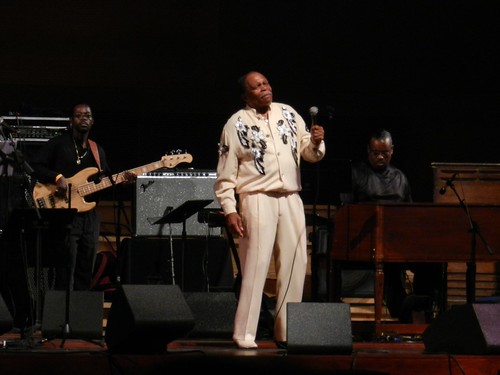
Monday, January 11, 2016

People Get Ready

Another repost for the LOL.

Good morning my brothers and sisters, Church is once again in session and while  Deacon KC is doing his own introspective examination of the sources of his unseemly show of anger, still I return to my Sunday morning duties.

Here is another volume in this eminently listenable collection of classic Gospel. Great stuff if you aren't really all about having a collection or if you are just starting to get into it. Even those who have much of this material may want to grab it for the great sound and the appealing sequencing. If YOUR town had a radio station that played killer Gospel on Sunday mornings, you sure as... wouldn't be complaining about THIS show! Anyone on the fence just dl, and advance to track 8 -- if that don't work for ya, then walk on by my brother.

Peace be with you.

No Tears In Heaven

A repost for our LOL

The organ swells in the background and it is once again time for our Sunday service with Deacon KC. This morning I bring you an eminently listenable collection of artists well familiar here by now. I really haven't bothered to check to see how much overlap we have with previous sets, as I dance around my room this morning with tears of joy on my cheeks I find I just don't care...

NO TEARS IN HEAVEN: GREAT GOSPEL brings together 22 classic recordings by the world's most celebrated gospel artists including Mahalia Jackson, The Five Blind Boys of Alabama, The Staple Singers, Sam Cooke & The Soul Stirrers, Swan Silverton, The Caravans, and The Violinaires, among others.


Sunday, January 10, 2016

30 Soul Men


Otis Clay - Watch Me Now

I am not sure where this one came from, but thanks to the original source. A nice 1989 effort on Willie Mitchell's Waylo label - there is another one from the same time frame called "The Only Way Is Up" - anyone got it?

Otis Clay with The Gospel Songbirds 1964

Courtesy of Dr Hep Cat

New Orleans Gospel Recordings

NEW ORLEANS GOSPEL QUARTETS contains 21 tracks and detailed liner notes. Extremely fine recordings by the Jackson Gospel Singers, Zion Harmonizers, Southern Harps, etc. ~ Opal Louis Nations 22 track compilation features rousing New Orleans gospel music from the Jackson Gospel Singers, Famous Soul Comforters, Southern Harps, Famous Four, New Orleans Humming Four, Delta Southernaires, Southern Revivalists, New Orleans Chosen Five, Zion Harmon Performers include: Zion Harmonizers, Southern Harps, Jackson Gospel Singers, Famous Soul Comforters, Famous Four, New Orleans Humming Four, Delta Southernaires, Southern Revivalists, New Orleans Chosen Five, Crescent City Gospel Singers. Personnel: Albert Veal, Joe Maxon, Joe Gaines, Charlie Hampton, Ruth Jackson, Helen Matthews, Lee Alexander (tenor saxophone); 

Religious Recordings From Black New Orleans is also from 504 records and digs back even further into New Orleans Gospel history. These recordings come from the earliest era of 78's and even before. A little rough on the sound quality as one would expect.

Saturday, January 9, 2016

Otis Clay - Got To Find A Way, The Beginning

We have lost another giant of Southern Soul, the great Otis Clay has passed away. I will be doing a whole lot of Otis posts, but this one is the earliest material out there and it is among the rarest.

"The music industry liked to peg Chicago vocal master Otis Clay as a soul singer. Or an R&B king. Or a gospel titan. Or a high-energy showman. He was all of that, and more, Clay's roots in Mississippi and musical blossoming in Chicago making him an uncommonly eclectic musician who drew upon more stylistic influences than even his more ardent fans may have realized.

The artist, who churned out hits in the late 1960s with "That's How It Is (When You're in Love)," in the early '70s with "Trying to Live My Life Without You" (later covered by Bob Seger) and in the '80s with "When the Gates Swing Open," said he soaked up the music of Duke Ellington and Thomas A. Dorsey, Sam Cooke and Muddy Waters, and a great deal more.

Clay died Friday at age 73, said his longtime arranger and producer, Thomas "Tom Tom" Washington. Further details of Clay's death were not yet known, Washington said.

"Writing this with a very heavy heart and tears in my eyes as I recently heard the very sad news that the great Otis Clay suddenly passed on," Chicago blues musician Dave Specter wrote on Facebook. Specter collaborated with Clay on "Message in Blue," Specter's critically applauded 2014 album. "Otis conveyed power with soul music and with blues like very few people I've ever heard live," Specter said Saturday. "It was as good as it gets. "His live shows — it was so stirring, and so moving. And he was a great showman. Not when you think of a showman being an over-the-top entertainer on steroids. Nothing like that. It was so real."

Indeed, in concert Clay proved a galvanic force, his gravelly, rumbling low notes and fervent, imploring high ones showing a potent mixture of the sacred and the secular, the accessible and the sophisticated.

"My life always has been a combination of things musically," Clay told the Tribune in 2013, as he was celebrating the release of his album "Truth Is." "Every Saturday night I listened to the Grand Ole Opry," added Clay, who was born Feb. 11, 1942, in Waxhaw, Miss. "During the day, later on, you listened to (radio) coming out of Memphis. During the noonday, at 12 o'clock, we listened to (blues pioneer) Sonny Boy Williamson, coming out of Helena, Ark. (And) I'm listening to Vaughn Monroe and Rosemary Clooney and listening to Hank Williams and Roy Acuff." So the far-flung idioms those artists represented were set deeply in Clay's musical persona, even before he came to Chicago as a teenager, in the mid-1950s, to live with his uncle and aunt. In Chicago he absorbed further musical influences but in the flesh.

"I guess I've always loved Chicago," Clay said in the Tribune interview. "And people say, 'Well, you're from Mississippi.' And I say, 'Chicago is only a suburb of Mississippi.' It was the place to go. It was exciting, of course. "You got to be in a place where a lot of legends (lived), whether they were blues or gospel, they were in Chicago. I guess I was about 6 or 7 years old when I saw my first live show. I was living in Clarksdale, Miss., at that time, and that was Muddy Waters. "And now I'm in the same city that Muddy Waters is living in and playing local clubs and what have you, though I wasn't going to 'em yet. Sam Cooke was here, the Soul Stirrers, the Caravans and all these (other gospel) people. It was a lot of excitement."

By age 15, Clay was singing Chicago gospel with the Golden Jubilaires, and three years later, in 1960, touring America with Charles Bridges' Famous Blue Jay Singers. That experience only expanded Clay's artistic range, because "our audience was basically, most of the time, white," meaning the singers were expected to perform repertoire well outside gospel tradition. On Sundays, though, "most of the time we would be singing in black churches. … 1960: What was the greatest craze at the time? The twist. So we added that to our repertoire. We added 'That Old Gang of Mine,' 'Mother Machree.' We were variety singers, so therefore I had that exposure, so it wasn't so hard for me to do it."

Though Clay began releasing soul records on Chicago's One-derful label in the 1960s, he never lost touch with his gospel roots, recording and performing that repertoire through the decades. When disco was ascendant in the 1970s, Clay found a growing and devoted audience for his earthy music on the other side of the world, in Japan. This came as a surprise to him. "I had no idea," he said in the Tribune interview. "I thought when we got ready to go to a foreign country, we were going to go Europe. I didn't think I was going to go to Japan, because I'm thinking Pearl Harbor, WWII. … (I thought:) What am I going to sing? I thought it was one of the craziest ideas. "And then I go to Japan. I find that they are so up on the music. That, too, was a lesson well learned. … They know the songs, they know the meaning of the songs."

Clay had been scheduled to perform Saturday night on Chicago's West Side, said arranger-producer Washington. Specter spoke to Clay on Wednesday: "When you get a FaceTime call from Otis Clay, it's a big deal," said Specter, honored by the call and noting that the singer looked to be in fine spirits.

"He was just a combination of his voice, his passion, his intensity," Specter said. Performing with Clay was "the most inspiring feeling I ever got," he said. "I remember the first rehearsal at Delmark (Records) for 'Message in Blue' – his voice made me cry. And it was just a rehearsal. "I've worked with a lot of great singers. But I don't think I've worked with anybody who had that feeling."

Funeral plans have not been announced."  Howard Reich, Chicago Tribune

Otis Clay - Live (Japan (1978) and Clarksdale (1991)

As I promised in our discussion of Soul Man Live in Japan, I am posting two more live sets here for Otis Clay freaks like me who can't get enough. The first disc, Live!, is from the first professionally recorded concert in Japan, which dates from 1978, as opposed to the 1983 concert already posted by KC.   While this recording may not reach the heights of the extraordinary 1983 set, it is still quite worthwhile for Otis Clay fans. It contains a number of songs recorded for Hi Records that he did not keep in his repetoire in subsequent years.  This rip is from a CD.  As I understand, the 2-disc LP contains a few extra songs not included here.  If anybody has access to those songs, and could post them here, it would be much appreciated.  

The second concert comes from the Sunflower Blues Festival in Clarksdale, Mississippi, vintage 1991.   It is a private recording in low fi that is nevertheless near and dear to my heart.  It is the only recording I know that features Otis with his fantastic band of the time: Chicago Fire.  I had the opportunity to hear Otis live a number of times in the late 80s and early 90s with Chicago Fire.  The best of them were some of the most memorable concerts of my life.  Chicago Fire was something like the perfect foil for the artistry of Otis Clay.  They gave him all the room he needed for a secular sermon that always left you with the feeling that your soul had been cleansed and spirt rejuvinated.  

The last time that I saw Otis Clay with Chicago Fire was at Slim's in San Francisco around the time of this concert.  I went Friday night, and had to come back Saturday as well.   I was extremely happy to hear Otis' announcement that they had just signed a recording deal with Rounder Records.  Finally, I thought, this incredible sound would be caught for the ages. 

Fate would have it that, for one reason or another, Otis Clay and Chicago Fire went their separate ways before Otis went to the studios for Rounder.  To their credit, Rounder assembled crack bands for Otis' two discs for that label.   But it didn't really work.  The bands didn't know how to give Otis the flexibility that he needed to work his magic.  As a result, Otis ended up in a sort of musical straightjacket, trying hard to complement what the band was doing, as opposed to the other way around.   What could have been classic albums in the Otis Clay discography with Chicago Fire turned out to be among his weakest.

At any rate, if you can tolerate the lo fi sound, here is Otis in all his glory with Chicago Fire in 1991.

By the way, Otis' new album, Truth Is, is his best release in a while.  Support the Soul Man and buy it!


Otis Clay - Soul Man Live in Japan LP rip

The first time I posted this it was the truncated CD Version, but now thanks to Unky Cliff I am able to offer the full original double LP with 22 extra minutes of goodness!

 One thing for damn sure - Otis Clay is best enjoyed live. He is one hell of a dynamic performer. Bullseye/Rounder saved so many of these guys from total obscurity, thank god for Scott Billington and the rest of them for doing this in time to catch a Johnny Adams, an Otis Clay or James Booker before it was too late. For me the 'Moment" here is Clay's tribute to old friend O.V. Wright with his cover of "A Nickle and a Nail".

"All of Otis Clay's albums are worth hearing, but this one--a 1983 concert recorded in Tokyo--is not only his masterpiece but one of the best live soul albums since the mid '60s heyday of the Stax/Volt Revue. Backed by an incredible band (mostly the guys who played on Al Green's hits), Clay roars through a set that includes a couple of Green tunes that he thoroughly makes his own. He also quotes Sam Cooke to fine effect on the gospel-ish "Precious Precious," and nearly convinces the audience that he's the second coming of Otis Redding. This is an essential album for any soul music collection."

Recorded live at Yubin Chokin Hall, Tokyo, Japan on October 22, 1983. Includes liner notes by Robert Pruter.


Personnel: Otis Clay (vocals); Mabon "Teenie" Hodges (guitar); Henri "Hank" Ford (tenor saxophone, background vocals); Paul Howard (trumpet, background vocals); Bill McFarland (trombone, background vocals); Charles Hodges (organ); Dedrick Blanchard (keyboards); Leroy Hodges (bass); Howard Grimes (drums).

Living Blues (1/92-2/92, p.51) - "...Clay still reigns as the Windy City's top soul man, as the reissued "Live In Japan" soulfully demonstrates..."


 "Thankfully, Otis Clay is an artist who refused to change with the times. When the R&B audience embraced disco and, later, urban contemporary, the hard-edged belter wisely stuck with the type of raw, unapologetic-ally Southern-sounding soul that put him on the map. Though he calls Chicago home, Clay's approach has always shouted "Memphis!" in no uncertain terms. A 41-year-old Clay was clearly very much in his prime when this magnificent live date was recorded in 1983. Sparing no passion on such treasures as "Holding on to a Dying Love" and Al Green's "Here I Am (Come and Take Me)," Clay illustrates why his small yet devoted following holds him in such high regard. One of the most pleasant surprises is the ballad "Love Don't Love Nobody." While the Spinners' excellent hit version boasted a sleek Philly soul production, Clay takes the gem straight to Memphis. " AMG

Otis Clay - The Best Of Otis Clay The Hi Records Years

The links on this one were gone and Chubby needs a re-up so I'll bring it forward for those who missed it the first go-round. RIP Otis

Otis Clay was born 11th February 1942 in Waxhaw, Mississippi in rural Bolivar County, Mississippi to a musical family, who moved in 1953 to Muncie, Indiana. After singing with local gospel group, the Voices of Hope, he returned to Mississippi to sing with the Christian Travelers, before settling in Chicago in 1957. There, he joined a series of gospel vocal groups including the Golden Jubilaires, the Famous Blue Jay Singers, the Holy Wonders, and the Pilgrim Harmonizers, before making his first solo secular recordings in 1962. They were unissued, and Clay joined the Gospel Songbirds, who recorded in Nashville in 1964 and who also included Maurice Dollison who sang R&B under the name Cash McCall, and then the Sensational Nightingales.

In 1965 Clay signed with One-derful! Records in Chicago, to make secular recordings.  After releasing a series of gospel-tinged soul records, his first hit came in 1967 with "That's How It Is (When You're In Love)", which reached # 34 on the R&B chart, followed by "A Lasting Love" (# 48 R&B).  In 1968 the record company folded and his contract was bought by Atlantic Records, who launched their subsidiary Cotillion label with Clay's version of the Sir Douglas Quintet hit, "She's About A Mover", produced at the FAME Studios in Muscle Shoals. The record became Clay's biggest pop hit, reaching # 97 on the Hot 100 (# 47 R&B). However, follow-ups on Cotillion, including "Hard Working Woman" produced by Syl Johnson, and "Is It Over?" produced by Willie Mitchell in Memphis, were less successful.


Clay moved to Mitchell's Hi Records in 1971, and made many of his best known soul blues records for the label. His biggest hit came with "Trying To Live My Life Without You," a # 24 R&B hit in late 1972, which he followed up with "If I Could Reach Out". "Trying To Live My Life Without You" was later covered by Bob Seger, whose version made # 5 on the pop chart in 1981. After several more
Otis Clay w/ the Hi Records Rhythm section
Hi singles and the album I Can't Take It, Clay moved to Kayvette Records, where he had his last national hit single in 1977, "All Because Of Your Love" (# 44 R&B). He later recorded for the Elka and Rounder labels, as well as his own Echo Records for whom he recorded the original version of "The Only Way is Up" in 1980.

He has remained a popular live act in Europe and Japan, as well as the US, and has recorded two live albums, Soul Man: Live in Japan and Respect Yourself, recorded live at the Lucerne Blues Festival in Switzerland. In the 1990s he also recorded two soul albums for Bullseye Blues: I'll Treat You Right and the Willie Mitchell-produced This Time Around. In 2007, he recorded the gospel album Walk a Mile in My Shoes.

In a way, Clay has become a standard bearer for the grittier blues soul hybrid and the Chicago soul tradition when the city is more readily recognised as the nerve centre of so many great blues records and home to a number of the great and legendary straight ahead blues performers. He has been a nominee for a Grammy for Best Traditional R&B Vocal Performance. As a resident of Chicago's West Side, he is actively involved in community-based economic and cultural initiatives, including the development of The Harold Washington Cultural Center.

Friday, January 8, 2016

Johnny Adams - The Early Singles of the Tan Canary

Okay...,it becomes a regional thing here. To me this is the baddest Johnny of the whole damn bunch right here! Johnny Adams could be drunk AND have pneumonia and STILL out sing damn near any MoFo on the planet.....just saying, imo and all that (of course if you disagree you need some Qtips).

I've completely reworked this early post to include the vast majority of the Tan Canary's early singles - there are three collections in the 2 links and only 2 tracks overlap giving you....drum roll....50 tracks!

 "He was born in New Orleans, Louisiana, the oldest of 10 children, and became a professional musician on leaving school. He began his career singing gospel with the Soul Revivers and Bessie Griffin's Consolators, but crossed over to secular music in 1959. His neighbor, songwriter Dorothy LaBostrie, supposedly persuaded him to start performing secular music after hearing him sing in the bathtub, and he recorded LaBostrie's ballad "I Won't Cry" for Joe Ruffino's local Ric label. Produced by teenager Mac Rebennack (later known as Dr. John), the record became a local hit, and he recorded several more singles for the label over the next three years, mostly produced either by Rebennack or Eddie Bo. His first national hit came in 1962, when "A Losing Battle", written by Rebennack, reached #27 on the Billboard R&B chart.

   After Ruffino's death in 1963, Adams left Ric and recorded for a succession of labels, including Eddie Bo's Gone Records, the Los Angeles-based Modern Records, and Wardell Quezergue's Watch label. However, his records had limited success until he signed with Shelby Singleton's Nashville-based SSS International Records in 1968. A reissue of his recording of "Release Me", originally released on Watch, reached #34 on the R&B chart and #82 on the pop chart. Its follow-up, "Reconsider Me", a country song produced by Singleton, became his biggest hit, reaching #8 on the R&B chart and #28 on the pop chart in 1969. Two more singles, "I Can't Be All Bad" and "I Won't Cry" (a reissue of the Ric recording) were lesser hits later the same year, and the label released an album, Heart and Soul. However, he left SSS International in 1971, and recorded unsuccessfully for several labels, including Atlantic and Ariola, over the next few years. At the same time, he began performing regularly at Dorothy's Medallion Lounge in New Orleans as well as touring nightclubs in the south.

  In 1983, he signed with Rounder Records, and began recording a series of nine critically acclaimed albums with producer Scott Billington. Beginning with From the Heart in 1984, the records encompassed a wide range of jazz, blues and R&B styles while highlighting Adams' voice. The albums included tributes to songwriters Percy Mayfield and Doc Pomus, as well as the jazz-influenced Good Morning Heartache which included the work of composers like George Gershwin and Harold Arlen. The albums, which also included Room With A View Of The Blues (1988), Walking On A Tightrope (1989), and The Real Me (1991), brought him a number of awards, including a W.C. Handy Award. He also toured internationally, including frequent trips to Europe, and worked and recorded with such musicians as Aaron Neville, Harry Connick Jr., Lonnie Smith, and Dr. John."

He died in Baton Rouge, Louisiana, in 1998 after a long battle with prostate cancer."

Monday, January 4, 2016

Andrew B.B. Odum - Goin' to California

 A repost by request:


"Not long before he died, Odom made the album of his life with a combo called the Gold Tops, who provided precisely the right backing to properly spotlight his booming voice. A few overdone standards -- "Rock Me Baby," "Woke Up This Morning," "Next Time You See Me" -- intrude a bit, but Odom's own "Bad Feelin'," "Why Did You Leave Me," and "Come to Me" make impassioned amends. Steve Freund, best-known for his long stint with Sunnyland Slim, contributes stellar lead guitar." Bill Dahl

Saturday, December 26, 2015

Plug It In, Turn It Up! - Electric Blues, Part 4 1970-2005

AllMusic Review by Stephen Thomas Erlewine
"In some ways, the fourth installment of Bear Family's four-volume Plug It In! Turn It Up! Electric Blues - The Definitive Collection is the most important -- not because this was the most innovative period for electric blues but rather the years of 1970-2005 are generally considered to be when the genre was rather dormant. Certain acts had hits now and then, but the blues weren't ruling the R&B charts and rock & roll starts to shed its blues influence during the '70s, so its presence doesn't seem as immediate. Nevertheless, this fourth volume proves that electric blues not only has a rich legacy but that it is one that continues into the modern era, both by old hands (Buddy Guy pops up with his 1991 "Damn Right, I've Got the Blues") and new (Robert Cray's "Smoking Gun," which actually crossed over into the Top 40). Most of the major names of soul-blues and mainstream blues are here -- B.B. King, Al Green, Z.Z. Hill, O.V. Wright, Bobby Rush, Bobby "Blue" Bland, Albert King -- and this also traces the rise of Alligator Records (Hound Dog Taylor's "Give Me Back My Wig" still sounds nasty all these years later), grapples with such rock bands as the J. Geils Band and ZZ Top, and makes a case for the influence of Stevie Ray Vaughan and the Fabulous Thunderbirds. While it doesn't necessarily make a case for the next generation -- some of the newer tracks toward the end of the set are by old guys like R.L. Burnside -- this fourth volume does prove that electric blues remained vital well into the new millennium."

Sunday, December 20, 2015

Bessie Griffin - Even Me

And one more time this Sunday!

Mother Mahalia was not the only Gospel queen from New Orleans, Bessie Griffin was often referred to as .Mahalia's protegee, but her voice was very different and she was a highly accomplished artist in her own right.

"Bessie Griffin (July 6, 1922 – April 10, 1989) Born Arlette B. Broil in New Orleans, Louisiana, she was the daughter of Enoch Broil and Victoria Walker Broil. Her mother died when she was just five and she was raised by her grandmother, Lucy Narcisse, from whom she learned to sing. Griffin was educated in the Orleans Parish schools graduating from McDonough Number 35 Senior H.S. Her first marriage to Willie Griffin lasted two years and her second to Spencer James Jackson, Sr. produced one son Spencer Jr. She sang in church choirs and a number of gospel singing groups.


In 1951, Mahalia Jackson invited Griffin to sing at Jackson’s anniversary celebration. Two years later Griffin joined the Caravans and traveled with them for a year before settling in Chicago. She also hosted her own radio show “The Queen of the South” in New Orleans. In 1956, Griffin visited and worked in Los Angeles. After performing in the musical, Portraits in Bronze, she moved there.

It was in Los Angeles that Griffin began to take Gospel into the nightclub circuit. This allowed her to contribute to her profession and differentiated her from Jackson. Both singers were from the same hometown. Jackson was Griffin’s mentor, to whom she was often compared but Jackson would never have performed in nightclubs. Some of Griffins noted recording were: The Days Are Passed and Gone, It’s Real, and Soon-ah Will Be Done With the Trouble of the World. She worked concert tours, television, and Broadway and was nominated for a Grammy. Bessie Griffin died on April 10, 1989 in Los Angeles.

Mahalia Jackson - How I Got Over, Vol 3

Of course this is reposted as well.

The final volume of the pre-Columbia recordings of the great Mahalia Jackson. Thanks to our brother Elder Clifford for providing this lovely set.


The divine Mother Mahalia rules this Sunday!

Mahalia Jackson - How I Got Over, Vol 2


Once again a repost - more of the magical early recording of the great Mahalia Jackson.

Mahalia Jackson - How I Got Over, Vol 1

A repost by request
My prayers go out this morning to the family, and the friends of Les Muscutt, banjo and guitar master and former member of the Preservation Hall Band. Les passed away at home early Friday morning. His quick, dry wit will be sorely missed by those of us lucky enough to regularly while away our morning coffee hours with him. (this was 2 years ago now)


This comes complete with full scans of the 20 page booklet from Opal Louis Nations.

Friday, December 18, 2015

Bill Coday - Right On Baby: The Crajon Recordings

When Bill Coday left us suddenly in the summer of 2008, most of America took no notice.  But the Chitlin' Circuit mourned one of its favorite singers.  While Bill Coday released a number of excellent records during his career, his first recordings, collected here and produced by Willie Mitchell, are the cornerstone of his legacy.

Bill Coday was born in 1942 in Coldwater, Mississippi.   He began his career in music as a teenager, working mostly in Arkansas.  For a while, he was in the same local band as a young Son Seals.  In the 1960s, he moved to Chicago and changed his name to Chicago Willie.  After Denise LaSalle heard him there in 1969, she signed Coday to her Crajon label and sent him to Memphis to record with Willie Mitchell.   One of his first recordings with Mitchell, "Get Your Lies Straight" hit #14 on the national R&B charts.   Coday's powerful performance of the strangely titled composition contributed by Denise LaSalle, "If You Find a Fool, Bump His Head," also charted. But none of the other Crajon singles did as well, despite their high quality.    

 Bill Coday recorded a few other songs for Epic in the mid-70s before essentially retiring from music for ten years.   None other than Denise LaSalle again brought him back to the Southern Soul scene in 1985, where he built a strong following and released a number of LPs on Echo Records until his death.   One of his last Southern hits was a tribute to the Chitlin' Circuit, "On The Chitlin' Circuit."

The Bill Coday heard on these early recordings sounds something like a cross between Wilson Pickett, O.V. Wright, and Johnnie Taylor - not a bad thing!  Whether you happen to be in the mood for a rougher-voiced O.V. or a bluesier Pickett, Bill Coday might just hit the spot.  Add quality material and classic Willie Mitchell arrangements/accompaniments and you have yourself some timeless music that can provide repeated enjoyment.  

Little Bob and the Lollipops - I Got Loaded

Re-posting this got me to listen to it again - Wow these guys were good and Bob was a really good singer! Can you imagine what it was like in Lafayette when these guys played 6 nights a week!

"Little Bob and the Lollipops
It Was Beautiful
By Gene Tomko

"Ask any musician from the 1960s Southwest Louisiana blues and R&B scene to name the best band that has ever come out of the area and one name gets repeated over and over—Little Bob & the Lollipops. In a land where so many extremely talented musicians emerged, to be remembered so enthusiastically by so many is quite an amazing feat.
At the height of his popularity in the mid-1960s, singer, songwriter, drummer and bandleader Little Bob was Lafayette’s reigning superstar, performing six nights a week and even hosting his own local television show. With a top-notch nine-piece band consisting of some of the area’s finest musicians such as ace saxophonist John Hart and former Excello guitarist Guitar Gable, Little Bob absolutely dominated the area music scene for more than a decade. He also happened to record some of the finest soul music to ever come out of Louisiana, most notably for La Louisianne and Jin Records.

Camille Bob was born on November 7, 1937 in Arnaudville, Louisiana, and was raised just southeast of Opelousas in rural Prairie Laurent. Bob grew up working on the farm but took an early interest in music and started singing in talent shows at school, inspired by Guitar Slim, B.B. King and Count Basie. He acquired his first set of drums by trading a horse for a drum kit and by 1955 was performing with Good Rockin’ Bob [Ed Thomas]. Music provided a good excuse to avoid working in the fields, as childhood friend Roscoe Chenier explains, “He was playing with Good Rockin’ Bob and if the dance was at three, he would tell his mom that it would start at eleven so he wouldn’t have to pick cotton!”

While working with Good Rockin’ Bob at the Moonlight Inn in Opelousas, he left his drums on the bandstand one night and returned to find the bass drum professionally hand-lettered with the words ‘Good Rockin’ Bob featuring Little Bob on drums.’ It was from then on he would be known as Little Bob.

In 1958, Little Bob formed his own group and made his recording debut for Goldband Records. Throughout the next several years he and his top-notch band the Lollipops developed a following that was unrivaled. Singer Bobby Allen recalls, “[Little Bob] came down to the Peppermint Club every Monday night and would play there. It was awesome. [He had] a big band. You had to be there early—I mean early like five or six o’clock in the evening in order to get a seat!”

Lafayette record label La Louisianne signed Little Bob in 1964 and he recorded a string of soul and R&B classics for the label throughout the next several years including Nobody But You, Look Out Mr. Heartache and the b-side party anthem, I Got Loaded, which still remains one of the most requested songs on Southwest Louisiana bandstands to this day.

Little Bob and the Lollipops were continuously hailed as the region’s top band, crisscrossing from New Orleans to Houston, but at the very heart of their success was Little Bob’s magnificent voice. Allen remembers one of the best compliments he’s ever received, which also reveals Little Bob’s confidence in his own talents. “[Bob and I] were talking and he said, ’Well, you know, you can get any musician you want.’ I said, ‘You think so?’ He said, ‘Oh, yeah, you can. You can and I can. As far as I’m concerned, there’s only three singers in Southwest Louisiana.’ I said, ‘Really?’ He said, ‘Oh, yeah. And I’m one of them.’ I said, ‘Well, who are the other two?’ He said, “Why, you of course—and Johnny Truitt.’”

Little Bob retained his unprecedented popularity through the 1970s but the huge zydeco resurgence of the 1980s made work as an R&B artist increasingly difficult. He made a brief comeback in the 1990s with Back Again for Vidrine Records, reuniting with Gable, Hart and drummer Jockey Etienne, and performed sporadically through the early 2000s.

But due to increasing health issues, Bob retired from performing in 2005 and is currently residing in a nursing home in Opelousas, where he still receives visits from old friends like Jude Taylor and Guitar Gable. Although he recorded many soul and R&B classics during his prime, one in particular remains extra special, as Bob fondly recalls the good old days, “It was beautiful, man. It was beautiful. [We had] three or four [records] you couldn’t beat. But I Got Loaded did it all and we got movin’. We got movin’!” [smiles]
From Living Blues

Sunday, December 13, 2015

Best of Christmas Gospel

A little pre-Christmas Gospel service...not a bad little collection.

Sunday, December 6, 2015

Swanee Quintet - 4 more parts!

Well I promised a supplemental - I didn't really expect that it would be as big as the 4 parts already posted! Dr. Hep Cat was busy tapping some of his sources for this so some additional thank yous are in order - Mr. Robert Laughton & Mr. John Glassburner were extremely helpful in filling the gaps that we had - particularly on the older tracks. 

If you take your previous four parts extract them to a single folder, then drop these in, sort by album name, then year and you should have them in order - you will find 5 or 6 duplicates, I think the tracks from this group will be the better sounding. Once you are finished you will be in possession of the largest, most complete set ever assembled!

Sunday, November 29, 2015

Pilgrim Jubilee Singers - Walk On and The Old Ship of Zion

Our Sunday fare is a repost because my lazy ass has yet to finish tagging and sorting our final Swanne post - this is some wonderful stuff here and the great news is that Dr Hep Cat will have a supplimental once he has finished sorting and tagging!

THIS is a gospel post you should try...this is all killer stuff here!

 The Pilgrim Jubilee Singers of Chicago: Cleve Graham, Clay Graham, N. Major Roberson, Percy Clark (vocals), Richard Crume (guitar). WALK ON was released on the Peacock label in 1962, THE OLD SHIP OF ZION was released on Peacock in 1964. Includes original release liner notes by Dzondria Lalsac and additional notes by Jerry Zoltan and Ray Funk. Mobile Fidelity's Walk On/The Old Ship of Zion combines two Peacock albums -- 1962's Walk On and 1964's The Old Ship of Zion -- on one compact disc. Both albums capture the Pilgrim Jubilee Singers at their peak, demonstrating that they were one of the greatest hard gospel quartets of their time. ~ Leo Stanley Personnel: Percy Clark, N. Major Roberson (vocals); Richard Crume (guitar). Unknown Contributor Roles: Clay Graham; Cleve Graham.

This time around I am adding a third album of live material!


Sunday, November 22, 2015

Holy Spirit - Spiritual Soul and Gospel Funk From Shreveport's Jewel Records

"One of the funkiest gospel collections you'll ever hope to own – and an amazing document of the criss-crossing styles going down at the legendary Jewel Records! Jewel didn't just record gospel, but handled a fair bit of soul, funk, blues, and jazz – all of which seems to bubble forth in these amazing recordings – tracks that easily represent some of the hippest, coolest gospel sides of the late 60s and early 70s – the kind of work we've dug for years in its ability to easily cross over to the secular scene, thanks to wicked grooves underneath the vocals! And the vocals are pretty darn great too – work by singers who could have been huge in the mainstream world, had they broken from the spiritual realm – really belting out with the best of the southern soul scene of the time. The package features a whopping 41 tracks in all – with tracks that "Don't Forget The Bridge" by Mighty Songs Of Glory, "There's A Creator" by Roscoe Robinson, "Trouble's Brewin" by The Meditation Singers, "Brotherly Love" by BP's Revolution, "I'm Trying To Be Your Friend" by Soul Stirrers, "Far Away From God" by Armstrong Brothers, "Golden Gate" by Traveling Echoes, "He's A Friend" by Dorothy Norwood, "Watch That Rogue" by Silver Gate Quartet, "You've Got To Serve Somebody" by Bill Moss, and "The Upper Way" by The Violinaires."  © 1996-2015, Dusty Groove, Inc.

Tuesday, November 17, 2015

Plug It In, Turn It Up! - Electric Blues, part 3

AllMusic Review by Steve Leggett

"This is the third three-disc volume in Bear Family Records' ambitious four-volume history of the electric blues, all compiled and annotated by blues historian and musicologist Bill Dahl. The Gibson guitar company introduced the first electric guitar in the 1930s, and the advent of amplification meant the blues could preach louder and longer, which allowed a country acoustic music to transform itself into its own kind of powerfully rhythmic pop music. Taken as a whole, this ambitious Bear Family series traces and surveys that transformation, beginning with jazz-inspired jump blues tracks and following through to the juncture of blues and rock, blues and funk, and beyond, on into the 21st century. This particular volume covers 1960 to 1969, a time when blues and rock & roll really started to join hands, and it features classic tracks like Buddy Guy's "First Time I Met the Blues," Jimmy Reed's "Big Boss Man," Albert King's "Crosscut Saw," and B.B. King's "Rock Me Baby," but it also collects lesser-known gems like Frank Frost's "Jelly Roll King" and Junior Parker's "Driving Wheel," then slides into blues and rock hybrids like the Animals' "House of the Rising Sun," Canned Heat's Henry Thomas-inspired "On the Road Again," and Janis Joplin's "Ball and Chain," before closing things out with Stevie Wonder's blues-based "I Ain't Superstitious" done by the Jeff Beck Group. Bear Family Records is known for its quality releases, and this volume is no exception. When the full 12 discs are taken together, with nearly 300 tracks, it makes for a fascinating survey of the blues in all of its electric configurations."

Monday, November 16, 2015

Allen Toussaint - Sehorn's Soul Farm

This 2 disc collection represents the height of Toussaint's production career where he was instrumental in creating the soul/funk for which New Orleans is justly famous. My first version of this set was of utterly wretched sound quality, but this one is audibly improved, tho still not adequately remastered given the importance and quality of the music contained here.

Sunday, November 15, 2015

Nashboro Gospel - I Heard The Angels Singing

Okay - I know that church is late today, but I'm distracted - this one is for our favorite little old lady!

"Ernest L. Young learned the music business from the ground up, starting in the jukebox operating field, and soon became one of the largest suppliers in the Nashville area. He opened Ernie's Record Mart on Third Avenue North in Nashville as a means to move more records, and realizing the advantages in making his own product, he built a small studio in the back of the store, later expanding into a larger space on the third floor of his shipping department building, finally opening the pioneering gospel label Nashboro Records in 1951. Young launched a secular subsidiary label, the more famous Excello Records, four years later in 1955. Always hands-on, Young oversaw every phase of making records at his labels, and gospel artists responded by giving Young's Nashboro imprint one of the finest rosters of gospel in the genre's history, while his roster for the Excello blues and R&B subsidiary was pretty singular too -- but that's another story. This four-disc set, which comes complete in a gatefold LP-sized package, surveys Nashboro's gospel output chronologically from 1951 to 1983, and it's an eye-opening, explosive anthology of gritty, exuberant black gospel from a label that had as much to do with shaping the sound of pop music in the latter part of the 20th century as more famous labels like Sun and Chess Records did. The roots of soul and so much more are heard here, and with the way the set is assembled, one can hear the decades build forward through the civil rights movement of the 1950s and 1960s into the full-band, funky and R&B-influenced tracks from the 1970s and 1980s. The whole anthology is a delight, and there are some familiar names here, like the Fairfield Four, for one, but there are just as many or more obscure artists here making powerful musical statements. A particular high point is the husband-and-wife duo the Consolers' 1957 version of "This May Be the Last Time," a song the Rolling Stones had a secular hit with in the mid-'60s (under the title "The Last Time"). In the Consolers' hands, the song seems so much brighter, jangly and more alive, and it speaks to deeper and wider concerns than the Stones' version does. It's just one example of the many powerful tracks collected in this set. Bravo to Tompkins Square for spotlighting the best little gospel label that ever was." AllMusic Guide

Friday, November 13, 2015

The Minit and Instant Story

Allen's first work as a fledgling producer is featured here, particularly on disc 1.- 

 Minit Records was a record label originally based in New Orleans and founded by Joe Banashak. After making a distribution deal with Imperial Records, the label released its biggest hit, the #1 Mother-in Law by Ernie K-Doe. A number of Allen Toussaint productions were issued on Minit, including hits by Irma Thomas. After the hits dried up, the label was sold to Imperial Records. Banashak also owned Instant Records which he kept. Minit was acquired by Liberty Records in 1963 as part of its acquisition of Imperial Records. Later its records were re-issued between 1966 and 1970 by Sunset Records and the label was active during the same time period as a soul music label. The Minit catalog is currently owned by EMI.

"This 52-song collection doesn't entirely overlap EMI's Minit Records Story box set, which has a few rarities and obscure tracks, but it's a good overview of some of the best and most interesting of the label's output, and also the sheer diversity of the company's output, from the hard blues of Jessie Hill to the smooth, near-pop stylings of Allen & Allen. Joe Banashak, who founded Minit and Instant, was truly in love with the sounds he heard from the clubs in New Orleans, and he seldom seems to have heard any artists expressing confidence and inspiration who he didn't want to release. Thus, hard-rocking numbers like Lee Dorsey's "Lottie Mo" share space on this set with harmony numbers like "The Owl Sees You" by the Showmen (aka the Humdingers) and the sultry, seductive soul of Irma Thomas ("It's Too Soon to Know," "Ruler of My Heart," "It's Raining"). British Invasion fans will find a lot to keep them busy as well, given the originals by several Brit-rock favorites, including "Fortune Teller," "Something You Got," and "I Like It Like That" represented here. Throughout both of these discs, Allen Toussaint is represented as producer, arranger, and frequently songwriter as well; if anyone needed convincing that Banashak had a resident genius under contract, the first few tracks do the job. The second disc moves up through later, post-Toussaint Instant and Seven B label tracks that feature Eddie Lang, Skip Easterling, and Eddie Bo, as well as Bo's production work from the mid- and late '60s. The sound is excellent as well, and one only wishes that a bit more material from Minit's early history was present, and that a few more details were available on some of the lesser-known artists.  AMG