Friday, October 25, 2013

B.B. King - Live At The Regal

Over in the chatbox Gus mentioned that it would be nice to see B.B. in a small venue - that made me think of this absolute essential album. The Regal isn't juke joint sized by any means, but it is a good deal smaller than most places you could have seen King at anytime over the last 20 years or more.

If you had to limit yourself to one BB King album, this 1965 live album is the one I would recommend. Everything clearly clicked this night, the band, B.B., the audience...all are just electric. Sure, you have heard every tune here a hundred times --- never better than this tho.

(Ooops, the first picture was the wrong place according to Cliff who has been there...sooo I believe I've found the right place...a little earlier than 1965 by my guess but pretty close. The movie on the marquee would place this picture around 1960.)

Thursday, October 24, 2013

McKinley Mitchell - The Complete Malaco Collection

McKinley Mitchell (December 25, 1934 – January 18, 1986) He was born in Jackson, Mississippi, and died in Chicago Heights, Illinois, from a heart attack, at the age of 51.

"Blessed with an extraordinary set of soaring pipes, McKinley Mitchell waxed a series of superb Chicago soul platters during the 1960s, later veering stylistically closer to contemporary blues in his last years of performing.

At age 16, Mitchell was already fronting a gospel group, the Hearts of Harmony, in Jackson. After spending time singing spirituals in Springfield, MS, and Philadelphia, Mitchell hit Chicago in 1958 and went secular. A rocking debut for the tiny Boxer label the next year preceded his signing with George Leaner's fledgling One-derful logo in 1961.

His first single for the firm, the gorgeous soul ballad "The Town I Live In," proved a national R&B hit and launched the imprint in high style. Mitchell's One-derful follow-ups, including the imaginative "A Bit of Soul," failed to equal the heights of his first single; neither did 45s for Chess (produced by Willie Dixon) and a variety of Dixon-owned labels.

Finally, in 1977, Mitchell returned to the R&B charts with "The End of the Rainbow," another beautiful R&B ballad, for Malaco's Chimneyville subsidiary. An eponymous LP for the label the next year stunningly showcased Mitchell's still-potent voice on a program that combined blues and soul material. A 1984 LP for Retta's, I Won't Be Back for More, was among the singer's last releases (by then, he was back living in Jackson)." AMG

Wednesday, October 23, 2013

Raw Spitt


"Though Charlie Whitehead is actually the singer on Raw Spitt, it's hard to shake the feeling that he's pretty much acting as a mouthpiece for Jerry Williams, Jr. aka Swamp Dogg. Williams, after all, not only produced and arranged the album, but wrote or co-wrote all of the songs but two. Whitehead, in contrast, didn't write any of the material. It's an interesting, mildly offbeat early-'70s soul record, with the kind of slightly off-kilter songs that were Swamp Dogg's stock-in-trade. There were songs about race, like "Call Me Nigger," which is, contrary to what you might expect from the title, a statement of pride rather than anger. There's lust that factors in a little black pride as well with "I Dig Black Girls." And there are generally thoughtful speculations on injustice and self-respect/determination, such as "Who Do They Think They Are" and "Excuses," sometimes (as in "Sweet Bird of Success") leavened with witty wordplay. The arrangements cook along in an earthy if somewhat easygoing manner, bringing in touches of hard rock guitar and oddness (such as the jew's-harp on "The Freedom Under Certain Konditions Marching Band"), though the funk only really heats up with "This Old Town." Whitehead/Raw Spitt's vocal style is more genial and less penetrating than Swamp Dogg's, however, leaving one to wonder whether this might have been a better record had Swamp Dogg himself done the singing. As it is, it's a little like listening to a Swamp Dogg record that's less penetrating and idiosyncratic than his more hard-hitting stuff of the era." AMG

Tuesday, October 22, 2013

Swamp Dogg - 1972 Cuffed, Collared, & Tagged

Of the early albums of Swamp Dogg this is easily the one most often overlooked, maybe the tame cover is responsible. The music and songs remain smart, edgy, funny and angry. Listen carefully to the lyrics of Sam Stone, this song could have come from the pen of Gil Scott-Heron or Bob Dylan (it comes from John Prine). The radio wasn't ready for this song in 1972, the story was too strong, too real...in this era of a whole new wave of broken young men returning home to little hope, it could have been written yesterday.

Dogg follows with perhaps the strangest post apocalyptic pop ballad ever sung, 'Complication No. 5' (well it IS a somewhat limited catagory!). A funkified Lady Madonna follows and the Beatles lyrics fit seamlessly into spirit of this album. 'You Say You Trust Your Mother' offers another powerful commentary of the state of man in America followed by a funky good time nod to friend and influence Sly Stone.

 "I'm gonna be the first one at the graveyard, baby, I want to see the beautiful groove...I'm gonna throw the first shovel of dirt right down on you and make sure you know!" One of the best pissed-off breakup song lines ever from 'Your Last Dirty Trick' which opens side 2 - more good stuff follows but the most notable is 'Captain Of Your Ship', a song with some hit potential to my ear if done by someone like Pickett. Easy to see why the 'industry' would hate on this.

Sunday, October 20, 2013

Wiregrass Sacred Harp Singers - The Colored Sacred Harp

We are still in Alabama this Sunday morning but todays' fare is the shape-note singing from The Colored Sacred Harp of Judge Jackson. These selections are performed by the actual descendants of Judge Jackson and his parishioners. 

"The Colored Sacred Harp - Wiregrass Sacred Harp Singers. Notes by Barbara L. Hampton. 1993. Recorded Anthology of American Music, New World Records NW 80433-2.

The Sacred Harp, by B.F. White and E.J. King, is the chief printed repository for the living tradition and repertory of early American psalmody. Available in several editions and revisions since its first printing in 1844, the book unites most southern singers, black and white, who cultivate the tunebook tradition, as well as enthusiasts throughout North America who are drawn to its distinctive sound, repertory, and performance practice. Writers on the Sacred Harp have noted the participation of African Americans in that tradition, chiefly in southeast Alabama and northern Florida. While they sing mainly from the Cooper Revision of The Sacred Harp, these black songsters employ seven-shape songbooks on occasion, and also a four-shape tunebook of local origin, The Colored Sacred Harp (1934) by Judge Jackson (1883-1958), which has been available in reprint since 1973.

Previous studies of this book and its author have treated them as a special case within a predominantly Anglo-American genre (“Black Giant of White Spirituals”) or as evidence of a unique homespun musical creativity (“Plantation Meistersinger”). In her musical and sociological study of shape-note singers in the area, Doris Dyen (1977) paid scant attention to The Colored Sacred Harp, because its use is indeed marginal. While a handful of songs have become standards within the community, most of the book lies unused, except at the annual Jackson Memorial Singing in April. Singers regard Jackson’s book more as a source of community pride than as a source of active repertory.

The goal of the present recording is not to reflect the singers’ tastes and repertory—it includes pieces solely from Jackson’s book. The accompanying essay, by Barbara L. Hampton, subtitled “A Songbook by Nineteenth-Century African-Americans,” serves as a valuable supplement and corrective to earlier treatments. The historical section attempts to provide an Afrocentric context for Sacred Harp singing, showing “the process by which African Christians adopted the Sacred Harp and made it a significant artistic expression in their communities.” In exploring this process, Hampton examines differential settlement and land ownership patterns in the Gulf Coast and Tennessee Valley regions. While she acknowledges “research conducted by Cheryl Johnson in Alabama” (p. 6), this research is nowhere fully cited, nor is it clear how the 1856 sale of illegally-imported Africans to Selma planters affected the assimilation of Sacred Harp singing in southeastern Alabama. Drawing on oral history, Hampton documents the role of black and white singing-masters in passing on a tradition of musical style and literacy that nourished the creativity not only of Judge Jackson but of several other composers represented in The Colored Sacred Harp. Biographical sketches of these composers represent a significant addition to the story of this singing community.

The group of singers on the recording is small, and better represents the “Wiregrass Singers” that perform at concerts, festivals, and on television, rather than a typical “class” at an all-day singing. The sound, while rather thin, is dominated by altos, who number seven of the seventeen voices. It is instructive to compare the strong and confident rhythms on this recording with their rather inaccurate representation on the pages of Jackson’s tunebook—this suggests that the performance by Jackson’s own descendants and community represents the compiler’s musical conception better than the often inconsistent and inept notation in the book. The small size of the ensemble also enables the listener to hear clearly the embellishments and variations that are a feature of this regional style.

Those who are looking for a representative recording of African American Sacred Harp singing would do well to hear Wiregrass Notes: Black Sacred Harp Singing from Southeast Alabama (Alabama Traditions 102), produced by Hank Willett and Doris Dyen. This collection, recorded in 1982 at a two-day convention in Dale County, features four selections from The Colored Sacred Harp, nine from The Sacred Harp, and one seven-shape selection by Albert M. Brumley, sung from memory as a closing piece. For those who own one of the reprint editions of The Colored Sacred Harp, or are interested in its author or his music, the present recording represents a fitting and almost necessary complement, providing both the sonic dimension and the historical background to the music and the community that gave it life.
David Warren Steel
University of Mississippi

Saturday, October 19, 2013

Roy Roberts, Johnny Rawls, Barbara Carr - Three Pair

Now HERE is a completely delightful surprise and it comes under the heading of new music! Three of the foremost warhorses still traveling the chitlin circuit have joined forces and all three are the beneficiaries.

There is sooo much to like about this album. They sing in the 3 different duets available and all together at times, solo at others. The band is super tight, really nice arrangements, you are gonna find your feet moving! Boy I hope they take this show on the road!

Barbara Carr may benefit the most from this setting - she just shines as she trades with the fellahs. Her voice is particularly well suited to Roberts deeper gravel, but she sounds great next to Rawls Hi Records smooth as well.

This one gets the "ALL KILLER, NO FILLER" tag!

Friday, October 18, 2013

Slim Harpo - The Excello Singles Anthology

"Born James Moore in Lobdell, Louisiana, United States, the eldest in an orphaned family, he worked as a longshoreman and building worker during the late 1930s and early 1940s. He began performing in Baton Rouge bars under the name Harmonica Slim and later accompanied his brother-in-law, Lightnin' Slim, both live and in the studio.

Named Slim Harpo by producer J.D. "Jay" Miller, he started his own recording career in 1957. His solo debut was the Grammy Hall of Fame single "I'm a King Bee" backed with "I Got Love If You Want It."

Harpo recorded under A&R man J.D. "Jay" Miller, in Crowley, Louisiana for Excello Records based in Nashville, Tennessee, and enjoyed a string of popular R&B singles, including Rock & Roll Hall of Fame inductee "Rainin' In My Heart" (1961) and the number one Billboard R&B hit "Baby Scratch My Back" (1966). On these recordings he was accompanied by the regular stable of Excello musicians, including Lazy Lester.

Never a full-time musician, Harpo had his own trucking business during the 1960s. He died following a heart attack at the age of 46, 20 days after his birthday. Harpo was buried in Mulatto Bend Cemetery in Port Allen, Louisiana." wiki

"... He was born James Moore just outside of Baton Rouge, LA. After his parents died, he dropped out of school to work every juke joint, street corner, picnic, and house rent party that came his way. By this time he had acquired the alias of Harmonica Slim, which he used until his first record was released. It was fellow bluesman Lightnin' Slim who first steered him to local recordman J.D. Miller. The producer used him as an accompanist to Hopkins on a half-dozen sides before recording him on his own. When it came time to release his first single ("I'm a King Bee"), Miller informed him that there was another Harmonica Slim recording on the West Coast, and a new name was needed before the record could come out. Moore's wife took the slang word for harmonica, added an "o" to the end of it, and a new stage name was the result, one that would stay with Slim Harpo the rest of his career.

Harpo's first record became a double-sided R&B hit, spawning numerous follow-ups on the "King Bee" theme, but even bigger was "Rainin' in My Heart," which made the Billboard Top 40 pop charts in the summer of 1961. It was another perfect distillation of Harpo's across-the-board appeal, and was immediately adapted by country, Cajun, and rock & roll musicians; anybody could play it and sound good doing it. In the wake of the Rolling Stones covering "I'm a King Bee" on their first album, Slim had the biggest hit of his career in 1966 with "Baby, Scratch My Back." Harpo described it "as an attempt at rock & roll for me," and its appearance in Billboard's Top 20 pop charts prompted the dance-oriented follow-ups "Tip on In" and "Tee-Ni-Nee-Ni-Nu," both R&B charters. For the first time in his career, Harpo appeared in such far-flung locales as Los Angeles and New York City. Flush with success, he contacted Lightnin' Slim, who was now residing outside of Detroit, MI. The two reunited and formed a band, touring together as a sort of blues mini-package to appreciative white rock audiences until the end of the decade. The new year beckoned with a tour of Europe (his first ever) all firmed up, and a recording session scheduled when he arrived in London. Unexplainably, Harpo -- who had never been plagued with any ailments stronger than a common cold -- suddenly succumbed to a heart attack on January 31, 1970." Cub Koda

Wednesday, October 16, 2013

Joe Hinton - Funny (How Time Slips Away)


Yet another Unkie Cliff special!

"Joe Hinton (November 15, 1929 – August 13, 1968)  Hinton was born in Evansville, Indiana. He began as a gospel singer with the Chosen Gospel Quartet and the Spirit of Memphis Quartet. Producer Don Robey asked the singer to try doing secular tunes, and Hinton began recording for Robey's record label, Peacock Records, in 1958. It was not until 1963, with his fifth single on the label, that he managed to chart with "You Know It Ain't Right"; the next single, "Better to Give Than to Receive", also hit the lower regions of the charts. His biggest hit was 1964's "Funny How Time Slips Away", written by Willie Nelson; the tune (simply credited as "Funny" on the original record label) peaked at #13 on the Billboard Hot 100 that year. Cash Box magazine listed "Funny How Time Slips Away" as #1 for four weeks on their R&B chart. The track sold over one million copies, and was awarded a gold disc. "I Want a Little Girl", the next single, also charted, but it was his last hit.

Hinton died of skin cancer in 1968 in Boston, Massachusetts, at the age of 38, while still in the prime of his recording career."

Tuesday, October 15, 2013

Memphis Slim - Rockin' This House (Chicago Blues Piano 1946-1954)

As promised; 64 tracks, 2/12 discs.

"Memphis Slim's birth name was John Len Chatman (September 3, 1915 – February 24, 1988), and he was born in Memphis, Tennessee, United States. His father Peter Chatman sang, played piano and guitar, and operated juke joints, and it is now commonly believed that he took the name to honor his father when he first recorded for Okeh Records in 1940. Although he started performing under the name Memphis Slim later that same year, he continued to publish songs under the name Peter Chatman.

He spent most of the 1930s performing in honky-tonks, dance halls, and gambling joints in West Memphis, Arkansas, and southeast Missouri. He settled in Chicago in 1939, and began teaming with Big Bill Broonzy in clubs soon afterward. In 1940 and 1941 he recorded two songs for Bluebird Records that became part of his repertoire for decades, "Beer Drinking Woman," and "Grinder Man Blues." These were released under the name "Memphis Slim," given to him by Bluebird's producer, Lester Melrose. Slim became a regular session musician for Bluebird, and his piano talents supported established stars such as John Lee "Sonny Boy" Williamson, Washboard Sam, and Jazz Gillum. Many of Slim's recordings and performances until the mid-1940s were with guitarist and singer Broonzy, who had recruited Slim to be his piano player after Joshua Altheimer's death in 1940.

After World War II, Slim began leading bands that, reflecting the popular appeal of jump-blues, generally included saxophones, bass, drums, and piano. With the decline of blues recording by the majors, Slim worked with the emerging independent labels. Starting in late 1945, he recorded with trios for the small Chicago-based label Hy-Tone. With a lineup of alto saxophone, tenor sax, piano, and string bass (Willie Dixon played the instrument on the first session), he signed with the Miracle label in the fall of 1946. One of the numbers recorded at the first session was the ebullient boogie "Rockin' the House," from which his band would take its name. Slim and the House Rockers recorded mainly for Miracle through 1949, enjoying commercial success. Among the songs they recorded were "Messin' Around" (which reached number one on the R&B charts in 1948 and "Harlem Bound." In 1947, the day after producing a concert by Slim, Broonzy, and Williamson at New York City's Town Hall, folklorist Alan Lomax brought the three musicians to the Decca studios and recorded with Slim's on vocal and piano. Lomax presented sections of this recording on BBC radio in the early 1950s as a documentary titled The Art of the Negro, and later released an expanded version as the LP Blues in the Mississippi Night. In 1949, Slim expanded his combo to a quintet by adding a drummer; the group was now spending most of its time on tour, leading to off-contract recording sessions for King in Cincinnati and Peacock in Houston.

One of Slim's 1947 recordings for Miracle, released in 1949, was originally titled "Nobody Loves Me". It has become famous as "Every Day I Have the Blues." The tune was recorded in 1950 by Lowell Fulson, and subsequently by a raft of artists including B. B. King, Elmore James, Ray Charles, Eric Clapton, Natalie Cole, Ella Fitzgerald, Jimi Hendrix, Mahalia Jackson, Sarah Vaughan, Carlos Santana, John Mayer and Lou Rawls.[5] Joe Williams recorded it in 1952 for Checker; his remake from 1956 (included in Count Basie Swings, Joe Williams Sings) was inducted in the Grammy Hall of Fame in 1992.

Early in 1950, Miracle succumbed to financial troubles, but its owners regrouped to form the Premium label, and Slim remained on board until the successor company faltered in the summer of 1951. His February 1951 session for Premium saw two changes in the House Rockers' lineup: Slim started using two tenor saxophones instead of the alto and tenor combination, and he made a trial of adding guitarist Ike Perkins. His last session for Premium kept the two-tenor lineup but dispensed with the guitar. During his time with Premium, Slim first recorded his song "Mother Earth".

Slim made just one session for King, but the company bought his Hy-Tone sides in 1948 and acquired his Miracle masters after it failed in 1950. He was never a Chess artist, but Leonard Chess bought most of the Premium masters after the failure.

After a year with Mercury Records, Slim signed with United Records in Chicago; the A&R man, Lew Simpkins, knew him from Miracle and Premium. The timing was propitious, because he had just added Matt "Guitar" Murphy to his group. He remained with United through the end of 1954, when the company began to cut back on blues recording.

Slim's next steady relationship with a record company had to wait until 1958, when he was picked up by Vee-Jay. In 1959 his band, still featuring Matt "Guitar" Murphy, cut LP Memphis Slim at the Gate of the Horn, which featured a lineup of his best known songs, including "Mother Earth," "Gotta Find My Baby," "Rockin' the Blues," "Steppin' Out", and "Slim's Blues."

Slim first appeared outside the United States in 1960, touring with Willie Dixon, with whom he returned to Europe in 1962 as a featured artist in the first of the series of American Folk Festival concerts organized by Dixon and promoter Willie Dixon that brought many notable blues artists to Europe in the 1960s and 1970s. The duo released several albums together on Folkways Records, including, Memphis Slim and Willie Dixon at the Village Gate with Pete Seeger, in 1962. That same year, he moved permanently to Paris and his engaging personality and well-honed presentation of playing, singing, and storytelling about the blues secured his position as the most prominent blues artist for nearly three decades. He appeared on television in numerous European countries, acted in several French films and wrote the score for another, and performed regularly in Paris, throughout Europe, and on return visits to the United States. In the last years of his life, he teamed up with respected jazz drummer George Collier. The two toured Europe together and became friends. After Collier died in August 1987, Slim appeared in public very little.

Two years before his death, Slim was named a Commander in the Ordre des Arts et des Lettres by the Ministry of Culture of the Republic of France. In addition, the U.S. Senate honored Slim with the title of Ambassador-at-Large of Good Will.

Memphis Slim died on February 24, 1988, of renal failure in Paris, France, at the age of 72. He is buried at Galilee Memorial Gardens in Memphis, Tennessee." wiki

Saturday, October 12, 2013

Swamp Dogg - Rat On! 1971

Yeah, yeah I know - bracketing the previous 3 posts with a pair from the Swamp Dogg makes me a sick puppy. No problem, I'll own that. 

Is there another album cover that regularly shows up on both best album cover lists and worst album cover lists? (I even have a t-shirt!) I imagine there probably is another candidate out there but I seriously doubt that album could hold a candle to this one musically. Plain and simple, this is a terrific album start to finish! The songs are smart, funny and infectious - listen a couple times through and tell me you don't find yourself singing along - I wish I could tell you my friends and I were hip enough to discover this one in it's day.... but it was 20 years later when I first heard it.


"The cover of this LP--Swamp Dogg riding a white rat, hands raised and fists clenched in triumph--lets you know that you're not in for any ol' R&B record, even before the needle hits the grooves. It's a satisfying continuation of the eclectic soul-singer-songwriter mix of his debut. Vocally, Swamp Dogg sounds like a cross between General Johnson (of Chairmen of the Board) and Van Morrison; as a songwriter, he's his own man. With the exception of Sly Stone, no other soul men of the period were investigating controversial topics with such infectious musicality and good humor. He takes on promiscuity with unbridled frankness in cuts like "Predicament #2," and bemoans the eternal delay of American justice for minorities in "Remember I Said Tomorrow," and twists Irving Berlin's "God Bless America" into a protest song (and also, bizarrely, covers the Bee Gees' "Got to Get a Message to You"). None of this endeared him to industry insiders, and Swamp Dogg was dropped by Elektra after the album's release." AMG

I suppose it shouldn't be all that surprising that the "industry" didn't have the sense of humor or the insight to see just how phenomenal this material was, but what a shame...had this gotten airplay in the 70's I would have been all over it like a cheap suit and I don't think I would have been alone. Still, despite being only sporadically in print, in 40 years as "cult" albums "Total Destruction..." has eventually gone gold and I have to think "Rat On!" can't be far away by now. As I sit listening this morning for the 3rd time in a couple days, I am struck by just how fresh this record sounds even today.

Friday, October 11, 2013

Songs We Taught Your Mother - Alberta Hunter*Lucille Hegamin*Victoria Spivey

Yet another absolute essential and the logical third leg of this segment.

" Although Alberta Hunter, who had briefly come out of retirement, gets first billing on this CD reissue, in reality she shares the spotlight with two other veterans of the 1920s: Lucille Hegamin and Victoria Spivey. Each of the singers is featured on four songs apiece while backed by such top players as clarinetist Buster Bailey, trombonist J.C. Higginbottham, and Cliff Jackson or Willie "The Lion" Smith on piano. Hunter is in superior form on such numbers as "You Gotta Reap Just What You Sow" and "I Got a Mind to Ramble," although she would soon be out of music for another 15 years, continuing her work as a nurse. Hegamin (who had not recorded since 1932) was having a brief last hurrah, despite sounding good, and Spivey, reviving her "Black Snake Blues," would soon be launching her own Spivey label. This is a historic and enjoyable set recommended to both classic jazz and blues collectors." ~ Scott Yanow

Thursday, October 10, 2013

Ida Cox - Blues For Rampart Street

In my mind this album and the preceding Alberta Hunter post just belong together! Another absolute essential!

"Ida Cox sang in church choirs as a child in Georgia. She ran away from home in 1910 when she was a teenager and performed in minstriel and tent shows as a comedienne and singer. Sometime during this period she married a performer minstriel named Alder Cox.

Ida worked her way into vaudeville and eventually became a headliner. She toured the country throughout the Teens and 1920s sometimes singing with Jazz greats like Jelly Roll Morton and with King Oliver at the Plantation Cafe in Chicago. In 1923 she began her recording contract with the Paramount label, who billed her as the Uncrowned Queen of the Blues. She recorded extensively throughout the 1920s often using pseudonyms such as Kate Lewis, Velma Bradley, Julia Powers and Jane Smith. Cox wrote many of her own songs, and had several of her own touring companies such as Raisin' Cain and Darktown Scandals which criss-crossed the country during the late 1920s and early 1930s.

Unlike many of the Classic Blues singers of the 1920s Cox continued to perform and occasionally record during the Depression. She was married to Blues pianist Jesse Crump during the 1920s and 1930s. They recorded together often for Paramount. In 1934 Cox and Bessie Smith appeared together in the musical revue Fan Waves at the Apollo Theatre. She spent most of the rest of the decade on the road until 1939 when she performed regularly at the Cafe Society night club in New York City. She also appeared in John Hammond's Spirituals to Swing concert at Carnegie Hall in 1939. which briefly revitaled her recording career. She released records under the name of Ida Cox and her Allstar Band and Ida Cox and her Allstar Orchestra during this time period.

In the mid 1940's she had a stroke and passed out during a performance in New York. She left show business and moved to Knoxville, Tennessee where she lived with her daughter. Some time in the 1950s she began performing again sporadically. In 1961, Cox recorded for the last time on the Riverside label. The album was called "Blues for Rampart Street". She was accompanied by the Coleman Hawkins Quintet on this record. She died of cancer in 1967. " redhotjazz.com

Alberta Hunter - Amtrak Blues

Am I a sick puppy to follow Swamp Dogg with Alberta Hunter? Yeah, maybe, but I'm okay with it somehow.

 It is really hard to believe that no-one has ever written a movie around the life of Alberta Hunter; I mean, how could it fail to be riveting?!  Unkie Cliff calls this one an absolute essential and I couldn't agree more.

"Alberta Hunter was a pioneering African-American popular singer whose path crosses the streams of jazz, blues and pop music. While she made important contributions to all of these stylistic genres, she is claimed exclusively by no single mode of endeavor. Hunter recorded in six decades of the twentieth century, and enjoyed a career in music that outlasted most human lives.

Hunter was born in Memphis, and depending on which account you read, she either ran away from home or her family relocated to Chicago when she was 12-years-old. Her career began in the bawdy houses on the south side of Chicago, probably in 1911 or 1912, although she claimed 1909. Early on she married, but ultimately discovered she preferred women to men. In Chicago Hunter worked with legendary pianist Tony Jackson, was good friends with King Oliver's pianist Lil Hardin Armstrong, and even sang in white clubs. But working in these violent, rough-and-tumble nighteries was dangerous business, and not long after an incident where Hunter's piano accompanist was killed by a stray bullet, she decided to try her talent in New York.

Not long after she arrived, Hunter made contact with the Harry Pace and his Black Swan Records concern. Hunter's initial records for Black Swan, made in May 1921, were the first blues vocals recorded by the company. Later, after Paramount acquired Black Swan, these sides were co-mingled with Hunter's newer Paramount recordings; her work from both labels dominated the early couplings in the Paramount 12000 Race series. Her recordings were also pressed up for labels like Puritan, Harmograph, and Silvertone under pseudonyms such as Josephine Beatty, Alberta Prime, Anna Jones, and even May Alix, the name of another (incidentally inferior) real live singer!

Although some listeners accustomed to her voice on her post-1977 recordings have little or no use for these early waxes, Hunter contributed positively to some very important sessions. These include a 1923 Paramount date where she was accompanied by a white group, the Original Memphis Five, said to be the first session of its kind; the famous Red Onion Jazz Babies session for Gennett-Champion's New York studio with Louis Armstrong and Sidney Bechet that produced "Cake Walking Babies from Home" and the vocal version of "Texas Moaner Blues"; many sessions backed by Fletcher Henderson's earliest orchestra, and some others where she was supported by Fats Waller, Eubie Blake, Lovie Austin, and Tommy Ladnier. Altogether, Hunter made more than 80 sides before 1930, most of them being made before 1925. A (rumored) rejected 1926 date for Vocalion teamed her with King Oliver, Lil Armstrong, and Johnny Dodds, but nothing concrete about this session has ever surfaced, and certainly no recordings of it.

During the '20s, Hunter also established herself as a songwriter of some significance; her song "Downhearted Blues" was covered by Bessie Smith on her first recording for Columbia -- it was a huge hit for Smith. Hunter was able to break easily into the black vaudeville circuit and by 1927 she was off to Europe for an extended stay which would keep her out of the U.S. for most of the depression. In London in 1934, Hunter made an extensive series of recordings with an orchestra led by Jack Jackson, some of these being straight-up pop records with no pretension of being blues or jazz. Returning to the U.S. in 1935, Hunter still found an audience waiting for her, but record dates were getting harder to come by. She made sessions with ARC, Bluebird, and Decca, but these generated no hits, and some weren't even released. Hunter ultimately wound up working for fly-by-night indies such as Regal and Juke Box in the '40s. Unfazed, Hunter worked the USO circuit during World War II and still had considerable drawing power in terms of personal appearances. There are those who insist that her recordings are nothing but a weak imitation of the real thing, and that it was Alberta Hunter the "live" performer that kept her fan base active during these years.

Hunter dropped out of show business for two decades starting in 1956 in favor of working as a licensed practical nurse at a hospital in the New York City area. She broke from this routine only once, in 1961, in order to make a justly celebrated album for Bluesville which reunited her with her old friends Lovie Austin and Lil Hardin Armstrong. None of her patients or co-workers at the hospital had any idea who she was or what a famous name she had been, and Hunter preferred it that way.

When Hunter retired from nursing in 1977, she was 81 and ready to go back on the road. By this time her voice was gritty, down and dirty, and her fans loved her for it. She made four albums for Columbia between 1977 and her death in 1984, including the extraordinary Amtrak Blues, and for many younger listeners these are the records by which Alberta Hunter is defined. Oddly, these same fans have little patience for her sweet and precious singing in the '20s, and relatively few outside of England would have much tolerance for her '30s work with Jack Jackson. Nonetheless, all of Hunter's recordings are interesting and wonderful in their own way.

Alberta Hunter was one of the earliest African-American singers, along with Sippie Wallace, to make the transition from the lowly brothels and sporting houses into the international spotlight. That she defies easy categorization attests to the astonishing fact that she was on the scene a little before the genres themselves were defined. Her longevity as a popular artist is equaled by only a few others, and she was successful in adapting her style to changes in popular taste, as well as along the lines of her own personal experiences."
Uncle Dave Lewis, AMG

Wednesday, October 9, 2013

Swamp Dogg - Total Destruction To Your Mind

Jerry Williams, Jr. (born 12 July 1942) is an American soul music artist who is better known by his pseudonym Swamp Dogg.

Okay, that is the short info line....now...how do we even begin to discuss the Swamp Dogg?? A genuine southern funk/soul genius? Yeah, I'll buy that --- crazed, angry, funny, sweet, and funky as a mutha...--- Yeah, all that too --- a bizarre-ass blend of Zappa, Clarence Clemmons and Sly? --- that works as far as it goes --- a political poet ala Gil Scott-Heron? -- sometimes THAT too, Starting to get curious? -- a nearly unknown soul artist who nonetheless found his way onto the Nixon enemies list and somehow lives in a mansion with his own limo? Oh Hell Yes! All of this and much more is waiting for you when you board the Swamp Dogg mystery tour! 

The AMG bio for this guy is good, but too long so I'm just using the first half for now...

"Raunchy, satirical, political, and profane, Swamp Dogg is one of the great cult figures of 20th century American music. The creation of Jerry Williams, Jr., an R&B producer and songwriter of the '60s, Swamp Dogg fit no tidy category. In sheer musical terms, Swamp Dogg is pure Southern soul, anchored on tight grooves and accentuated by horns, but the Dogg is as much about message as music. Williams incorporated all the mind-bending psychedelic ideas of '60s counterculture -- drugs, sex, radical politics, social politics -- into the framework of deep soul, establishing his blueprint on 1970's Total Destruction to Your Mind, then spinning out variations over the next several decades, never having hits (although Total Destruction to Your Mind apparently went gold at some point), but earning a rabid cult following while raking in royalties through his behind-the-scenes work, which included penning the country standard "She's All I Got," popularized by Johnny Paycheck.A native of Virginia, Williams began his career recording under the name Little Jerry, releasing a jump blues single called "HTD Blues" in 1954 when he was just 12 years old. For the next decade-and-a-half, he was an R&B journeyman working under the name Little Jerry Williams in the early '60s, then leaving the "little" behind in the mid-'60s, having a minor hit in 1966 with "Baby, You're My Everything." By that point, Williams had made serious inroads into the industry. He was working A&R and he was writing and producing singles, usually for unknown artists but occasionally for big names like Gene Pitney. Eventually, he earned the attention of Jerry Wexler and Phil Walden and began working behind the scenes at Atlantic Records in 1968, engineering and producing singles for the label. He also worked as a writer, and as the decade came to a close, he had written "She's All I Got" with Gary "U.S." Bonds, a song that wound up bringing him royalties for decades.Also at the end of the '60s came Williams' first LSD trip and, with it, a properly blown mind that led him to create Swamp Dogg. Inspired by Frank Zappa's satire and politics but determined to still sing soul, Williams' Swamp Dogg was filthy and political, wrapped up in a cheerfully vulgar package...quite literally so, as he's seen sitting in his underwear on a pile of garbage on his 1970 debut, Total Destruction to Your Mind. All of Williams' studio skills are on display on Total Destruction -- the grooves are tight, not sloppy, the songs precisely written -- and although what he was singing about was firmly outside the mainstream, his deep southern soul sounded commercial, so it became an underground hit...." AMG, Stephen Thoms Erlewine

Tuesday, October 8, 2013

Luther Allison - Blues on Mowtown???

BLUES ON MOWTOWN RECORDS? Well, yeah...not much but these 3 records were released on Mowtown's Gordy subsidiary label. I can't find a discussion, even in the now extensive Mowtown histories, but it appears that when the label moved to Tinsel Town in 1972, there was a brief experiment with blues on the revived Gordy imprint. Artists besides Allison included Amos Milburn, Mabel John (Little Willie's sister), Earl King and Arthur Adams; aside from Luther's albums, very little of the material was ever issued until recently.

Luther is a guy whom I'm a bit embarrassed that I had not featured much earlier, but sometimes the obvious escapes you. Cliff has often proffered the quite reasonable theory that the music of your late teens, both shapes your taste and resonates with you for life. Well under that theory Luther Allison most certainly qualifies for me! My first exposure was on the tour to support the 1972 'Bad News Is Coming' album, he was opening for Muddy Waters on college campuses across the midwest. I was 18, in my freshman year of college and it was a tiny venue (a cafeteria) so I was up front! Luther burned a lifelong image into my brain with ferocious, Hendrix-like guitar and Howlin' Wolf influenced vocals.

"Luther Allison (August 17, 1939 – August 12, 1997) was an American blues guitarist. He was born in Widener, Arkansas and moved with his family, at age twelve, to Chicago in 1951. He taught himself guitar and began listening to blues extensively. Three years later he began hanging outside blues nightclubs with the hopes of being invited to perform. He played with Howlin' Wolf's band and backed James Cotton.

His big break came in 1957 when Howlin' Wolf invited Allison to the stage. Freddie King took him under his wing and after King got his big record deal, Allison took over King's house-band gig on Chicago's west side. He worked the club circuit throughout the late 1950s and early 1960s and recorded his first single in 1965. He was signed to the Delmark Records label in 1967 and released his debut album, Love Me Mama, the following year. A well-received set at the 1969 Ann Arbor Blues Festival resulted in his being asked to perform there each of the next three years. He also toured nationwide and, in 1972, was signed to Motown Records, one of the few blues artists to do so. By the mid 1970s he began touring Europe and moved to France in 1977.


Allison was known for his powerful concert performances, lengthy soulful guitar solos and crowd walking with his Gibson Les Paul. Allison lived briefly during this period in Peoria, Illinois, where he signed briefly with Rumble Records, resulting in two Live Recordings, "Gonna Be a Live One in Here Tonight", produced by Bill Knight and "Power Wire Blues", produced by George Faber and Jeffrey P. Hess. Allison played the "bar circuit" in the USA during this period, spending eight months per year in Europe at high-profile venues, including the Montreux Jazz Festival. In 1992, he played as a duo with legendary French rock'n'roll star Johnny Hallyday for 18 shows in Paris, also playing during the intermission.

Allison's manager, and European agent, Thomas Ruf, founded the label Ruf Records in 1994. Signing with Ruf Records, Allison launched a comeback in association with Alligator Records. Alligator founder Bruce Iglauer convinced Allison to return to the United States. The album Soul Fixin' Man was recorded and released in 1994, and Allison toured the U.S. and Canada. He won four W.C. Handy Awards in 1994. With the James Solberg Band backing him, non-stop touring and the release of Blue Streak (featuring song "Cherry Red Wine"), Allison continued to earn more Handys and gain wider recognition. He scored a host of Living Blues Awards and was featured on the cover pages of major blues publications.

In the middle of his summer of 1997 tour, Allison checked into a hospital for dizziness and loss of coordination. It was discovered that he had a tumor on his lung that had metastasized to his brain. In and out of a coma, Allison died on August 12, 1997, five days before his 58th birthday, in Madison, Wisconsin. His album Reckless had just been released. His son Bernard Allison, at one time a member of his band, is now a solo recording artist.

Allison is buried at Washington Memory Gardens Cemetery in Homewood, Illinois." wiki

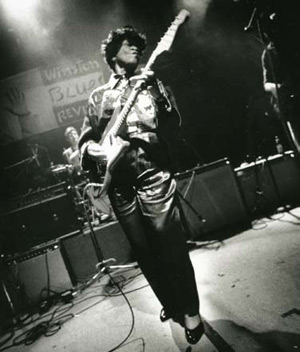
Beverly 'Guitar' Watkins - Back In Business

 From the current issue of Offbeat...

“When we were in our mothers’ wombs, God had decided what he wanted us to be,” says Beverly “Guitar” Watkins, “and he wanted me to be a musician.” Upon seeing the 74-year-old Watkins play fiery guitar solos—often with her guitar slung behind her head—over her hard-edged mix of blues and early rock and roll, it is hard to disagree with the Lord’s designation. Even after over 50 years in the music business, Watkins still sees music as a vocation rather than a job. “Blues is a feeling,” says Watkins, “and I’m grateful I’ve had a lot of opportunities to go out and share the blues.”

Watkins’ musical life began in ’40s rural Georgia, where she did not have much growing up. “We didn’t have electric lights in the country back in those days. We used kerosene lamps for light,” reflects Watkins. “The only thing we had to play was regular acoustic guitars and upright pianos, and we had to use a horse and wagon to get around.” Despite her underprivileged upbringing, Watkins’ aunt—also a musician—gave then eight-year-old Beverly a guitar to bring her into the family’s close relationship with music. “My granddaddy was a crop sharer, and there would be a big party called the bon dance whenever they finished getting the crops together,” says Watkins. “They’d have a banjo, washboards, and a fiddle. My granddaddy played banjo, and I’d go and sit beside him while he played.”
Watkins soon used music to begin establishing a career. “In my high-school days, I went on the road with Piano Red Perryman as a rhythm guitarist,” says Watkins. “His first band was Piano Red and the Meter Tones. We played around towns surrounding Atlanta.” Piano Red and his band soon found international fame behind the raucous hit “Dr. Feelgood,” its boisterous piano and driving rhythms an influence on Watkins’ music to this day. After the dissolution of the Meter Tones, Watkins continued to tour with various artists such as Eddie Tigner and opened for the likes of Ray Charles and James Brown.

Beverly "Guitar" Watkins, photo, OffBeat Magazine, October 2013Unfortunately, as Watkins entered the 1980s, she found herself playing to a continually shrinking community of devoted fans. However, Watkins experienced a renaissance in the late ’90s when she joined the Music Maker Relief Foundation’s stable of artists. Music Maker specializes in supporting struggling artists who perform roots music of the American South and, through the foundation, Watkins has been featured in several package tours, including the Winston’s Blues Revival tour and the Women of the Blues “Hot Mamas” tour. Joining Music Maker led to a dramatic career resurrection for Watkins, enabling her to tour around the world and—at age 60—release her debut solo album, Back in Business, in 1999. “With Music Maker, I’ve been to Paris, Italy, Australia, Argentina, and London,” says Watkins. “It just goes on and on.”
Watkins made her greatest comeback of all in 2005: fighting and beating lung cancer. “I am going on eight years as a lung-cancer survivor,” beams Watkins. While her battle for health sidelined her for a few years, she is thankful for a second chance. “This is a gift from God,” says Watkins, “and I thank him today.” She even views the experience as helping deepen her spirituality. “I give it all to the Lord,” says Watkins. “This has brought me closer to him.”
Upon remission, Watkins began to use music to give back to her community, playing in nursing homes and churches along with clubs and festivals in the Atlanta area. The revitalized Watkins soon enlisted the help of a new backing band, which she named the Meter Tones in honor of her past group. The band features like-minded members such as bassist Michael Petty, drummer Betsy Ann Dukes, a retired schoolteacher keyboardist simply named “Mojo,” and trumpeter John Perkinson, who played with Count Basie and also accompanies Watkins to teach music to schoolchildren through the Jazz Foundation. Using music to enrich others’ lives has also reconnected Watkins to her own roots. “My aunt had a group called the Haze Sisters, and they would play gospel in different churches in Georgia,” says Watkins. “I still play at Jonas Chapel in Commerce, Georgia every first and third Sunday.” Through beating the odds against cancer and a career revival, Watkins has learned that music means more than packing clubs; it is about serving something greater than oneself.
Since her comeback, Watkins has been the recipient of nine music awards, including a Grammy from Europe for her 2007 release, Don’t Mess With Miss Watkins. Despite being 74 with over 50 years of experience in the music industry, Watkins shows no signs of slowing down. “I’m going to play until the Lord says I’m through,” says Watkins. “Right now, I’m planning to get some stuff together and do another CD.” Even after decades in the business, Watkins is still excited about music and grateful for the opportunities it keeps presenting her. “I enjoy traveling and meeting different people,” says Watkins. “Playing keeps me going, keeps me motivated.”
 

Sunday, October 6, 2013

The Como Mamas - Get An Understanding

"The Como Mamas are a trio of gospel singers from Como, a tiny town in Panola County in northwestern Mississippi. Ester Mae Smith, Angela Taylor, and her sister Della Daniels have been singing together since they were children. The trio appeared on Daptone's excellent compilation Como Now, a collection of a cappella gospel tunes recorded and produced by Michael Reilly using Mount Mariah Church as a studio. The Como Mamas performed three selections on that set. Like its predecessor, Get an Understanding is recorded a cappella and was cut front-to-back in a single morning at the church. This trio of voices provides more than enough sound for any listener; musical instruments would have been an intrusion. The throaty, raspy vocals of Smith lead the group's; her voice is earthshaking in its intensity; its expression one of coming right through the heart of worldly hardship -- aka the blues -- and plowing right on through it to the glory of the heavens. Taylor and Daniels voices provide pronounced rhythms, soulful harmonies, affirmative cadences, proclamations, and exhortations that push Smith's own conviction ever forward, through the lyrics and into the world of sound itself. Well-known spirituals "Peace of Mind," "Meet Me at the River Jordan," "I Know It Was the Blood," and "Soon I Will Be Done" are rendered with grainy rawness and stylistic panache, and embody not merely the history of Black gospel, but also the blues and rhythm & blues. No matter one's spiritual beliefs -- or lack of them -- she would have to have sawdust in her veins in place of blood not to be deeply moved by what is on display here. The term "soul stirring" doesn't begin to touch it. For those who seek the sounds of traditional gospel, à la Dorothy Love Coates and Clara Ward, or have been curious about gospel at its best, Get an Understanding is for you." Thom Jurek, AMG

Saturday, October 5, 2013

Ray Agee - Vol 2, Somebody Messed Up

Yup, the same cover with a different title - this set too is 18 tracks and a bit different from the actual pictured LP but it does include the title track and most of that record, the rest is on part one.

The truth is, I've kind of jumped the gun here with these 2 sets since I've already discovered more tracks and Cliff has discovered that three of the tracks identified in the Blues Discography as being from 1965 are in fact from the 70's. That has resulted in my relabeling and reshuffling here at home and Cliff has ordered even more on disc so we will likely revisit Mr. Agee in a month or two, but these uploads were already done and the two sets still represent the most Agee ever offered on the web.

The more I am immersed in this stuff the more impressed I am with this guy. He really SHOULD be in that first sentence about the West Coast blues scene with Percy Mayfield, Charles Brown, Lowell Fulson, and T-Bone Walker. The songs and music are first rate and he is a really cool singer who mixed rock and then soul into his music really effortlessly. The dizzying array of labels and his near total obscurity speak to the idea that he never developed much of a following, but it also seems clear that the record men heard what I do because he kept getting recorded. I'm also thinking that he must have been at least somewhat successful on the jukeboxes of the black clubs to have managed so many singles (more than 120 songs) and a twenty five year career.

Wednesday, October 2, 2013

Freddy King - Blues Guitar Hero Vol 2

This is my second post of the Federal/King recordings of the "Texas Cannonball" Freddy King, compiled on the quality Ace (UK) label. Here we have more of his best vocal and instrumental recordings and some rare alternate takes from the period 1961 to 1966.
Originally from Texas, Freddy moved to Chicago in 1950 and proceeded to hone his craft in the local club scene. As a young buck he became associated with the Chicago West Side school of blues guitarists along with Magic Sam, Otis Rush, Luther Allison, Eddy Clearwater and others.  At this time, during the late 1950's and early 1960's these artists were seen as the 'new thing' .
He was not signed by the famous Chess Records group as they believed his style was too close to the master B B King. Hence his signing to Federal/King where he would travel to Cincinnatti to make recordings under the supervision of pianist/producer Sonny Thompson,
So here are 24 recordings from that period and the sub-title 'Influential' is no empty claim. Freddie became a Blues hero around the world. Unfortunately Freddy was to have a short life and was dead at age 42 due to acute pancreatitis.
'Freddy' changed the spelling of his first name to 'Freddie' for his next recordings on the Cotillion/Atlantic label and I shall post these in the near future. Meanwhile enjoy the great guitar and wailing vocals of a Blues Master !!!